Welcome to Paula's Primary Classroom! This blog is where I share ideas for teaching and learning with families, friends and other early childhood educators. Please don't use the photos or text of this blog without permission, but please do use any ideas you find useful. Thank you for stopping by!
Showing posts with label STEM. Show all posts

Thursday, August 14, 2014

Pine cone science

Have you ever noticed that pine cones that start out closed and green on the tree, fall, dry out, and open?  Or that after they get wet, they close back up?  I have some dry old pine cones in my yard for the children to play with, so when I found a bunch of closed green pine cones while walking this morning, I gathered them and brought them home.  Instant science lesson!

 Here are two of the "new" pine cones - including one that has just started to open.
 Here's an "old" dry one, with all it's scales wide open.
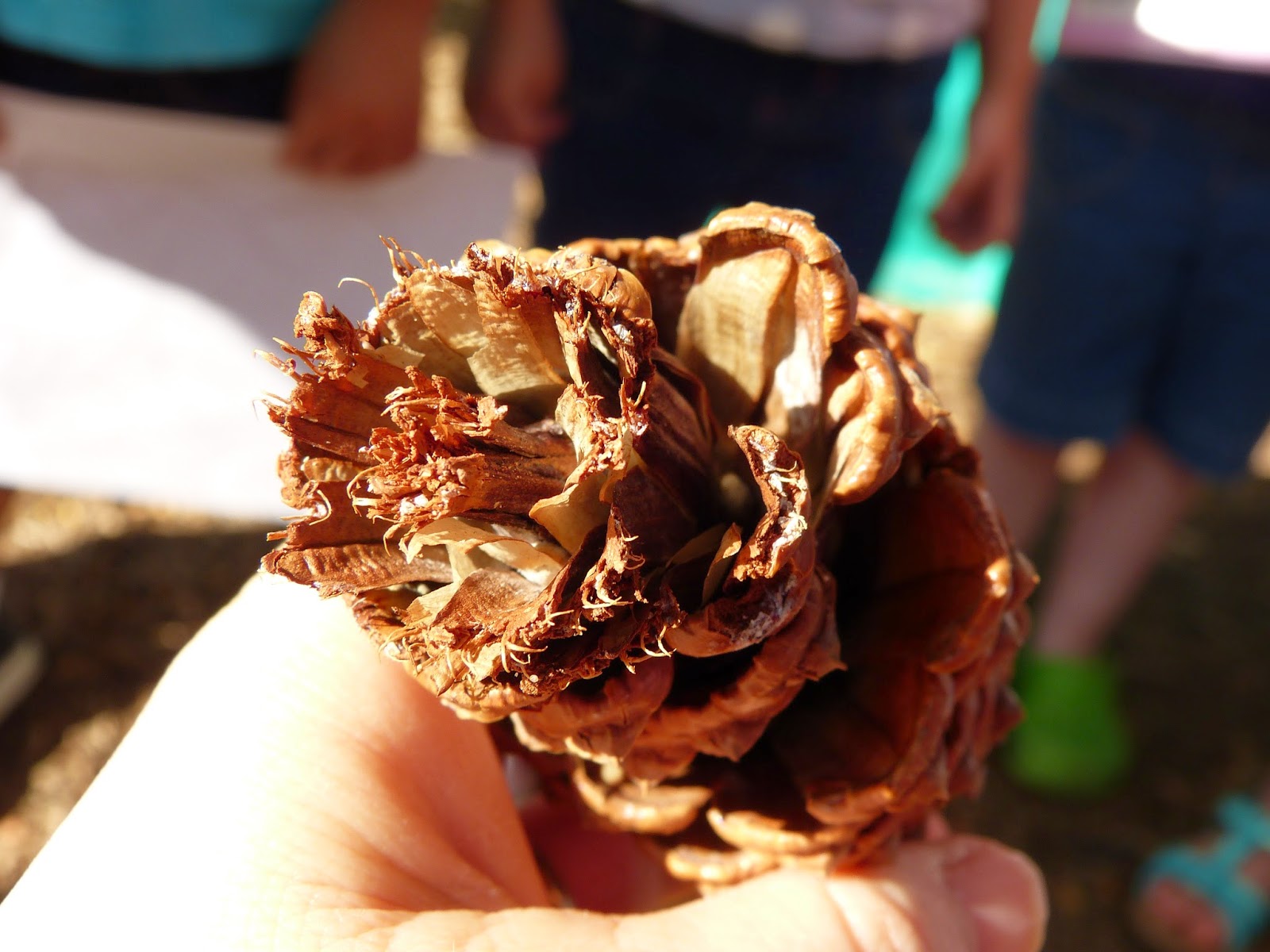
 When we looked carefully, we could still see many of the seeds in the partly opened pine cone - the little papery looking "wings" laying inside each scale.
We gently pulled some of the seeds out, and after someone accidentally dropped one, and saw how it spiraled to the ground, several children enjoyed dropping the seeds.
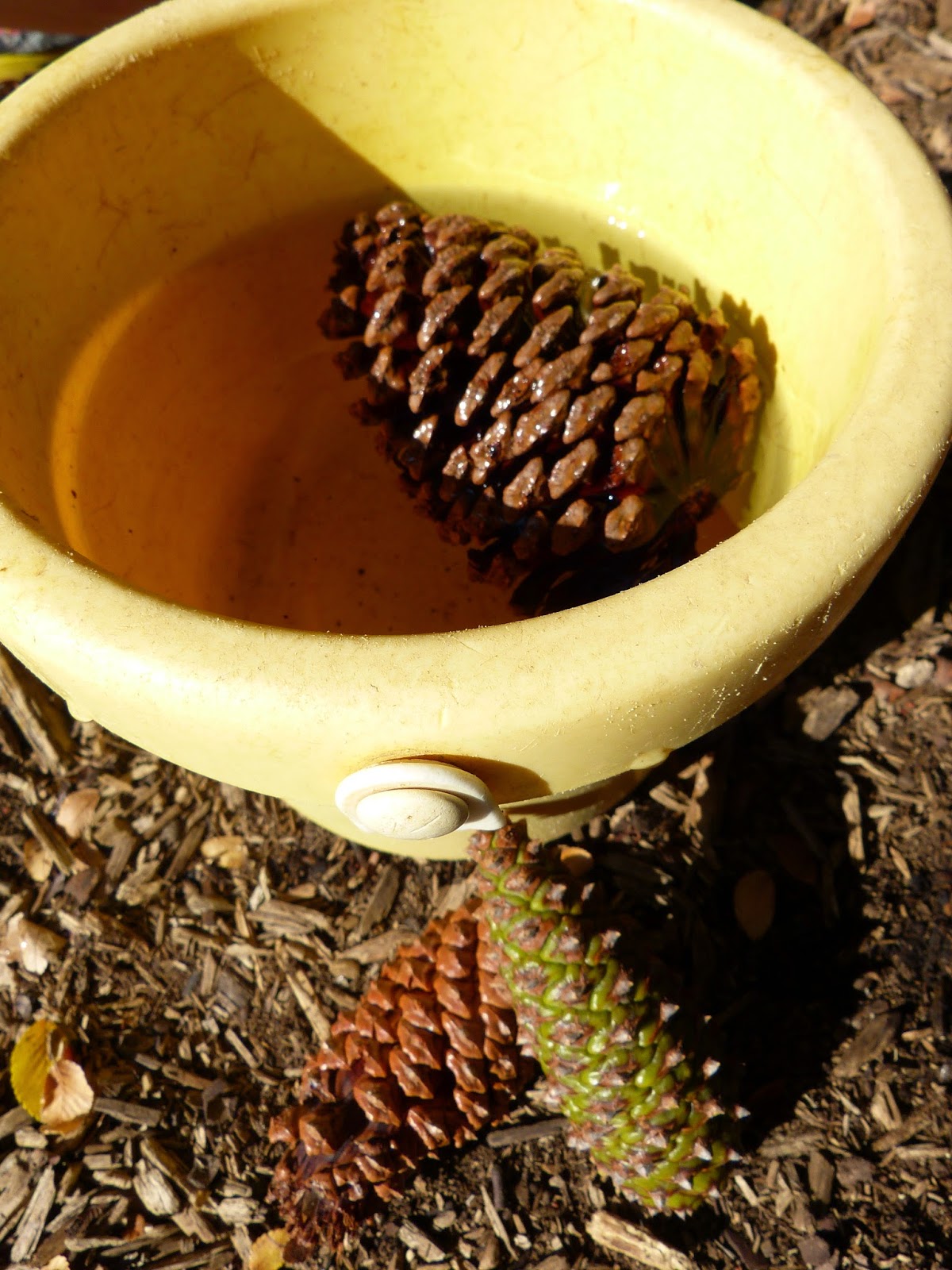
Next, we set up our experiment.   We put the dry pine cone (shown in the second picture of this post) into a bucket of water.

Two children wanted to plant their pine cone seeds, one at home, but the other was ready to plant right away. I took her to a pot of soil, and she made a small hole for her seed...
 ...dropped it in, and covered it...
 ...carried over  a watering can...
 ... and got her seed started!  I labelled it, so we can see how long it takes to germinate.  She predicted that it will take "a long time," but then sat and watched it for a few moments before heading off to play.

About 30 minutes later we went back to the "dry" pine cone in the bucket of water.  Check it out!
So do you wonder why this happens?  Here's an excerpt from an online article from
http://www.utsandiego.com/news, written by staff writer Katie Burns:

"Q: Why do pine cones open when warm and dry and close when cold and wet?

A: "There are actually male and female pine cones," said Betsy Read, a biology professor at Cal State San Marcos. "The female pine cone is the one we are most familiar with that opens and closes. The opening and closing of the cone is part of the life cycle of the pine."
The male pine cone, which is small and bumpy, produces pollen. Wind-blown pollen falls on a female pine cone on either the same tree or another tree. Over the course of a few years, seeds develop under the scales of the female cone. The female pine cone opens when the seeds are mature and the conditions are right.

"The reason why the pine cones open when it's warm and dry is because that's a more favorable condition for the seed dispersal and germination," Read said.
Wet and cold weather would prevent the seeds, which are often winged, from spreading far enough from the tree to find a place to grow. Seedlings also wouldn't last long in winter rain or snow.
After a pine cone falls from the tree, it can still open and close. The scales open when dry because their outer halves shrink more than their inner halves, and they pull away from the cone. When wet, the scales swell shut."


We pulled our closed, wet pine cone out of the water, and admired it.  I asked the children what would happen to it now.  They all agreed it would probably dry out, and open again.  I wanted to put it somewhere that no-one would bother it, but we could all observe it, so I put it a few feet behind a fence, in the sun.

 Here it is six hours later...
It's now the following day, and it has hardly changed at all.  How long will it take to dry out completely?  I don't know - but I'll keep you posted!

Tuesday, August 5, 2014

Accidental Bubble Science

In a recent post, I wrote about STEM learning, and claimed that the preschool kiddos are natural scientists.  Today they did an awesome job of demonstrating the curiosity and experimentation that scientists participate in, and reformed their ideas about the world based on what they observed.  

I set up a shallow water table with bubble wands and solution, and it happened to be near both the misters and a plastic picnic table.  The table was damp from the misters, so when a few clusters of bubbles landed on the table, they didn't pop - until helped along by the children.
 When the bubbles were popped they turned to a foamy mess, which reminded the children of the shaving cream we sometimes use to clean the tables inside - so a couple of kiddos set to work cleaning the table with bubble foam.
 Meantime, at the bubble play table, one of the children made an accidental discovery: he could put a bubble wand right through a large bubble, without it breaking.  Woah!  Two separate incidences of bubbles NOT BREAKING, when usually they burst so easily.
 Several children started poking at the large bubble, trying to replicate the results - as good scientists do. 

 One child, examining the large bubbles carefully for what must have been the first time, was fascinated by the way rainbow colors swirled and moved in the bubble.  He noticed that the colors faded as the bubble grew older.
The children who had been spreading bubble foam on the table were also interested, and I suggested they try making big bubbles on the table.
 "Why aren't they popping," I prompted.  The girls were sure it was because of the soap on the table.  I suggested we rinse off the soap, and see what would happen.  They took turns helping pour the watering can out on the table, and then tried blowing more bubbles.
 They held bubbles in their hands - and they didn't pop.
 They blew bubbles on the wet (but no longer soapy) table, and they didn't pop.  I was really hoping someone would suggest the bubbles didn't pop because the table was wet... but no.  I was informed that there must have still been some soap on the table, at least from the new bubbles.
 It was really hard to do, but I let them move on with their experiment in their own way.  They didn't want to figure out why the bubbles didn't pop any more - they had turned back into children, enjoying the moment of making big bubbles on a beautiful day. 
Even scientists have to stop and blow bubbles sometimes!

Wednesday, July 23, 2014

STEM learning outside

STEM learning (Science, Technology, Engineering and Math) is something many people in education are talking about right now.  According to the STEM Education Coalition:

"The central mission of the STEM Education Coalition is to inform federal and state policymakers on the critical role that science, technology, engineering, and mathematics (STEM) education plays in U.S. competitiveness and future economic prosperity."


It's easy to see the importance and relevance of these subject at a high school or even junior high school level, but what does it look like in preschool?  What kind of engineering tasks can a 3 year old do?  Before they learn to read and to think logically, what kind of technology, science or math can a child be expected to know or to learn?  Is it even relevant at this age?

Yes!  Our children are capable and interested, if only we provide opportunities for them to explore.  I'm not an expert, but with 20 years experience working with young children, I have some ideas to bring to the table.  Here are some photos and quotes from the kiddos this week, about building with pipes.

I provided 12" sections of 1/2"plumbing pipe, and a variety of connectors.  At first I simply provided the materials at the water table, and stood back to see what would happen...


At first the kiddos tried a lot of things that obviously (to adult eyes) wouldn't work, like sticking two connectors to each other.

Slowly their creations took shape at the water table.
As the kids seemed intent on pouring water into the tubes, I tried making a gadget with a sloping pipe, and again, stood back to watch what would happen.  Sure enough, someone tried pouring water into it.
The water came out of the bottom of the tube!
Soon the children tried more pouring options, and collection containers were set up at the end of the pipe.
The kiddos cooperated to meet their goal: pouring water through the tube and catching it again at the end.
A toy watering can with a spout shaped mouth turned out to work better at directing the flow of water into the small pipe opening.
The collection bucket was full to overflowing.


Another day we used the pipes dry, on the driveway.  At first the kiddos built a structure together.
This is "The Statue of Liberty!"


Can you catch the water spraying up from the mister, if the pipe is also sloped upwards?  How can you find out?

"Abracadabra!"
"Look at my contraption.  It's a water pipe trap thing."

"A plunger!"

Later in the day we also had pipe telescopes, umbrellas and guitars... all kinds of creative play inspired by a couple of pieces of plumbing.  

Yes, preschool children are indeed scientists and creators.  By playing with the pipes and connectors, they figured out how to join them together to create structures.  They named their creations after objects they resembled, and found ways to play with them.  The children cooperated to achieve mutual goals, and experimented with ways to pour and move water, modifying their structures to reflect their discoveries.  This was science and engineering learning, at a preschool level.  (But please don't tell the children, they just think we were having fun!)