I love teaching and learning with young children, this is where I share my ideas.
Welcome to Paula's Primary Classroom! This blog is where I share ideas for teaching and learning with families, friends and other early childhood educators. Please don't use the photos or text of this blog without permission, but please do use any ideas you find useful. Thank you for stopping by!
It's almost December, so we're going to skip ahead a few letters - because rocking December with Rudolph really is remarkable!
Have you sung the reindeer version of Head, Shoulders, Knees and Toes: Hooves, Belly, Antlers, Nose ?
It's so much fun!
There's also our Rudolph hand print, inspired by HandprintCreations.com and funhandprintartblog.com. I found the robin idea at creatingreallyawesomefunthings.com , the rocket at CraftyCrafted,
and I think I came up with the raccoon myself... but it's been a long
time, and it's so hard to remember! There are also other reindeer hand
prints on my handprint Pinterest board if you want to check them out.
The Rudolph hand and foot print ornament included below is one of my all time favorite preschool Christmas crafts!
I did this every year when my children were little, and have a progression of Rudolphs, slightly bigger each year as the children's hands and feet grew. Please please, when you do these crafts make sure you put your child's name and the year on the back, I promise you'll treasure them all the more for it!
The fun What's Up Rudolph? craft was inspired by this one on Artsonia. If you haven't visited Artsonia yet, why not?! It's a free site, full of wonderful art ideas for children of all ages, and it allows teachers to safely upload children's art into an online gallery. Parents can even order merchandise with their child's artwork on it!
For this project the children cut out rectangles, triangles and circles, then assembled their projects. It was a great fine motor / scissor skill activity, and they were thrilled that the results look so lovely!
Our letter R craft also incorporates Rudolph the red nosed reindeer, because the children absolutely remember the sound to associate with the letter this way!
Finally, I wrote a short song about the names of all the reindeer! You can see it on YouTube,
Here we are in late fall, looking at letter Ll - it's time for a leaf pile! Playing in leaves has kept my kiddos busy for months every year, and it never seems to get old to them - or to me!
Leafy learning certainly starts outside - watching the changing of the seasons, seeing leaves change color and beginning to fall, playing in leaf piles - but it doesn't have to stay outside! It's fun to take leaves into the classroom and to sort them by shape, size or color, to make leaf rubbings, to graph the colors of the leaves we've collected, and more. (I created printables for these activities, which are available in my TeachersPayTeachers store.)
I like to start our letter explorations with lots of items that start with our focus letter, so for Ll I collected ladybugs, lizards, lobsters, lunch lady, lightening, lions, lemons and more in a Lion King gift bag, and had the children take turns to pull them out and name each item.
We lay on the floor and measured ourselves with lovely long lines of
lace - to see whether we were longer or the lace was longer.
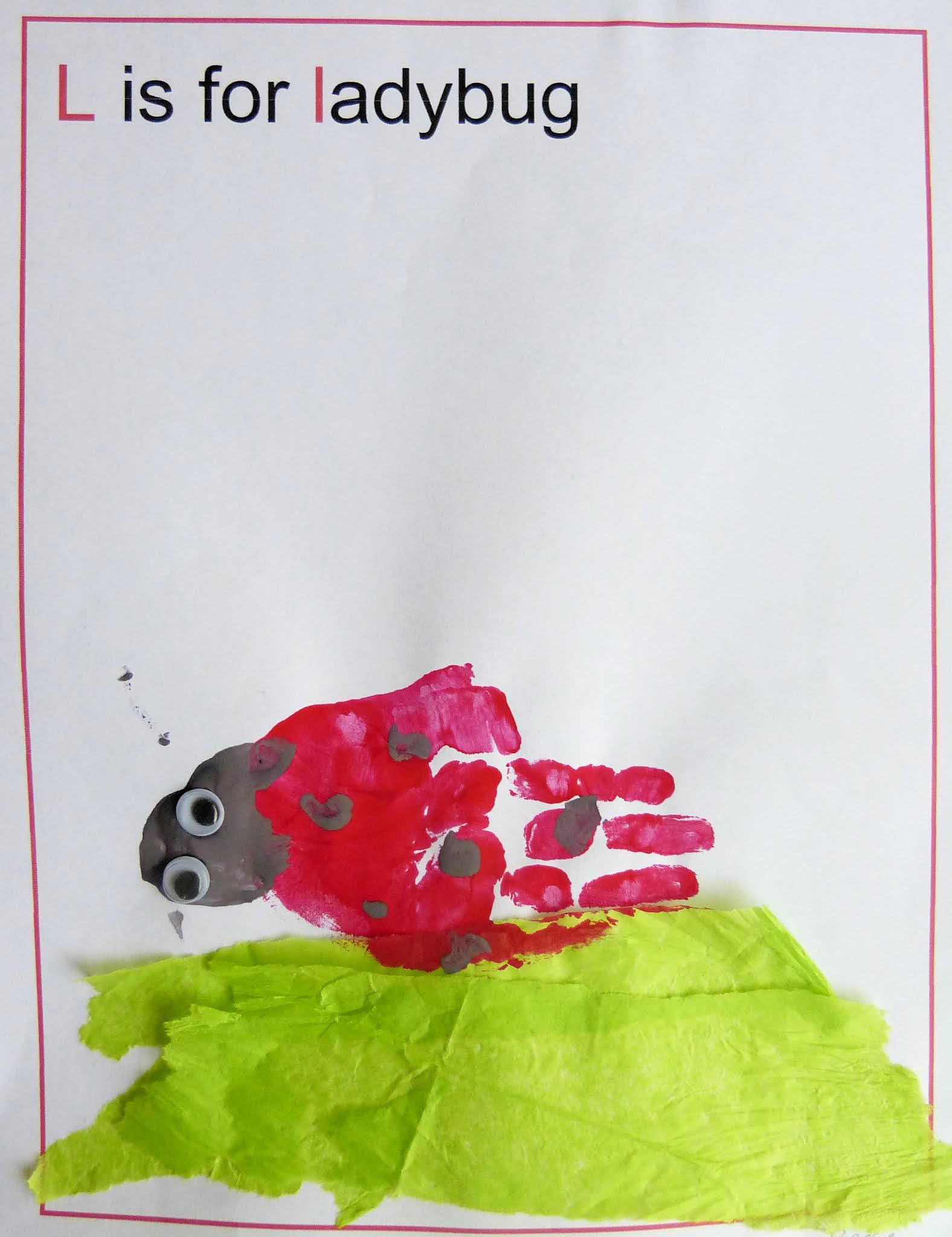
For some hand print fun, we made lions or ladybugs - we think they're lovely!
Another fun L word is lamb - so we replaced Mary with our own names and sang Mary Had a Little Lamb as we snuggled a stuffed animal lamb (or a leopard, because that's fun too)! I typed out the words for each child's version of the song, and they highlighted all the Ll letters they could find, then made it into a class book so we could read it over and again. These pages are included in my Class Books Bundle.
Do you know the song Lavender's Blue? This is a perfect week to learn it if you don't already know it!
By now you probably know I like to do a letter craft with the children too, and of course we made both upper and lower case letter Ll. We put ladybugs and leaves on logs for the upper case letter, and glued on lace for the lowercase letter.
You could also do a directed drawing of a lion. It's amazing what little children can manage when you break something down into tiny steps for them! We made our drawings in pencil, then went over the lines with black or dark brown crayon, then finally painted with shades of orange and brown.
I hope you have fun learning with the letter L this week! Which activity does your child like the most? I'd love to hear from you!
Here we are in October, looking at the letter Gg - which is GREAT because gourds, goblins, ghosts and googly eyes are all over the place in the weeks before Halloween! Shall we get going?!
Let's start with one of my all time favorite letter G activities: reading Go Away, Big Green Monster by Ed Emberly, and making our own Big Green Monsters. I've blogged about it here before, but in case you missed it, Big Green Monster disappears one feature at a time as you turn the pages of the book. I love to have my students paint a big green blob face, and add the features on as we reread the book in a small group. Not only are we rereading the book, the children really learn the sequence of the story, and can retell it with me (and without me)! There are lots of color words, and plenty of chances for expressive reading!
Another favorite letter G activity is our Googly Eye pictures and class book!
Chocolate + being silly + sticking out our tongues + taking photos = fun!
This next idea is one I haven't talked about before: making shoe box guitars. A quick YouTube search found this really cool video, and clearly I'm not going to do it better than PlayKids did! Check it out!
My area to shine is singing silly songs, and this is one my grandmother sang to me:
Do YOU know any little girls like this? ;-)
Want to play games to practice listening for the letter Gg? Check this hands on activity pack out in my TeachersPayTeachers store!
Making hand prints for each letter is a tradition at my preschool, so here are some fun ideas: ghosts, gorillas, and giraffes! Notice that the g in giraffe makes a different sound than it does in the other pictures, and talk about it with your little one. This is the 'soft g' sound, which sounds more like J. Sometimes letters are tricky!
How about cooking? Are you and your little ones enjoying time in the kitchen each week? Cooking involves lots of math concepts like measuring, counting, temperatures and time, so it's a natural way to include math in your days - and even more importantly, as your child learns to cook they are developing life skills! Consider making grilled cheese sandwiches for the letter Gg: your child can spread butter on the bread, and stack the bread and cheese ready to cook. You'll want to do the cooking part until your little ones are old enough to avoid getting burned - but while you're doing that, they can put grapes (another great G food) on the plates, and set the table with the right number of napkins for everyone who is eating.
Not a grilled cheese fan? Do you like Green Eggs and Ham?
A little green food coloring can change a meal into a book adventure! Add it to your eggs before cooking, and if you fry up some ham, add green food coloring in a little water, and cook it off - the ham will stay green!
It wouldn't be letter Gg week without getting out the glitter glue! Does your little prefer green or gold? Is it goopy? Or gooey? Either way, it sure is great!
Finally, I'll leave you with a simple craft project that will have your child talking about primary colors (red, yellow, blue), shapes (circles, squares, rectangles) and counting (gumballs).
Have a good, great, gorgeous week! See you next week for the letter Hh!
Are you feeling fabulous about Ff - and all the other letters so far? Preschool learning (and teaching!) is so much fun! Let's jump in and get started!
Make Friendship Fruit Salad
This is the easiest cooking activity EVER! Each year for the letter Ff I would ask each family to send in 1 piece of fruit. No need to assign apples here and bananas there - it truly doesn't matter which fruits you have, or what quantities! This is friendship fruit salad after all - we get to share the making and the eating with our friends.
Since fruit salad also doesn't need any actual cooking, the children can do all the steps! The first part of cooking is ALWAYS washing our hands. The children also washed their fruit, and then used butter knives to cut it up into small pieces. (I do core the apples and pears, and quarter them). Most fruit is soft enough that it is easy to cut with a butter knife, and this is a good time to teach children how to hold the fruit with one hand, and hold the knife with the other. Have a look at these little hands - they all have their index fingers pointed along the knife to help apply pressure, and their fingers safely back from the knife. This is a great early introduction to cutting, and lays the foundation for bigger cooking projects down the road.
Did I mention the eating part? Fruit salad is a healthy snack, and if you and your friends made it together, you know they all want to try it! There's seldom any left over either - this tasty treat gets gobbled right up!
Finding things that start with Ff in our feely box
I'm going to start with the classroom version of a feely box, but I also have a super easy at home version. If you're going to be teaching the letter Ff to a big group of children year after year you might prefer something more sturdy and more educational than if you're teaching your own child only.
My feely box for Ff was a shoe box in a previous life... until I covered it with flower photos, and lined it with fake fur, and filled it with fences, fires, flies, frogs and everything else I could find that starts with Ff.
Here we are taking turns reaching in and finding things that start with Ff to put next to our letter F, all the while making the f sound.
The at home super easy version of the feely box is just that - super easy!
Field trips
I've said it innumerable times, but I'll keep on saying it: children learn best through hands on experiences. If you can get out and explore the world, do. Talk about everything you're seeing, smelling, tasting, touching, hearing and thinking! Your child will learn the big words and big ideas you share with them, and you'll both have fun.
For the letter F some of my favorite suggestions are to go to a farm, see flamingos at the zoo, look for fish and frogs (at an aquarium or zoo, or at the pond), find a fountain and flowers at the botanical gardens. No botanical garden near you? Find a flower shop or just a pretty park! What other field trip ideas can you think of?
Fun on the farm from home
Even if you can't get to a real farm, you can bring out farm themed learning! Do you have a toy farm, or toy farm animals? Let your child sort them, or order them in height. Count how many horses - and find out if there are more sheep or cows.
I'm a huge fan of tangram puzzles, and have an adorable farm set that makes practicing shapes fun.
Make the letter F for your home-made alphabet.
Want to know a secret? It's not SO secret... but I had no idea what I was doing on a lot of my letter crafts when I first decided to do it. I'd seen a few ideas for some letters, and decided to go for the whole alphabet, but.... what to do? That's why the lower case letter f looks like I got into my craft supplies and found everything I could that starts with f: flowers, flamingos and feathers. The bits and bobs you have on hand, left over from long ago craft projects are GOLD to your child. Please don't feel like you have to reproduce someone else's ideas exactly, just do what works for you and your child. :-)
My upper case letter F started with a die cut frog years ago, and that was it - until I saw some plastic flies one Halloween, and bought up a teacher life time supply of them. The frog tongue has been a strip of paper, or a piece of ribbon - either way, our froggy is catching a fly, and it works. For more frog learning activities, hop over to my TeachersPayTeachers store here.
Sing songs
Have you caught on that this is an every week activity? There are always songs to sing, you can do it anywhere, it's free, and it makes you feel good. Let's sing!
That's enough to keep you and your little one super busy for about a month - but I have more letter Ff ideas, so come back on Wednesday for hand prints, a sensory bin, and some very silly fish hats! Until then, enjoy, and remember to tag me if you post about doing any of these activities on social media!
@paulabeckerman2399 on Instagram and Paula's Primary Classroom on FaceBook.
Welcome to part 2 of letter Bb preschool activities you can do at home or at school! In the last installment I talked about baking bread, going on a bear hunt, enjoying a teddy bears' picnic, and lots of fun backyard activities you and your child will love. Let's explore even more ideas today!
Activity 1: Songs
You had to know there would be songs! You probably already know Take Me Out to the Ball Game, and if you do, you might even have a baseball bat and ball you and your littles can enjoy. Here are two more letter Bb songs:
Activity #2: This week's hand (and foot!) print ideas are a bumble bee, bear, and butterfly. Bea-u-ti-ful!
Last week some of you shared your hand print creations with me on
Instagram 💗💗💗💗💗! I
would LOVE to see how you and your littles use any or all of these
learning activities! Please tag me @paulabeckerman2399, or leave
comments on this blog - it absolutely makes my day!
Activity #3: Make binoculars
You'll need 2 paper tubes, a sheet of paper, a hole punch, and about 18' of yarn.
Start by measuring the length of your paper tubes, and cutting your sheet of paper to that width - keep all the length. You'll have a long rectangle. Tape or glue it to one of the paper tubes, carefully lining it up the ends of the tube and the paper. Wrap it around both tubes, then tape or glue it in place. (Remember, your little one can do the taping and gluing, only help with the parts they can't do well, and always let them do as much as they can!)
Use the hole punch (this part is probably too difficult for your child) to punch one hole on the outside of each tube. Thread the yarn through and tie the ends so your child can put the binoculars around their neck. It's fun to look through the binoculars to look for things that start with the letter B!
Activity #4 Butterfly paintings
You probably remember doing something like this when you were little: fold a paper in half, apply paint to one side, fold the paper shut, smush it, then open it again to find a symmetrical painting. I recommend having plenty of paper on hand, because most children LOVE the magic of this simple activity.
This is a great time to introduce the word symmetrical - being the same on both sides. It's a great word, and once they start looking they'll notice LOTS of things are symmetrical: their face, many doors, lamps, the fireplace, the tv, the couch and more! If they ask - and someone's child will ask - things that are not symmetrical are asymmetrical.
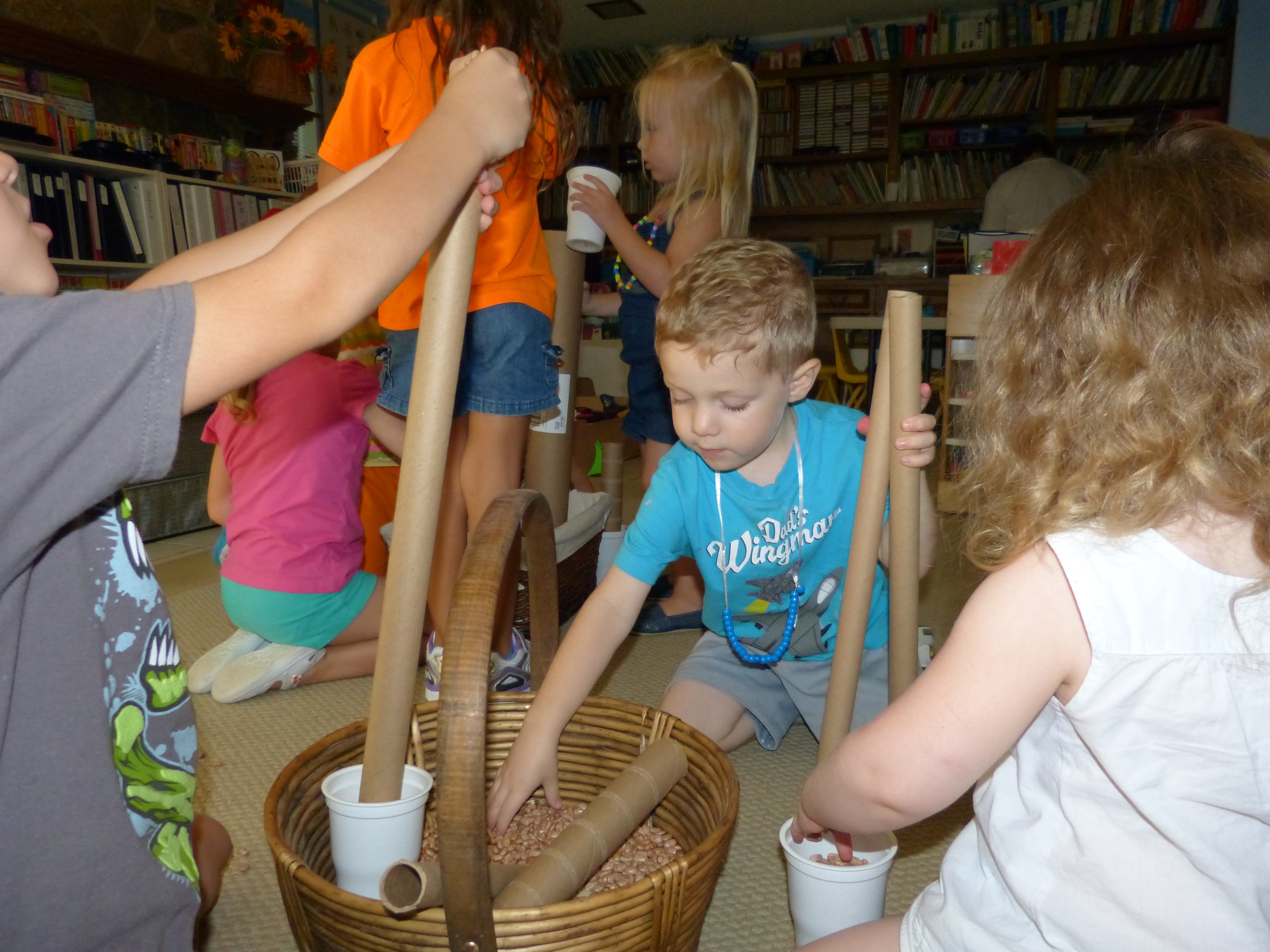
Activity #5 Sensory play with a basket of beads / buttons / dry beans.
A lot of children really enjoy sensory play. Just running your hands through a bowl of beads feels marvelous, and this is something our children don't get to enjoy often enough. Sensory play can include water play, mud and sand play, soft animals, finger painting, smelling jars and much more - all staples of early childhood learning. You can connect sensory play to letter learning by choosing materials that start with your focus letter, such as beads, buttons, or dry beans.
Sensory play can get very messy - children are scientists who explore the world with wild abandon, and don't always keep materials in a container as parents and teachers might wish. There are some easy ways to make sensory play a happier experience for both you and your child:
1. Know it will get messy to some degree, and put this kind of material out when you have the time and patience to deal with it. Stay close enough to supervise and redirect if your child starts throwing small pieces all over. Make sure they know your expectations (Do you them to keep the materials in or near the container? Do you expect them to help pick it up afterwards? Is there a time limit on how long you can keep it available?)
2. Place your sensory bin on a large towel or sheet, so when they're done most of the materials can easily be scooped back into the bin.
3. Consider taking water, sand and dry food materials outside to play, where clean up is easier. I used to buy feed corn for our outside sensory bin, and whatever we didn't clean up, the squirrels would take care of.
4. Consider the ages and stages of your child(ren) and make sure materials won't be a choking hazard.
5. If the materials don't offer a way to play, your children will invent something - so put in a couple of scoops or bowls for them to fill, add some toys to hide and dig up, or add a favorite bath toy - the kind you pour water through - so they can pour materials through it. Bored children WILL find a way to be entertained.
Activity #6: Letter Bb crafts
When I taught preschool one of our weekly activities was to cut out both the upper and lower case letter of the week, and to decorate them with things that represented the letter. I had a copy of our alphabet letters posted along the top of the wall, and many of my students put their letters up on their bedroom walls and created their own alphabet wall at home. These activities evolved over time, and your letters don't have to look like mine - there are many right ways of doing things in this world! I'll share my ideas with you, but if there is something that is more meaningful to you and your child, do that instead. I've taught a lot of children, and know a fair amount about early childhood education - but YOU know YOUR child best.
B is for butterfly. You (or your child) can draw or cut out an upper case letter B from a piece of construction or printer paper. Notice how the top and bottom half of the B are symmetrical? Remember our symmetrical butterfly painting? How could your child turn their B into a symmetrical butterfly? We glued on shapes, and I guided children to find 2 of each shape, and to place one on the top and one on the bottom of the B. A pipe cleaner bent in half, with the ends curled around my fingers make simple antennas, which we stapled on. If your child wants to add a couple of wiggly eyes, or long thin oval to represent the butterfly's body, go for it!
b is for bat and ball. When I was in kindergarten Mrs. Potts taught us "first the bat and then the ball for b" - and it stuck with me. I could tell the difference between b and d because d was "first the dog and then its tail". Thank you to Mrs. Potts, my students made their letter b crafts with a paper baseball bat and paper baseball, and I printed the words on it so they and their parents would remember.
If your child is starting to pay attention to letters, and enjoys coloring, you may like this FREE activity to practice Bb, Cc and Dd. Please follow their lead on what is enjoyable - the most important thing they're learning in preschool and kindergarten is that learning is FUN! We're setting the stage for their attitude towards school for the rest of their life - that's a big responsibility! If they don't want to color or do worksheets, please don't make them.
Most of the resources I make for preschool and early kindergarten are games. If you want more play based learning activities, I'd love for you to check out my resources on TeachersPayTeachers - and no, you don't have to be a school teacher to use the site, parents are teachers too!
Thank you for reading all the way through. I really would love to know how you're using these ideas! Let me know in the comments, or tag me on Instagram: @PaulaBeckerman2399 . See you next week for the letter Cc!
I've always sung with and to my kiddos. Sweet songs, silly songs, classroom management songs, things we make up as we go - they're all part of the sound track of childhood. Recently I've started recording short videos of me singing some of my favorites, and posting them to social media. If you have a little one (or two or three or twelve), I hope you'll check them out!
This one is "Down by the Banks of the Hanky Panky," a fun knee bounce rhyme for babies and toddlers.
Did you know there's such a thing as Talk Like A Pirate Day? It's celebrated (okay, that may be stretching the truth) on September 19th each year. Now I don't know about you, but I'm all for dressing up, painting a beard on my face, and talking funny like a pirate, especially if I can say I'm doing it for work, for the children. Who's to say I'm not?
I've found pirate learning to be a great match for learning the letter X - after all, X marks the spot, but isn't used for a whole lot else that makes sense to little kids. As you can see my students enjoyed eye patches, cardboard hats (I found both of these at the dollar store), and stick on mustaches or tempera paint beards. Add in a toy pirate ship, some inexpensive compasses and beads, and some cardboard "bones", and you have the making of letter study and pretend play.
I blogged about pirate learning several years ago, and included photos of some of the other pirate learning we've done: digging for treasure in the sensory bin, walking the plank (literally a plank on the floor!), costume play, and crafts.
Since then I've created many pirate themed resources to bring a pirate theme to measurement, reading, addition and subtraction, counting money, patterns, and numbers to 100. If you're looking for some quick pirate themed lessons, I hope you'll check them out.
I've also gathered lots of pirate ideas on my Pinterest board - you can check that out here:
Finally, I thought I'd share some fun pirate videos that are targeted at the preschool - primary grade crowd. These will get your students in the mood for pirate fun! My students loved to dance along to Portside Pirates and to Jack Hartmann's Silly Pirate Song - and they make great brain breaks. Want to talk about addition? Try Harry Kindergarten's When You Add with a Pirate. Ready for a silly story that will have the kiddos giggling? Try Pirates Love Underpants!
That's it fer now, me hearties, ye've got some pirating to do now!
I love teaching the letters R and S in December - between Rudolph and Santa, there's plenty of awesome activities, books and crafts, and the children are so eager to do them all! Today I thought I'd share just a few of our favorite Rudolph activities, besides reading the Classic book by Robert May and singing the Christmas carol that almost everyone knows.
Another fun song for the preschool and kindergarten crowd is a variation on Head and Shoulders: Hooves, Belly, Antlers, Nose. I found an adorable video of children singing it here, your kiddos will quickly make it their own! I like to add a red sticky dot to the children's noses when we sing this one - and it makes a really cute picture for their families!
You've probably seen the painted hand print reindeer included in my photo above, I recently found a version via pinterest that also included Santa in his sleigh - that's one to try this year! While some children aren't eager to have their hands or feet painted, I've found that most do warm up to the idea, and then enjoy the tickly sensation of the wet paint brush on their hands. It's a fun sensory experience, and a quick one on one time with a teacher - hand prints are one of our favorites!
I've also made the construction paper hand and foot print reindeers for... well, for ever! I began making these with my preschoolers when my own children were tiny, and each year I still bring out these treasured ornaments - we have a slew of them, one for each year that the boys would still go for it, showing their hands and feet growing incrementally year after year. These make fantastic gifts for parents, and trust me, even if they have had one every year since their children were born, they'll be thrilled to have another! (Teacher tip: trace the children's hands a day or two before you want the children to assemble the reindeer, so you can cut them out. Nap time is a great time to sit and prep for this!)
I wish I could claim the Surprised Rudolph idea as my own, but the idea came from a faithful attempt. She in turn found her inspiration on Artsonia.com. Have you met Artsonia yet? Check out our school gallery, then look around at all the other amazing lesson plans that are there to inspire you! This cute project not only looks adorable, but gives the children a lot of fine motor practice with scissors
and glue,
plus tracing around a circle shape, and talking about squares, triangles, rectangles and positional words.
That's a lot of learning for a holiday decoration!
Let me know if you have some other fun reindeer activities to share - I'm always on the look out for more fun learning ideas!
Today I'd like to share our morning routine with you. My school is in my home, and I've created a combination preschool, kindergarten, and home child-care. Children arrive any time after 7:30am, we eat breakfast around 8 am, and by 8:30 we're ready to learn. This is how we start the structured learning part of each day.
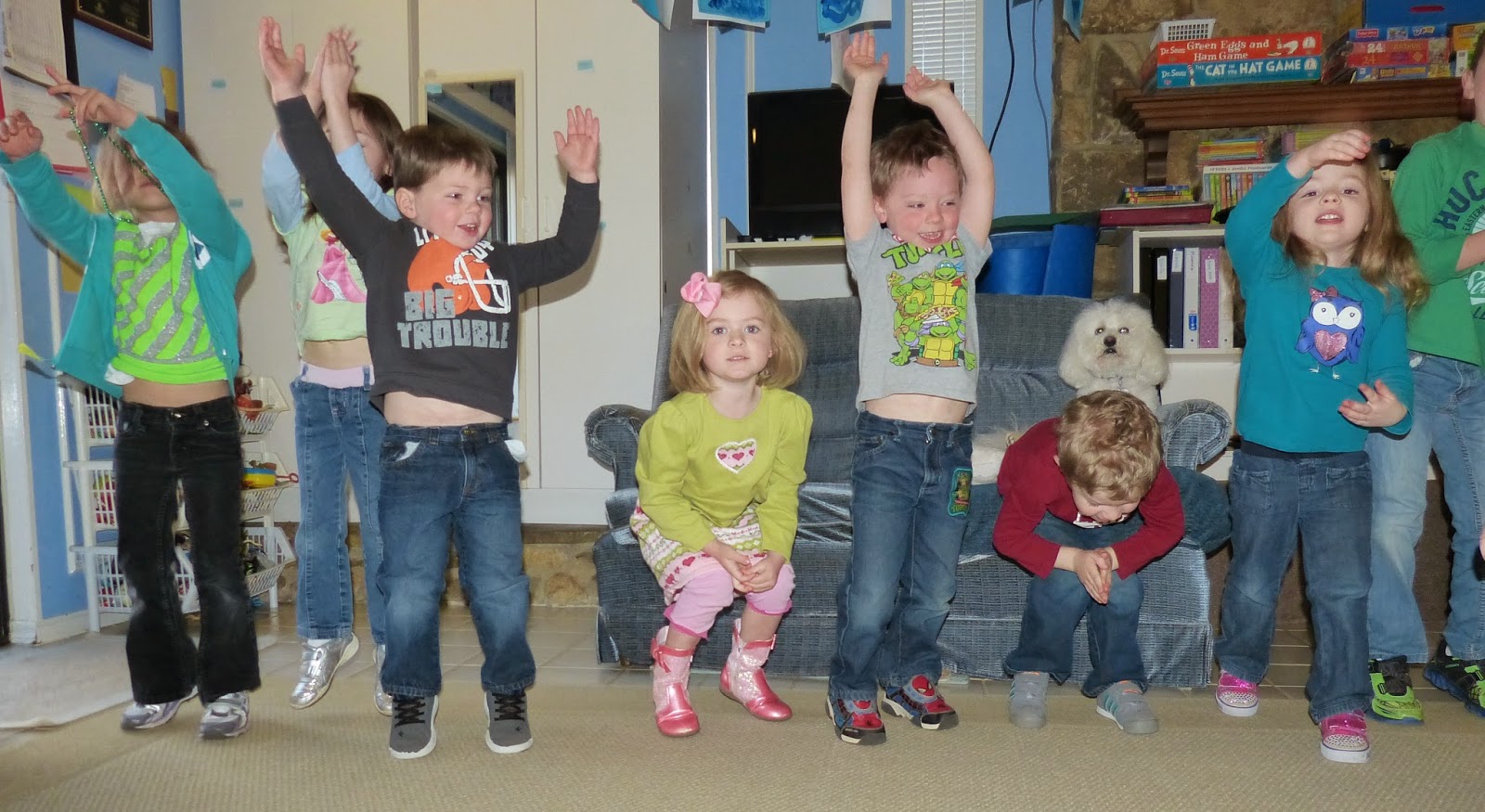
We sing and dance! Children love to move, and they learn best when they are moving, listening, looking at and joining in with engaging activities, so we start each day with 20-30 minutes of active learning with youtube.com. I've created a play list for each week of the school year, so it's super easy for me to pull it up on the computer. Each playlist starts with something energetic! Here the kiddos are enjoying I Like To Move It, from Madagascar.
When singing and dancing is finished, the kiddos sit on the carpet, and I draw them back together with an alphabet activity. Some days we recite Chicka Chicka Boom Boom as I point to the letters on my Chicka Chicka Boom Boom tree, other days we chant the alphabet, and sounds. Here the kids are pretending to eat an apple as they say, "A is for apple, a a a."
D is for dog, d d d...
Their favorite is V is for volcano, v v v, because they use big voices and big arms. Even sitting down, we're incorporating music and movement.
Next we stand up, ready to jump and count to 20, and to follow along as one of us points to the number line. We jump to emphasize the move to the next number, as working on 1-1 correspondence is important at this stage. Of course, jumping also gets our wiggles out, and even younger children who may not be able to say all the numbers to 20, can jump and participate, whilst hearing the numbers, and perhaps learning their sequence.
I ask 3 kiddos to tell me something we have zero of (lions, sharks, and unicorns today), and then let everyone else whisper their idea to a friend. Then we jump and count!
We sit down quickly when we're done, so we can count by 5's to 100, raising 5 toes as we say each number.
We sit up straight and put 10 fingers up in the air for each number when we count by 10's to 100.
Then we quickly stand up, and reach high into the air to be rocket ships, and count down. 10, 9, 8...
5, 4, 3, 2, 1...
0, blast off!
Next we sing a counting to ten song in Spanish. I wish I could provide a link to it, it's one I learned from Sesame Street a looooong time ago, but I can't find it on youtube. It might seem like a small thing to include in our routine, but I know it's worthwhile. Just last week a parent asked me if I had been teaching her son to count in Spanish, because he was walking around at home singing the Spanish numbers song! Music really does help children (and adults) remember things!
While we're standing up we do the pledge to the flag, standing tall and proud, showing respectful body language. I made up a little rhyme to help the kiddos remember the names of our flag:
The Red, White and Blue,
Old Glory too,
The Stars and Stripes,
We respect you!
We sit back down, and look out the window, and on the count of 3, everyone whispers what our weather looks like, so we can graph it. Thr child in the next picture is signing "equal", because we've had 0 snowy days and 0 rainy days so far this month.
I ask questions about our graph, from easy (How many ___ days?) to challenging (How many more ___ than ____?) We always notice what has the most, and what has the fewest!
The last thing we do is look at the calendar. I use a picture pattern for the calendar numbers, and we always start several days back, and count-on to find out what number we need. We don't start counting at 1 every time, because counting-on is an important pre-addition skill, and one preschoolers might not otherwise experience. We say the pattern too, starting several days back, and continuing the pattern to discover which picture we need. This month our calendar numbers have shamrocks on one side, and rainbows on the other.
We finish by singing and dancing to Dr. Jean's Macarena Months song, and the Days of the Week song. With that last dance, the children are ready to sit down for a quick story and lesson, or whatever we have planned for the morning.
As you can see, our "Preschool" time is very active, and very musical. We include a lot of things! Over 20 years of teaching, I've found that daily repetition is key to students remembering.
Next time I'll tell you more about what comes after our preschool routine!