Welcome to Paula's Primary Classroom! This blog is where I share ideas for teaching and learning with families, friends and other early childhood educators. Please don't use the photos or text of this blog without permission, but please do use any ideas you find useful. Thank you for stopping by!
Showing posts with label trees. Show all posts

Friday, March 20, 2015

Calaveras Big Tree State Park, California

Until now, all my blog posts here have focused on teaching young children, on materials and ideas that have worked in my own classrooms, and that I hope may be useful to others.  Today I'm going to step outside of that zone, but with purpose.  I hope you'll come along with me.

Last week, during spring break, my family took a trip to Calaveras Big Tree State Park in California.


I've seen pictures of giant sequoias before, you probably have too.  Pictures showing groups of people all holding hands to reach around the base of a tree, pictures of cars driving through holes carved into their trunks, pictures of people dwarved by them.  I knew I wanted to see them, my family has wanted to see them for a while, so we jumped at the opportunity to go.  What I didn't know, was that all those pictures mean next to nothing until you stand at the base of a BIG tree.

We walked through the North Grove, a 1.5 mile path amongst 2000 year old sequoias.  There are both shorter and longer paths, camp sites, and much more to do at the park, and if you are interested you can click the link at the top of this page to the official web page for the park.

Early in our walk we came upon this tree stump, which was used as a dance floor way back when. 
 You get a much better perspective when you see a person near a section of the tree!  These trees were so large that there weren't saws long enough to cut through them, so they used plumbing augers to drill many many holes into the trunk instead.

During this early part of the walk I really was just taking in the sheer size of the trees, which, regardless of seeing pictures, I hadn't really understood.

These trees, Mother and Son, appear to have been pressed against each other, the parts of their trunks facing each other mirroring each other's shape.
Here's the view from between them.
 
It is amazing to me to think of these trees being 2000 years old;  they aren't the oldest trees on earth, or even the tallest, but they are certainly the biggest.  According to the website,
 "The largest redwood in Calaveras Big Trees State Park is the Louis Agassiz tree. It is located in the South Grove. This tree is "only" 250 feet tall, but it is over 25 feet in diameter six feet above the ground! The largest tree in the North Grove is probably the Empire State Tree, which is 18 feet in diameter six feet above the ground." 
 The largest Sierra Redwoods have a diameter of 30 feet, and measure 93 feet around!

If you are a teacher, try measuring out 93 feet of string, tying it into a loop, and laying it out on the ground.  How many children can you get in that space?  Oh, my, goodness!  Can you measure and lay out a string 300 feet long to represent the height of one of these trees?  Wow!

My family laughed at me, but I laid on the ground to take a picture looking up at these marvels of nature.  I got dusty, but the view was well worth it!

There is  a  hollow, fallen tree that you can walk through.  I'm 5'2" and could easily stand up, my 6' tall son had to stoop in some places.  This is the view up through a crack in the tree.  Look how thick the remaining wood is.

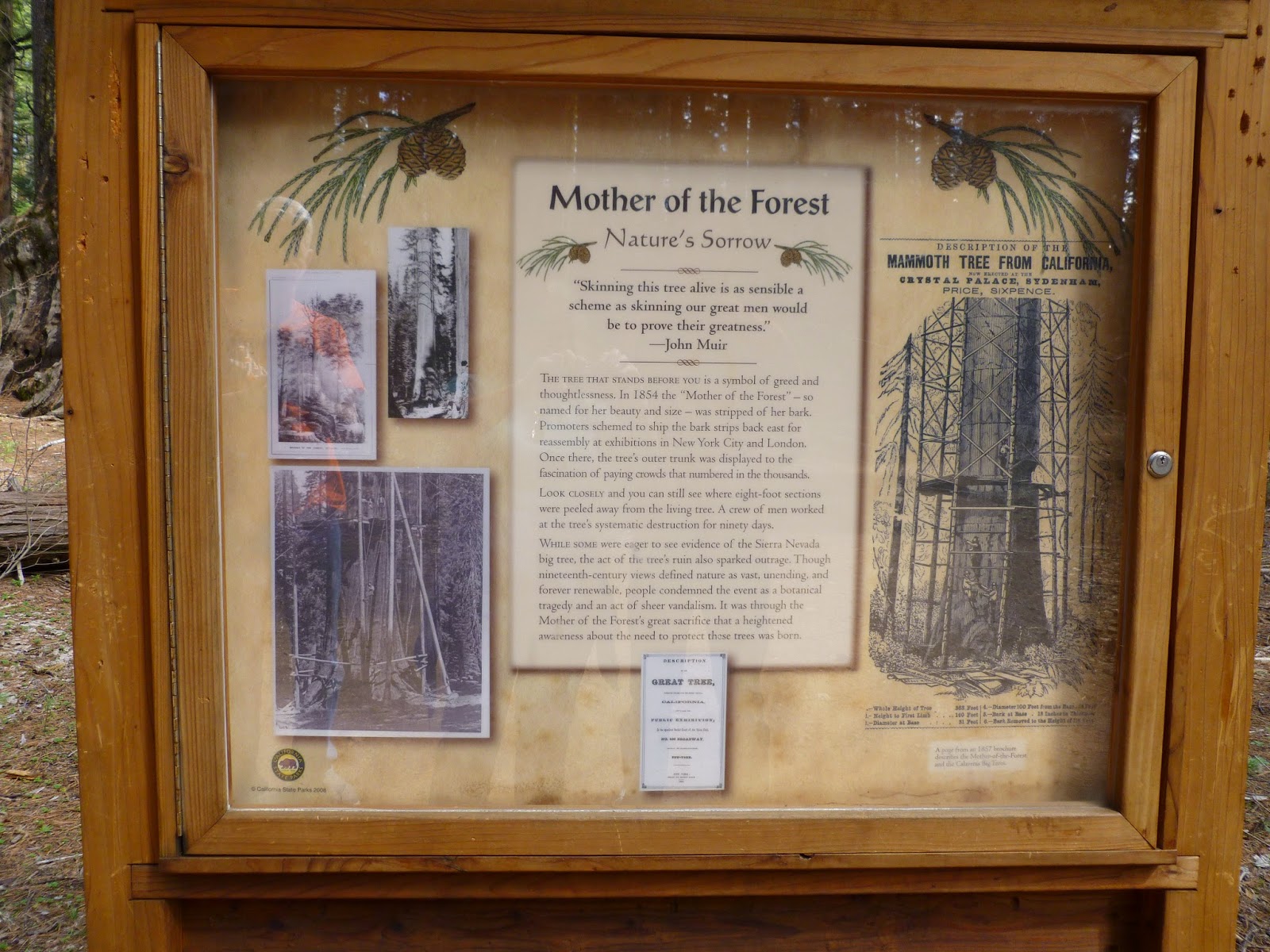
Just past half way along the trail we came upon The Mother of the Forest. 
She is dead, killed by human greed.
The price of viewing her reassembled bark was sixpence.  I keep finding myself making judgements about these circumstances, and then skirting around the very difficult environmental questions of our own times, and my own role in using resources.

 Does she remind you of Edvard Munch's "The Scream"? 

 Near her is another testament to human folly.  I have to admit, seeing pictures like the one below, I've briefly wondered if cutting the hole through it harmed the tree, but I've always let it go, to be amazed by the very clear size of the trees shown in pictures like this. 

 The answer is yes, cutting through trees like this does indeed harm them.  It's 140 years since this tree was  hollowed out, and there is only one small surviving branch. 

 Here's the remaining life in the tree, the little leafy part at the top left in this picture.
 Again, I wondered about my own role in all of this, as I stood at the base of this dying tree, taking pictures in the same place people have been taking pictures for 140 years, a photo opportunity that is killing the tree.  I understand why this is a national park, why people fought political battles to save the remaining trees, and why we still visit Mother of the Forest, and  The Pioneer Cabin Tree.  They are reminders to stop and think about our own roles in the world, a call to arms - or at least to composting, recycling and using resources more wisely.

What does this experience mean for me as a teacher and as a parent?  I have to admit, after a week thinking about it, I'm still not sure.  I don't know my own role in this, not clearly, and so how can I lead children to find theirs?  When it comes to reading and writing and math and how caterpillars grown and change into butterflies, all those "normal" things we teach our children, I know where I stand.  I'm comfortable dancing my part in the give and take of learning and teaching. It is a dance, a back and forth, leading and following, finding the way together.

And there the answer lies.   I'm sharing my experience with you, continuing the dance, learning and and teaching. 

We'll find the way together. 

Thursday, January 30, 2014

Trains, turtles and trees for T

 This week started out with another cool box creation!  My neighbors brought me another box, and the cardboard corner pieces begged to become a ball track.  We rolled ping pong balls (yes, I rolled some too,) whenever the box was available.  I finally retired the bean box midweek, when all the beans were spread all over the floor.  Twenty-one ping pong balls are easier to pick up than 3000 beans!


Learning about trees (and more!) for the letter T
 One of the things I wanted to include this week was more science. 
We started learning about trees by brainstorming what the children know or think they know.  This is called activating prior knowledge - basically, if they're thinking about something, it's easier to add new knowledge onto what they already know.
Learning about trees (and more!) for the letter T

Learning about trees (and more!) for the letter T
 We made models of trees; a half art, half science activity.  As they painted we talked about the parts of the tree, and I introduced the word "trunk" - I was surprised no-one knew that word when we made our chart!  We talked about making the roots under the ground as big as the branches above, and that roots branch out too.  Here are our finished trees, with all the parts labelled.
Learning about trees (and more!) for the letter T


Learning about trees (and more!) for the letter T
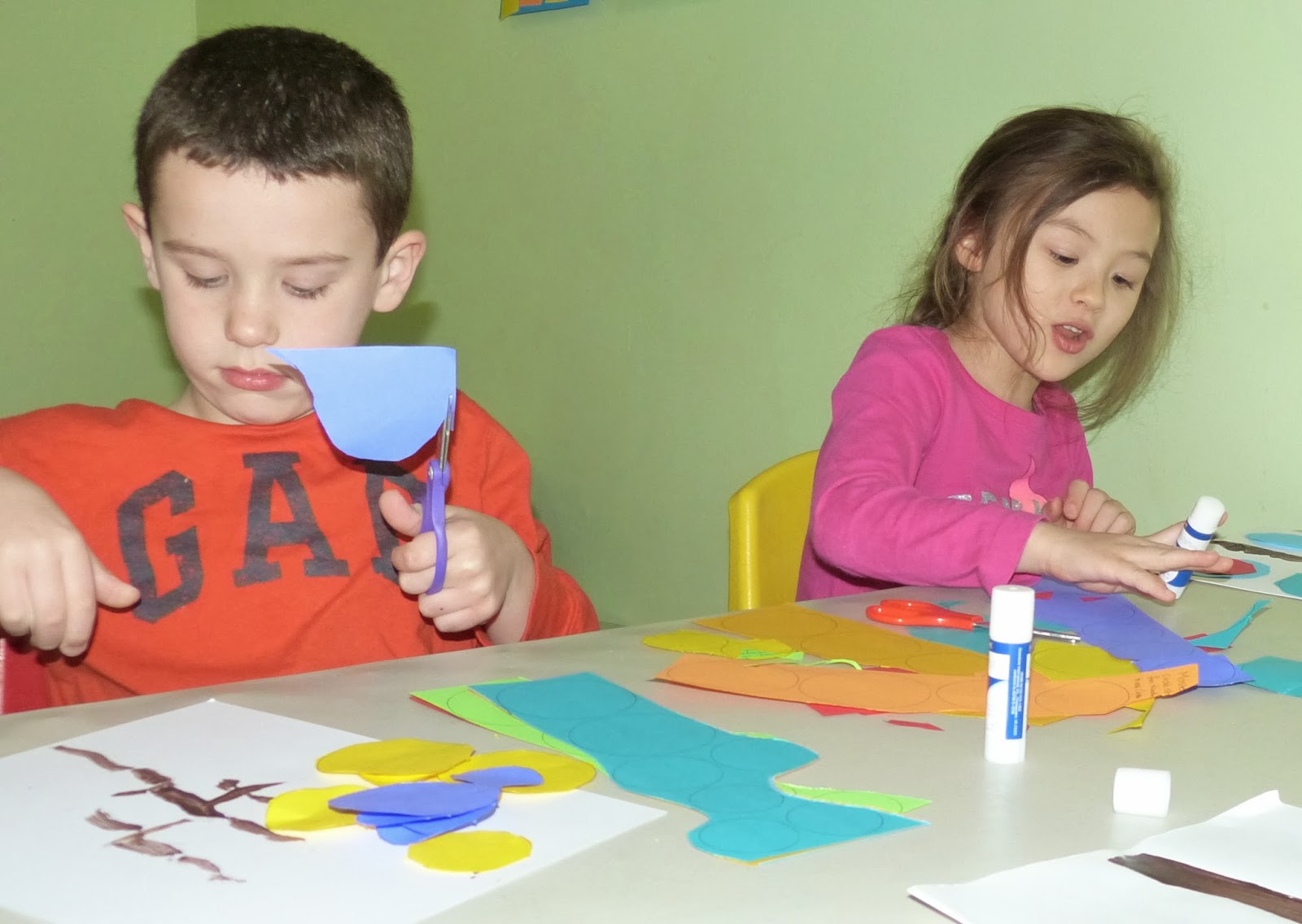
 Another tree project we did was one with concentric circles for leaves.  We looked at Kandinsky's paintings of concentric circles, then made our own.  The oldest kiddos cut out their own circles, the younger ones had precut circles.  We talked about shapes a lot this week!
Learning about trees (and more!) for the letter T
 You can see all our beautiful concentric circle trees at www.artsonia.com.

Learning about trees (and more!) for the letter T
 Here's what the children knew about trees a couple of days later.  They were very impressed to know chocolate comes from beans on a tree!  They learned new vocabulary - trunk, learned about more products from trees (cardboard, hockey sticks, rubber, maple syrup),  and learned that green leaves breath and make food for trees, and make oxygen for us to breathe too!  I'm impressed with how much these 3-5 year old kiddos know!


We also learned a lot about turtles this week - mostly sea turtles.  We did an awesome art project:
 On the first day we water colored an ocean background with cool colors.  The kiddos worked very hard to cover their papers with color!
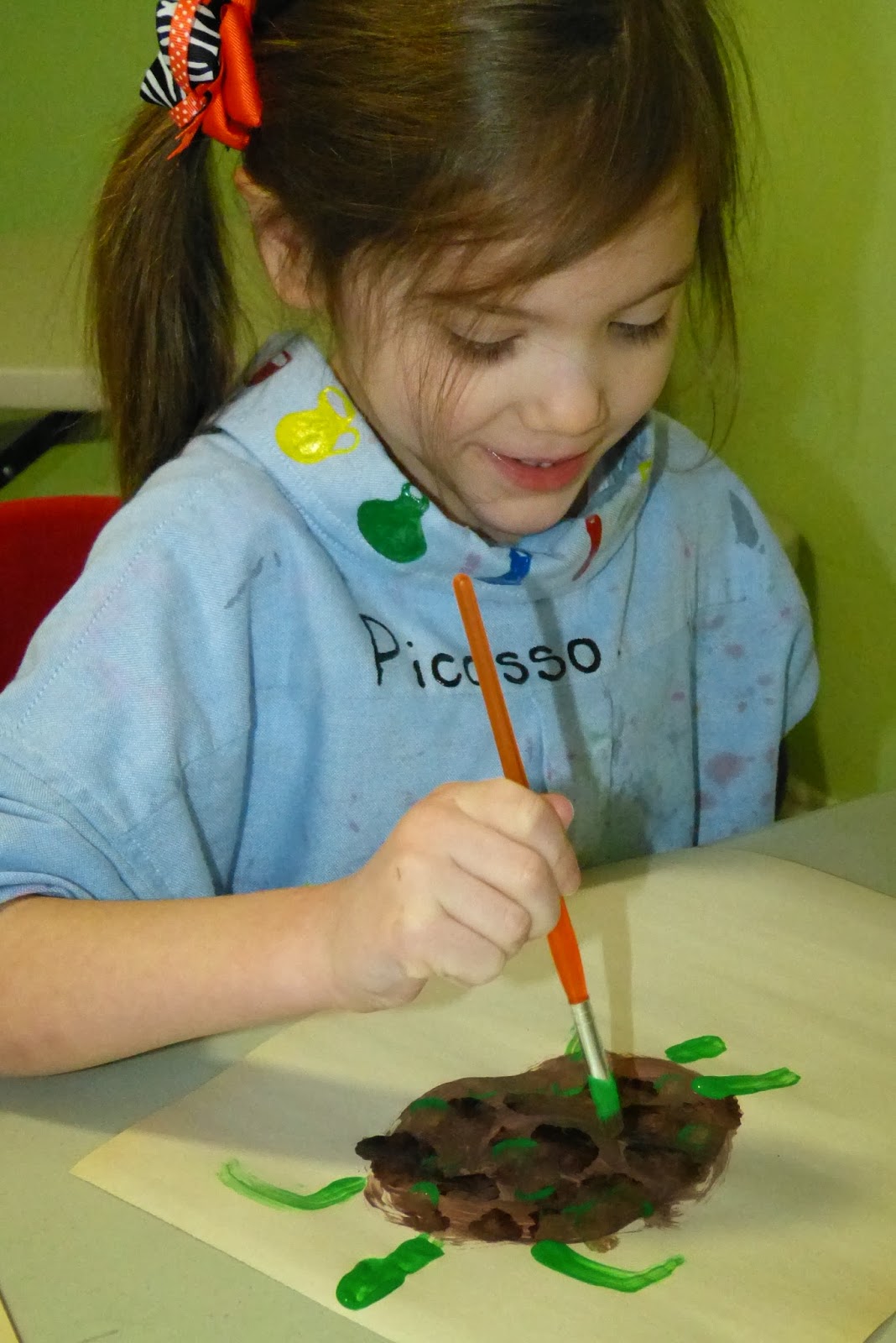
 The next day they painted the turtles.  I showed them a model of a sea turtle, and we noticed the shape (oval), counted flippers, and noticed that the front flippers were long and curved.  They followed step by step directions to make beautiful turtles.
 When they were dry the teachers cut them out, and the children glued their turtles onto the ocean background.  Beautiful!  You can see all of them at www.artsonia.com.


Our turtle study wouldn't be complete without acknowledging a certain group of 4 teenaged turtles.  I knew TMNT would engage the kiddos, particularly some of the boys who often wear turtle clothes to school, but I didn't want a day of Ninja wars and t.v.-related pretend.  Here's our compromise:
I made a chart comparing Ninja Turtles to sea turtles, and the children told me all the answers for Ninja turtles.  Next, I read a beautiful realistic fiction book about a loggerhead turtle: One Tiny Turtle, by Nicola Davies.  As I read, the children listened to find out what loggerheads eat, where they live, how big they grow, and other cool facts.  The kiddos remembered all the relevant facts!
We finished our turtle theme with a snack that looks like one.  I put peanut butter on Ritz crackers, and the kiddos added almonds for heads, cashews and peanuts for flippers, and topped it with another cracker for the carapace (shell).

 Of course, we did our usual activities: upper and lower case letter crafts, hand and foot prints, and our abc albums.

Some of the hand and foot print art doesn't require much work from the children, and I've been thinking that perhaps I need to change that.  Painting hands, and especially feet, this week, reminded me of what a fun sensory experience it is for the children to feel the brush as it spreads the paint, and the lovely squishy feeling of paint between their toes.  They love this activity, and that is enough sometimes!  For more hand and foot print ideas, check out pinterest.

Finally, here are some trains we made while talking about and reviewing the names of shapes.  This clever idea came from Counting Coconuts.