Welcome to Paula's Primary Classroom! This blog is where I share ideas for teaching and learning with families, friends and other early childhood educators. Please don't use the photos or text of this blog without permission, but please do use any ideas you find useful. Thank you for stopping by!
Showing posts with label learning. Show all posts

Sunday, April 2, 2017

14 of the best ways to get your students to practice spelling

This week a friend mentioned how painful it is to do spelling homework with her daughter.  She's tried a lot of things: writing the words, putting the words in sentences, flashcards, but nothing seems to help, and it's torture for both of them.  Sound familiar?  Well, I'm here to tell you that spelling practice does not have to be painful!  You can also use these fun ideas to practice sight words, math facts, or anything that needs to be memorized. 

1.  Write those words!  "Yeah, done that, hate it," you say?  I bet you weren't writing them in a layer of sprinkles on a cookie sheet!  How about writing them in chocolate sauce or honey on a plate?  (If When you spell each word correctly, you get to lick your finger.)  How about a layer or salt or flour on a tray?  Or using tic tac candies to make each word?  Once you start thinking about it, you'll come up with a lot of fun ways to practice!

2.  Text them.  Tell me your elementary age kiddos don't want to use their phones - or yours!  Have them sit with you while you're cooking dinner/ grading papers/ reading a book, and let them type and text those sight words to you or a family member.  Limited text plan?  Try emailing them!

3.  Learn the sign language alphabet and have your child finger spell their spelling words.  Here's a cute video to help you learn!

4.  Use magnetic letters to make the words on your refrigerator, a cookie sheet, the side of a filing cabinet... so many options!

5.  Write the words in shaving cream.  My kiddos LOVED writing and drawing in shaving cream, so we always did this to clean the tables in our classroom.  Simply spray a blob of foam on the table, then let the children smooth it out on the table top, then write in the it.  A quick hand swipe erases and resets the foam for the next word.  When you're done, your table top will be clean, the room will smell great, and that tricky spelling practice will be done!  (Your child may get some on her clothes, but it's basically soap, so it washes out beautifully.)

6.  Let your child write the spelling word with special writing tools.  Try markers, crayons, colored pens, that special pen on daddy's desk, scented markers... whatever it takes to make it fun.  Can your child write each word in all the rainbow colors?  (Yeah, you just got him to write each word 7 times!)  You can grab this rainbow writing page in my TeachersPayTeachers store, or just write them on regular paper.
https://www.teacherspayteachers.com/Product/Rainbow-Writing-Editable-Spelling-Practice-3091964

7.  Is your child super active, or does he want to live in the backyard after school?  You hate to squash that healthy energy with homework, but it has to get done.  If you have a trampoline, try having your child write each word in big letters on  index cards, and hang them around the trampoline.  She can then jump and spell each word.  No trampoline?  Use sidewalk chalk to write the letters on the pavement, and jump from letter to letter to spell the words.

8.  Invest in a set of letter stamps and a pretty stamp pad, and have your child stamp out the letters.  For many children the lure of playing with rubber stamps will motivate them.  Can't afford rubber stamps?  How about alphabet cookies or pasta?  Or even a set of letters cut from junk mail or magazines?

9.  Grab an old game of Twister out of your cupboard, or at a garage sale, and write the letters on the colorful spots.  There are 24 spots on the game board, so put x, y and z together on the last spot, and then jump from spot to spot to spell the words.  Can't get a Twister game board?  Try making one on poster board!

10.  Play spelling tic tac toe, bingo, or dots, or whatever games your child enjoys, using a spelling word to mark your space.  Your child will read and write the words over and over in each game, enjoy some fun time playing with you, and you'll both agree spelling practice has never been so much fun!

11.  Write letters on toy blocks and build your words.

12.   Paint the words, or make the letters from play dough and spell them out - this feels a lot more like play, and a lot less like work!

13.  Use bath crayons and write in the tub.  If your child loves a long soak in the tub, washable bath tub crayons are the thing for you!  You can also write on the tub in shaving cream, just like I suggested in item #5 - and now your child is practicing spelling words and CLEANING THE TUB!

14.  Write on pretty paper.  Try colorful post-it notes, or fancy letter writing paper, or use regular paper and pop the finished list into an envelope and send it to your favorite family member. 

Brainstorm with your child for even more fun ways to practice spelling, and together you'll conquer those spelling test blues!

Wednesday, August 3, 2016

The Shepherd Who Cried Wolf

Do you remember reading Aesop's fables as a child?  I do!  There are some that almost everyone is familiar with, like The Tortoise and the Hare, and The Shepherd who cried Wolf.
A beautiful retelling of Aesop's fable, with a game and retelling props - super cute!

 Maybe it's because I remember reading the stories and thinking about the morals, that I was really pleased when I recently found beautiful clip art for fables.  Whatever the reason, I bought it, and have started retelling the stories with it.

https://www.teacherspayteachers.com/Product/The-Shepherd-Who-Cried-Wolf-50-off-for-the-first-24-hours-2705648
I made a reproducible student booklet, and props for retelling the story.  (Fables and retelling stories are included in the Common Core State Standards for 2nd grade, so that's the reading level I aimed for - although younger children can certainly listen and retell the story, even if they can't read this version.)

I even made a short video of me using the props to retell the story!  I'd love for you to use this with your students - my kiddos loved watching short youtube videos like this, and I appreciated the opportunity to let another (virtual) teacher into my classroom to help me out for a few minutes.
https://www.youtube.com/watch?v=RbSzCfgrgnw

If you're a regular reader, you know I think it's important to make learning fun, so I've also been making games to go along with the books and story retelling props.  The game I made for this one requires a spinner, so I thought I'd show you two super easy ways to make a spinner in under a minute!  The first one is pretty self explanatory,
A beautiful retelling of Aesop's fable, with a game and retelling props - super cute!
- all you do is put a paperclip in the middle of your spinner background, and use a pencil to anchor it.  A flick with your finger sends the paperclip arrow around.  Talk about instant and easy!

Here's a more traditional way:  Use a pushpin to make a tiny hole where you want your spinner to pivot (can you see it right in the center of the circle?), then put a brad through a paperclip.  Put the brad through the hole - having that tiny hole will let you get the brad through your paper without wrinkling it up or pushing too hard and accidentally stabbing yourself in the finger with a brad.  (Yup, I've done that a time or two!)
A beautiful retelling of Aesop's fable, with a game and retelling props - super cute!

Open the brad on the back of the paper, and you'll have a spinner like this one:
https://www.teacherspayteachers.com/Product/The-Shepherd-Who-Cried-Wolf-50-off-for-the-first-24-hours-2705648

Super simple, and super fun!  How do you use fables with your students?  Do you use learning games too?  Let me know in the comments!

Have a great day!
Paula


Monday, June 22, 2015

Dare to Dream

What do you remember about your earliest years of school?  Stop for a moment, close your eyes, and think, what do you remember?

I remember walking home from school with my friend Susan, and the jam sandwiches her Nana made us every day.  I still love jam sandwiches!  I remember Douglas A. singing along with the Winnie the Pooh song at school.  I remember the blocks, dress ups, boxes of junk for creating with, and lots of recess time.  I remember Mrs. Potts, my first and second grade teacher, reading The Very Hungry Caterpillar, and the pants and hat she wore.  I remember we had lots of windows, and a big carpet on the floor, and I remember the school library, and the books we took home to read.
All the things I remember about my early learning years are fun things.  School was a fun place to go, full of marvelous, child appropriate things to do and see.  We learned our letters and sounds by singing fun songs (my favorite was Rrrrrrrats are rrrrrrrunning, rrrr, rrr, rrr, because we were encouraged to roll the r, and it was fun!).  I learned to read with the Spot books by Eric Hill, and it was just a natural part of what we did.  I don't remember any flashcards or worksheets, although I do remember we had some mimeographs once in a while, and they smelled funny!  I loved everything about school, and knew even at 5 years old that I wanted to be a teacher.  (That was going to be my day job, until I could be a famous singer like Sally Boyden from the Johnny Young Talent Time show!)

When I graduated college I got my dream job, teaching first grade!
 What could be better?  I had ducks and fish and butterflies in my classroom (I do NOT recommend ducks by the way!), and we read and read, and I think we all had fun while we learned.  Sure, there were spelling tests, and timed math tests every week, and end of year tests, and May was always a whirlwind of end of year activities and deadlines and requirements, but I loved it.  Yes, over the six years I taught in the public school system we did add more requirements every year.  A few more forms, "the test" style questions for first graders - to prepare them for third grade testing, and yes, we did start using scripted math and language arts curriculum, but I could supplement them with my own ideas and activities.  It was still good, but, there was an edge to things, something that didn't feel right to me.
                                     
When my youngest was born, a couple of my teacher friends suggested I should stay home and teach my kids and theirs, and when I thought about it, I said yes.  The money and benefits didn't come close to comparing to a professional salary, but the value of being at home with my children, and of making their early childhood years amazing was well worth it. 
Friends told me stories of the continuing changes in the school system, and I was glad to be out.
I think the best thing about being at home with the children, was that I realized I could teach at home, and do it however I wanted.  I got to examine my core values and beliefs, and then live them.  We took long walks to the playground every day, collected dandelion flowers and stomped in puddles.

                                   Paula's Preschool and Kindergarten: Playing barefoot in puddles as part of our lead up to International Mud Day, basically getting comfortable with the idea of getting messy.
We watched the big trucks work on the road (from a safe distance), and started taking a lot of field trips.  We visited the museum and the zoo, the stock shows and the library, city parks and anywhere else that had child friendly venues where we could have real, hands on learning. 

My children learned to read, not with flashcards or worksheets, but with my friend Spot the dog, Eric Carle books, and marvelous books on tape, like The Dragons Are Singing Tonight by Jack Prelutsky.  I learned a tremendous amount about how children learn, and developed my program around that.  I'm pretty opinionated about early childhood, because I've spent the last 16 years deeply and passionately involved in it.

All of this is my backstory for this week's TpT seller's challenge:
                                      
When I saw this blog topic this morning, I thought, what?  Yes, I do dream big, but to say that I'd like to make a living doing TpT full time seems a bit... well... ordinary.

I'm very lucky right now to be able to TpT full time, and I really hope that I can build my business to the point that I feel justified with this as my only job, and that I can make a meaningful financial contribution to my family.  I'm living the dream, working toward that goal!

The thing is, not everyone is living the dream.  Many, many excellent and outstanding teachers are still working in our public school systems, doing the best that they can for their students, within the constraints that have continued to grow, sometimes to the point of choking out the fun.  My educator friends tell me they can no longer do many of the things that we know are best for children's learning: cook with them, do craft projects, read poetry, be kids!

My dream, what all my 22 years as an educator have prepared me for, is to make it easier for teachers and students to learn in playful, joyful, age appropriate ways.  I know time is short, and I'm so very sorry, I know the constraints are tight.  Finding fun learning activities that also meet the various standards, whether that's Common Core or state standards, is getting harder.  The joy of learning and of teaching is all too often being sucked right out of our schools, in the name of rigor and testing.  I hear of early childhood classroom where you can't find a toy kitchen, dress up bin, or sand and water table, but worksheets and flashcards are at hand.  I hear of elementary schools with little or no recess time, limited physical education and music time, and I wonder how our kiddos manage!

I've been so very blessed to spend the last 16 years playing on swings, digging in the garden, reading books aloud, and doing jigsaw puzzles with children, who have learned a love of nature, understanding of plant and animal life cycles, mathematical and logical skills, and to love reading and how to get along with each other.  Now I want to share that joy with as many teachers and children as possible, to help teachers put joy and playfulness back into their classrooms, without compromising learning goals or breaking the bank.  I want my teaching materials to help make teaching and learning a little easier, and a little more fun. I want to make a difference!


Thank you so much to Third in Hollywood, Teach Create Motivate, Sparkling in Second Grade, and Peppy Zesty Teacherista for hosting the TpT sellers challenge, and posing this thoughtful prompt!

Saturday, June 13, 2015

Avoiding "Summer Slide"


Almost everyone has heard of summer slide, the loss of skills so many students experience during the long break from school.  Skills that our children (and their teachers) have worked hard to master during the school year are lost, simply because they aren't revisited for several months.

It doesn't have to be that way, maintaining skills through the summer can be as easy as having your child join you in doing chores, running errands, and playing games!  Here are some ideas that may help you enjoy the summer with your children, while keeping their skills sharp.

Number 1: read.  Read together, have your child read to you, show your child you value reading by modeling it - with a book, a magazine, a news article... whatever suits you.  Children who see their parents as readers are much more likely to want to be readers.  Try some of these reading techniques:
 - Snuggle up together, give your child your full attention for a few minutes, and take turns reading pages in a book that is just right for them.  Knowing that they only have to read one page at a time can really support struggling readers, and having a special time with you makes it even more appealing!

- Read aloud to your child.  Yes, you did that when they were 3 or 4, but don't give up on reading to your 10 year old either!  Find a novel that you think will appeal to them, and read one chapter each day.  My husband and I read all but the last of the Harry Potter books to and with our children - until our oldest, a teenager, finally asked if he could just have the last book and read it himself.  It was hard to let go of that tradition!
- Have your child read something they enjoy out loud to you while you are busy.  Driving somewhere?  Have them read to you, or listen to an audio book in the car together.  Our family favorites were the Hank the Cowdog books, and my children still quote them.  Your local library will have audio books available to check out.  An added advantage of this?  Listening to part of a series may get your child hooked on the stories, and interested in reading more of them.
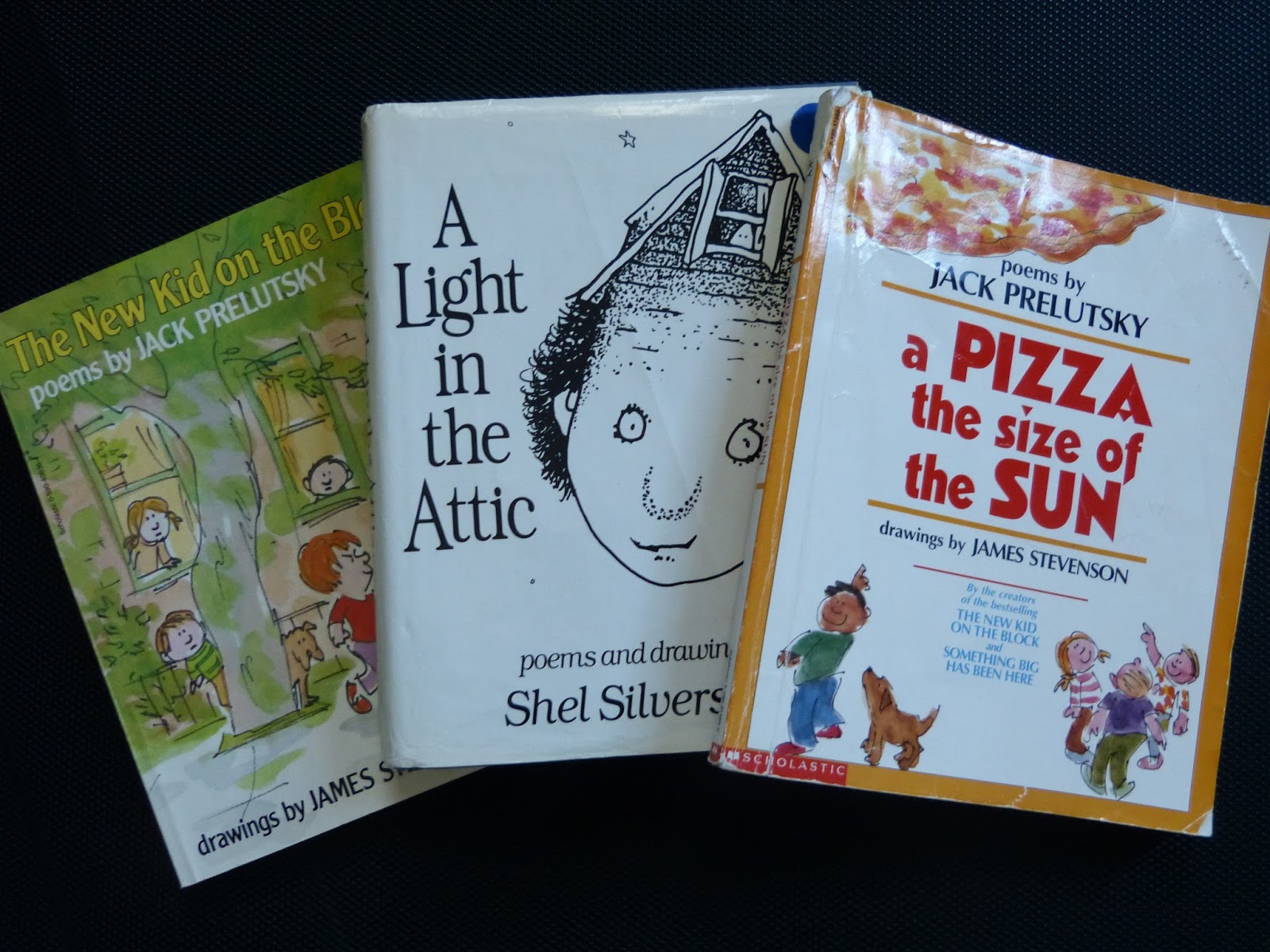
- Try poetry!  Shel Silverstein and Jack Prelutsky write witty and awesome verse for children, and many of them are short and sweet, enticing children who may not want to read something "long".  Again, your children may end up quoting their favorite lines for years to come.

- Read a book that has also been made into a movie, then watch the movie together and compare them.  My children and I really like the Roald Dahl books: Matilda, James and the Giant Peach, The BFG, Charlie and the Chocolate Factory.
- Reluctant reader?  Bring in something they are interested in: dinosaurs, cars, makeup, technology, etc.  Magazines designed for tweens make reading seem cooler, and more interesting, and once again, they are available at your public library!

Number 2: Do some math together.  No, not flashcards.  Real life math is a lot more fun, and more effective.  You could:


- Try cooking together.  Even very young children can help you count scoops of flour or spoons full of other ingredients. 

You can teach them to measure carefully by paying attention to fill lines.  For children who are able, try halving or doubling a recipe (they'll want to double that cookie recipe for sure!)  Cooking lets your child measure temperatures, read recipes, set timers and more, with a delicious incentive at the end of the process.  As always, decide what you think your children can safely learn, then teach them how to use sharp or hot kitchen products carefully, and supervise closely. 

- Do chores.  Have your child sort and put away cutlery, and set the table.  Have them fold towels (can they make it into quarters or eighths?) and match pairs of socks. They can count how many toys they put away, how many stairs there are to vacuum, and much more.  When you do chores together they seem to go faster, and are a lot more fun.
- Tell time.  Digital clocks are easy enough for most 4 or 5 year olds to read, as long as they can read 2 digit numbers.  At 2 years old my oldest son would wake up at the crack of dawn, ready to play.  We got him a digital clock, and told him he needed to stay in bed until the first number was a 6 or more.  That first night he was up at 12:06, 2:36, 3:16.... every time he saw a 6 anywhere.  The second night I made a paper frame to go around the hour space, and explained that the 6 needed to be in the box.  He never got up too early again!
- Count money.  Yes, it is hard at first, but it is such an important skill!  Start with just pennies. Then practice counting by 5 and 10, and counting nickels and dimes.  Slowly put the different coins together, adding quarters last.  One of my favorite ways to help families practice coin counting together is to have parents empty (or partly empty) their pockets of coins in the evening.  Challenge your child to count how much money there is: if they add it up correctly, they get to keep it!  Talk about motivation!  Again, start with whatever your child can manage, and slowly increase the challenge. 
One summer when my own children were 9 and 5, I challenged the 9 year old each day with a money problem, such as how to make 52 cents with exactly 8 coins (4 dimes, 2 nickels, 2 pennies).  He got to keep it if he could figure it out - with the added advantage of keeping him quietly busy for a few minutes!  Then I had him put together a small box with the same coins in it for his brother to count.  
-Add it up.  When you need to run to the store for a few items, have your child try to figure out how much your total is going to be.  As you put each item into your cart, tell them the price, and let them figure it out - calculators optional. 

Number 3: Observe the natural world around you.  Children are natural scientists, investigating everything around them.  Get outside and look for bugs, leaves, animals, clouds... whatever fascinates them.  Ask questions along with your child, and when you find something you are both interested in, look up the answers.  Your library is a great place to find books on everything, but you can also help your child learn to look things up on the internet.


Go to the zoo or the aquarium, and read the information displayed about each animal.  Take your time, and if there are times when zoo keepers are available to talk about the animals, take advantage of it!  You may be able to look up information about special programs on-line, and time your visits accordingly.


Number 4: Play games.  Board games teach our children how to take turns, pass the dice, count and move spaces, and more.  Many games have a learning component - look for some that you played as a child, and make a family tradition of playing together.  No money for games?  Try simple drawing games such as the dot game and tic tac toe.  You can also have your child invent a game board, and take turns rolling a dice to move, or use flashcards as questions to answer in order to move. 

There are so very many ways you can make learning together fun, you probably remember doing some of these things, and others.  My mother had us look for numbers on license plates (how high can you get before the drive is over?) and letters in the environment around us (start with A and work through the alphabet).

I realize now that those games served several purposes: they entertained us, kept us relatively quiet, and engaged our brains too. 

I recently created some games for 5 - 7 year old children to help parents engage their children, while entertaining and keeping them productively occupied.  If you are interested, please check it out at the link below.  There are four game boards for children to color, and game cards for sight words, telling time, adding, subtracting, shapes, coins, rhyming, color words, and patterns.  I think it covers a whole lot of skills, and playing to learn is so much more engaging than worksheets!
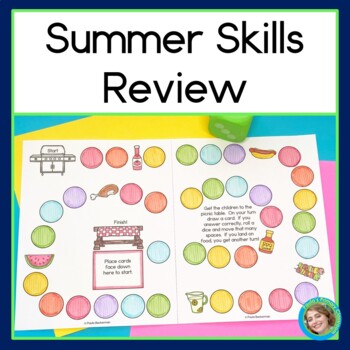


Bye Bye Summer Slide!Bye-Bye Summer Slide!

If you have more suggestions of ways to keep children engaged and learning during the summer months, please leave them in the comments below!

Friday, March 20, 2015

Calaveras Big Tree State Park, California

Until now, all my blog posts here have focused on teaching young children, on materials and ideas that have worked in my own classrooms, and that I hope may be useful to others.  Today I'm going to step outside of that zone, but with purpose.  I hope you'll come along with me.

Last week, during spring break, my family took a trip to Calaveras Big Tree State Park in California.


I've seen pictures of giant sequoias before, you probably have too.  Pictures showing groups of people all holding hands to reach around the base of a tree, pictures of cars driving through holes carved into their trunks, pictures of people dwarved by them.  I knew I wanted to see them, my family has wanted to see them for a while, so we jumped at the opportunity to go.  What I didn't know, was that all those pictures mean next to nothing until you stand at the base of a BIG tree.

We walked through the North Grove, a 1.5 mile path amongst 2000 year old sequoias.  There are both shorter and longer paths, camp sites, and much more to do at the park, and if you are interested you can click the link at the top of this page to the official web page for the park.

Early in our walk we came upon this tree stump, which was used as a dance floor way back when. 
 You get a much better perspective when you see a person near a section of the tree!  These trees were so large that there weren't saws long enough to cut through them, so they used plumbing augers to drill many many holes into the trunk instead.

During this early part of the walk I really was just taking in the sheer size of the trees, which, regardless of seeing pictures, I hadn't really understood.

These trees, Mother and Son, appear to have been pressed against each other, the parts of their trunks facing each other mirroring each other's shape.
Here's the view from between them.
 
It is amazing to me to think of these trees being 2000 years old;  they aren't the oldest trees on earth, or even the tallest, but they are certainly the biggest.  According to the website,
 "The largest redwood in Calaveras Big Trees State Park is the Louis Agassiz tree. It is located in the South Grove. This tree is "only" 250 feet tall, but it is over 25 feet in diameter six feet above the ground! The largest tree in the North Grove is probably the Empire State Tree, which is 18 feet in diameter six feet above the ground." 
 The largest Sierra Redwoods have a diameter of 30 feet, and measure 93 feet around!

If you are a teacher, try measuring out 93 feet of string, tying it into a loop, and laying it out on the ground.  How many children can you get in that space?  Oh, my, goodness!  Can you measure and lay out a string 300 feet long to represent the height of one of these trees?  Wow!

My family laughed at me, but I laid on the ground to take a picture looking up at these marvels of nature.  I got dusty, but the view was well worth it!

There is  a  hollow, fallen tree that you can walk through.  I'm 5'2" and could easily stand up, my 6' tall son had to stoop in some places.  This is the view up through a crack in the tree.  Look how thick the remaining wood is.

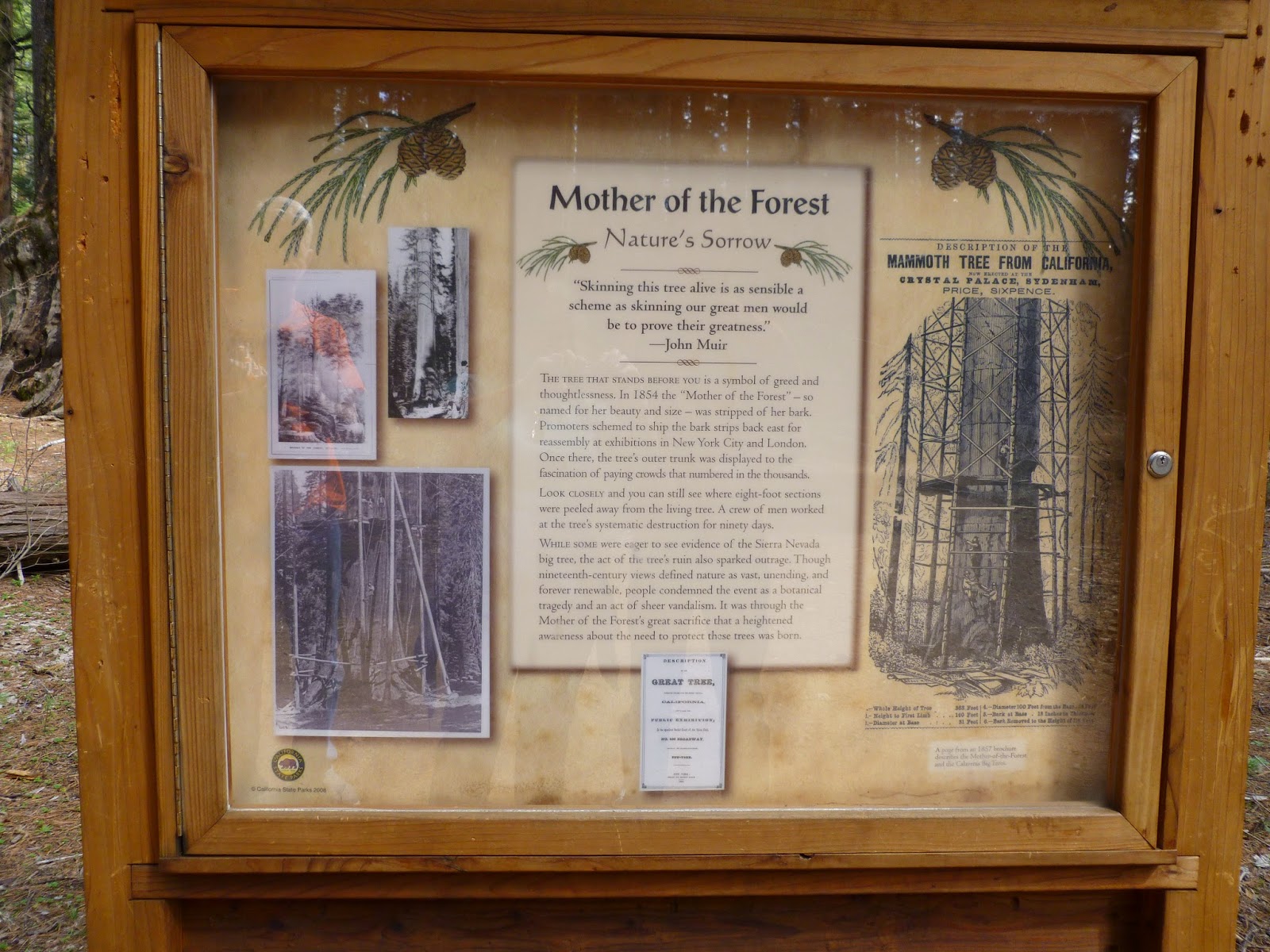
Just past half way along the trail we came upon The Mother of the Forest. 
She is dead, killed by human greed.
The price of viewing her reassembled bark was sixpence.  I keep finding myself making judgements about these circumstances, and then skirting around the very difficult environmental questions of our own times, and my own role in using resources.

 Does she remind you of Edvard Munch's "The Scream"? 

 Near her is another testament to human folly.  I have to admit, seeing pictures like the one below, I've briefly wondered if cutting the hole through it harmed the tree, but I've always let it go, to be amazed by the very clear size of the trees shown in pictures like this. 

 The answer is yes, cutting through trees like this does indeed harm them.  It's 140 years since this tree was  hollowed out, and there is only one small surviving branch. 

 Here's the remaining life in the tree, the little leafy part at the top left in this picture.
 Again, I wondered about my own role in all of this, as I stood at the base of this dying tree, taking pictures in the same place people have been taking pictures for 140 years, a photo opportunity that is killing the tree.  I understand why this is a national park, why people fought political battles to save the remaining trees, and why we still visit Mother of the Forest, and  The Pioneer Cabin Tree.  They are reminders to stop and think about our own roles in the world, a call to arms - or at least to composting, recycling and using resources more wisely.

What does this experience mean for me as a teacher and as a parent?  I have to admit, after a week thinking about it, I'm still not sure.  I don't know my own role in this, not clearly, and so how can I lead children to find theirs?  When it comes to reading and writing and math and how caterpillars grown and change into butterflies, all those "normal" things we teach our children, I know where I stand.  I'm comfortable dancing my part in the give and take of learning and teaching. It is a dance, a back and forth, leading and following, finding the way together.

And there the answer lies.   I'm sharing my experience with you, continuing the dance, learning and and teaching. 

We'll find the way together.