Welcome to Paula's Primary Classroom! This blog is where I share ideas for teaching and learning with families, friends and other early childhood educators. Please don't use the photos or text of this blog without permission, but please do use any ideas you find useful. Thank you for stopping by!
Showing posts with label playful learning. Show all posts

Sunday, January 10, 2021

Top 10 Proven Preschool Activities for Pp

Number 1: PLAY!

If you do nothing else this week, please let it be play!  Of course, almost everything I suggest is about playful learning because it is essential for children, and pretty darned important for grown-ups too.

Number 2: Pizza

See, learning about the letter P is fun AND delicious!  You already know I love to cook with children, and what's better for this week than making and eating pizza?! 

Depending upon how much time I want to spend on this, and on the age and skill level of my kiddos, I've had them help me make pizza dough (I cheat and use the bread machine), or I've used something as a pre-made crust.  Both work beautifully, are fun and fairly easy, and you end up with something delicious that your children will want to eat.  Today let's talk about letting children make their very own mini pizzas by using half an English muffin as a crust.

 I like to put out pizza toppings for the children to choose, and invite them a couple at a time to come and assemble their pizzas.  If you want to really talk about the sound of Pp, consider offering pepperoni, peppers, and pineapple along with any other toppings you want.  

It does take a few minutes for a preschooler to scoop up the ingredients they want, and to spread them on their pizza.  They're making decisions, estimating how much they want of each ingredient, and working their finger muscles as they arrange the toppings.  This is a fine motor, sensory, life-skill, healthy eating experience, and that's definitely worth the time it takes!

Make sure you know who's pizza is where on the baking sheet, because they WILL want THEIR OWN pizza!  Bake it until everything is hot and the cheese is starting to turn golden, and then.... well, your child will help you figure out what comes next!

Number 3: Pigs in a blanket

This is another fun cooking activity for your little ones, and you'll just need a can of biscuit dough and some mini sausages.

Let the children cut the pieces of biscuit dough in half, and squish each half.  Lay a sausage on the dough, then roll it up.

Lay them on a baking sheet and bake according to the directions for the dough.  YUM!

Again, if you're not sure what comes next, ask your children, they'll know it's time to eat!

Number 4: Picnic

You might be thinking a picnic takes a lot of planning and preparation, but when you're dealing with children, simply taking your meal outside to eat equals a picnic!  I like to keep a picnic blanket handy so we can make a picnic in just moments.  Have a large box from a delivery?  Instant picnic table! 

There's something magical about getting outside to eat - and of course, once they're done eating, it's time to PLAY!

Number 5: Puddle Stomping!
 

This is one of my all time favorite preschool activities, and one I think most of my former students remember well, even many years later.  I have a couple of pro-tips to help make this activity go smoothly, even with a group of children.

- Plan ahead.  Before you ever head out the door, make sure you have towels and dry clothes handy for afterwards.  Is your child wearing something that is okay to get wet, or do they need to change into play clothes first? Is the puddle in a place that's safe for bare feet? 

- Set limits.  Is splashing okay?  Are you getting full body wet, or just feet?  What space do you expect the children to stay in?  By thinking this through ahead of time you save yourself having lots of tired, wet children making a mess in your house afterwards!

I like to have the children take off their shoes and socks inside, and then head out. We run, we stomp, we splash... then we look for earthworms that have been washed out, and gently rescue them from the puddles.  We run around some more, and we notice how different everything looks when it's wet.  Take off your shoes and stomp right along with your child - I promise, it's fun!

Number 6: Penguins

Read about them (here's a post about penguin books), craft them, act like them, there are so many awesome ways to include penguins in your learning! Did you know Emperor penguin daddies keep their unhatched eggs warm on their feet? 
Penguins DO waddle, but they also like to slide on their bellies, which is called tobogganing.

They live in colonies or rookeries, and their chicks are fluffy and gray - NOT black and white.  

These are pictures of our penguin rookery - the patterns and instructions are available in my TeachersPayTeachers store here if you're interested, or for a penguin craft and games for learning letter P, check out this resource:

Number 7: Pirates

I've blogged about our pirate activities several times - check those posts out here, here and here!

Number 8: Hand prints and foot prints, of course!
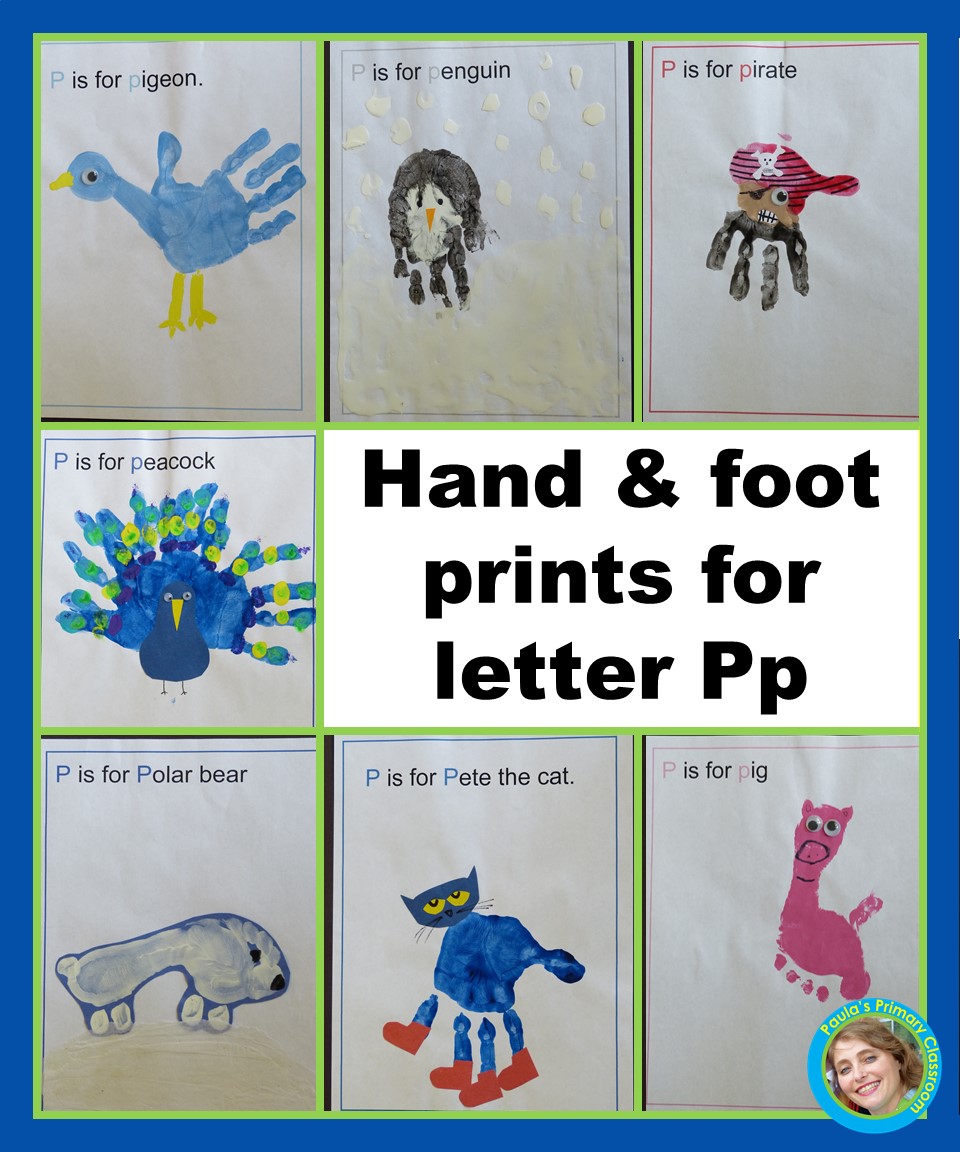
As always, you can find the original inspiration for each of these, and many more ideas for similar crafts on this Pinterest board.

Number 9: Puzzles

Do you and your littles do puzzles together?  Puzzles require children to look for similarities and differences in shape and color, to rotate pieces, to work their finger muscles, to think about what the picture is supposed to look like, and much more.  Start with puzzles with 4 or 5 pieces, and work up to more complex ones.  You can usually find puzzles at resale stores or garage sales for very little money, and your local library may also have some in the play area that you can use while you're looking for books!

Number 10: Letter crafts

Make the letter-sound connection by creating letters that go along with some of the letter Pp activities you're doing this week.  We added penguins to pink or purple lower case letter p, and turned the upper case P into a pepperoni and peppers pizza pie. 

Have a great week friends - peace!

Wednesday, March 4, 2020

Help! How should I teach my child to read?


Parenting is hard - maybe the hardest job there is!  Our children are ever changing, ever growing, ever evolving, needing different things of us.  Add a little parental sleep deprivation and a thousand other responsibilities, and how on earth are we to manage it all?

The good news is that you are already your child's first teacher!  They have or will learn to talk, walk, feed themselves and most importantly, what kind of person to be - by watching you!

Someone is learning to be a person by watching you from Paula's Primary Classroom blog


Still, there are things we want to help our children learn that we don't necessarily know enough about to be sure we're doing it "right".  Reading is one of those things, so today I want to share some ideas that can help you teach your child from home.

 (Disclaimer:This post contains affiliate links. I earn a small commission each time someone makes a purchase using one of my links, which helps to support the blog.  All opinions are my own and I only promote brands and products that I have used myself and truly love.)

The most important thing you can do to help your child learn to read is read yourself.  Let them see you reading books and magazines, point out the signs on the freeway and storefronts, let them know that reading is important to you, and read to them.  There's nothing as powerful as snuggling up together with a book and enjoying some time together!

There is no app to replace your lap from Paula's Primary Classroom blog

Learning to read and write is not a quick process, and just like walking and talking, our children go through different stages along the way.  The things we do to help them are different at each stage, so let's look at some of those steps.

Letter learning
There's more to this than just singing the ABC song, although that is a great place to start!  Before they can read, children need to know what letters look and sound like, as well as the name of each letter. 


A great introduction to letter learning is to point out the first letter in your child's name where ever you see it, and to encourage them to find it too.  Have them look for "their letter" while you're driving, when you read with them, in the grocery store, on the cereal box.  Introduce other letters as they're interested in learning more.

It's important to remember that learning is fun!  If your child is tired of a book, tired of a game, or tired of learning, move on to other things for a while.  

We want our children to choose to read and learn, not to see it as a chore.  Forget the flashcards and worksheets unless your little one truly loves them, and instead put magnetic letters on your refrigerator, foam letters in the bathtub, and have crayons, pencils and markers to draw and write with together!

Is your child asking for more?  Check out these basic skill board games that turn letter practice and other basic skills into a game you play together,
https://www.teacherspayteachers.com/Product/Ready-For-Kindergarten-Games-for-Basic-Skills-2007144
play games with letter sounds like these, or try this free St. Patrick's Day word building game where your children match letter tiles to letters.
https://www.teacherspayteachers.com/Product/Saint-Patricks-Day-Word-Building-2392921


Early emergent and emergent readers
This is what educators call that magical stage when children begin to understand that letters and strings of letters (words) have specific sounds and meanings, and they begin to read them.  Every child is different, but most children will become emergent readers some time between preschool and first grade.

Early emergent readers aren't ready for most of the books you see at the library or may have at home.  These kiddos are going to read the pictures as much as the words, and the few words there are on each page will probably be repeated on most pages.  Early childhood educators likely have sets of books like this - and your public library may too.  Emergent Reader: Red is a free example you can download and print out to read with your child, and is part of my Emergent readers for color words set.
https://www.teacherspayteachers.com/Product/Emergent-reader-red-3327294

 
 https://www.teacherspayteachers.com/Product/Color-Word-Emergent-Readers-2727117#show-price-update

If your child is in kindergarten or first grade, their teacher may have asked you to practice "sight words" or "popcorn words".  These are words that either cannot be sounded out (like "why" or "two") or that are used so often that taking time to sound them out will really slow a reader down ("the", "and", "is").

You might think you need flashcards to practice these words - and you certainly can practice them that way, but my students have always preferred games like Polar Bear Sight Words and Three Little Pigs Sight Words for practicing.

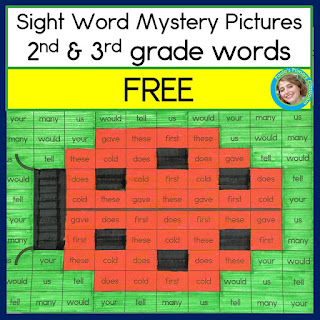
If your child enjoys coloring, or you need them to practice without you for a short time, sight word mystery pictures can be fun too!  These are worksheets you can print out, and your child can read the sight words and color by code.  As they color each space, a picture emerges.  Try this FREE fish sight word mystery picture with kindergarten words, or this FREE ladybug sight word mystery picture with 2nd and 3rd grade sight words to see if these are right for you! 

https://www.teacherspayteachers.com/Product/Sight-Word-Worksheets-Ladybug-Mystery-Picture-2nd-and-3rd-grade-FREE-4558136
If you and your child love them, I have many more sight word mystery pictures available at this link, with words for students from kindergarten to third grade.

As they move from early emergent readers to emergent readers, young readers are honing their skills and it's easy to see that they are indeed reading.  They still need lots of adult support, but they've moved beyond sounding out three letter words like "cat" and "dog" and can tackle slightly longer words with more complex spellings.

Help! How should I teach my child to read? blog post from Paula's Primary Classroom

These children are most motivated to read when they're offered something they're interested in, but still need a limited number of words on each page, and a limited vocabulary.  They may love reading Dr. Seuss books, or the Elephant and Piggie series by Mo Willems.  A lot of students at this stage also enjoy reading non-fiction or fables as they begin  "reading to learn" instead of "learning to read".

What if you're still not sure where to start?  Maybe you have more than one child and you want something easy you can do with both of them, perhaps you're really not at all sure where your child is on their reading journey, or you simply want to cover way more than just reading skills.  Good news!  You can cover all of those things while playfully learning and teaching with Bye Bye Summer Slide.
 https://www.teacherspayteachers.com/Product/Summer-Review-Packet-Bye-Bye-Summer-Slide-1857848
It's a HUGE packet, designed to be used at home to practice kindergarten, first and second grade skills.  It includes 4 game boards to print (and your child to color if desired), and cards for sight words, telling time, money, patterns and much more.  You and your child simply choose a game board and which skill you want to practice, grab a dice, and play!  If you have multiple children playing, each one can use their own set of skill cards, so one child might be working on addition and subtraction, while another identifies letters.

Yes, parenting is hard work.  Yes, it takes time and effort to help your child learn.  No, you'll probably never have ALL the answers - but
YOU can help your child learn to read!


Want some more ideas for teaching your children from home?  Click the pictures below to hear from Kelly at An Apple for the Teacher, and Melissa at Peas in a Pod!

https://l.facebook.com/l.php?u=https%3A%2F%2Fapplefortheteach.blogspot.com%2F2020%2F03%2Fhelping-your-child-learn-at-home.html%3Ffbclid%3DIwAR2-Um3utVlSI6MHRAPeymK9RWyye9uIt8ZoDHY0i-KiWCmMsJLe2FedEKQ&h=AT2CG4OIYOn5ynPMnJS3sEl0_vMIimWHWFyFIDYRlL-I4d4wC60Y2TlEn1Lw7G-Th1cJ3Qf1XYjjDpW5cFDocKod3TTGMob7LsCTKHr5q6rUZxLDAmKzGGLULLH4pPJrg87RCQ

https://peasinapodlessons.com/home-school/?fbclid=IwAR3Nf_Btc1bPJM91AX5oEDKEUa4Yo4cdqb-lWjnaVCazlMPGK65-xQGSbJI


Sunday, August 5, 2018

3 astonishingly easy ways to engage your kids in clean up

Kids engaged in clean up?  Yeah, right!  No-one wants to stop playing to clean up at home or at school - they'd rather play all day.

True, most children would rather play than clean up, but it doesn't have to be an either / or situation - clean up can be playful!  Don't believe me?  After more than 25 years of working with young children, I've learned a trick or two or three, and today I'm going to share them with you!

3 astonishinly easy ways to engage your kids in clean up, from Paula's Primary Classroom

Clean up trick #1:  The Magic Trash
I learned this trick my first year teaching, when a colleague shared it with me.  When it's time for clean up, just announce that there is a piece of magic trash waiting to be cleaned up, and watch your children scramble to find it!  Sometimes I'd offer a prize - at my school it was golden tickets - but no prize is needed if you engage with the kids to make it fun.  Say things like, "No-one has found it yet!", "____ you were close a minute ago!", or "Keep looking!"  If you're excited and engaged, the children will be too.  Make a big deal out of the "winner" who found it, and everyone will want to be the one who finds the magic trash next time.

Clean up trick #2:  Cinderella's step-mother
Which popular princess starts out by doing a whole lot of clean up?  Cinderella, of course!  Give your children a reason to role play her character by turning yourself into the mean spirited step-mother!  I always put on a properly haughty voice, and announce, "You can't possibly go to the ball until all this is cleaned up!"  (Click on the link above to hear how ridiculously silly I can be!) This one works well with a group - I usually give each child a specific task, "You! Clean the shelf!", "Sweep the floor!", "Pick up the toys!", or whatever needs doing.  If you have child sized cleaning tools like brooms, dustpans, dusters, or baby wipes, they'll eagerly play along - and that of course is the whole secret, you've made clean up into a game and you're playing it with them.  Make sure that when the cleaning is done that your little Cinderella(s) get to do something fun - like go outside to play.

Clean up trick #3: The Pirate Captain
Argh, do your kids disdain princesses?  Well maybe they'll listen to the pirate captain instead!  Once again, I recommend talking and acting in character so the kids get into the role play and make this a fun game with you.  I always start this one by announcing that I'm a pirate captain, and I'm taking away all the "loot" or "treasure" from the floor.  I then stomp off and get a bag or a box to put my haul in.  This usually prompts the children to scurry around grabbing all the toys off the floor, but just in case, when I return with the box I point out a toy that I'm taking for treasure, and make a show of marching over to pick it up.  What kid can resist racing to get there first?  Continue the fun by pointing out more toys and attempting to collect them for your own treasure.

With this clean up game I have sometimes managed to collect a few toys that the children didn't clean up, or didn't get to quickly enough.  When that happens I do put those toys out of reach for a few weeks - even though this is a game, if the children don't clean up their toys, the consequence is losing them for a time.  Will I give them back?  Of course!  Will it be today?  Not on yer life, land lubber!

I'd love to hear how these clean up games work with your children - and if you have any ideas to share with me, please leave me a comment.  I'm always looking for new ways to make learning, playing, (and even cleaning up) more fun!

Sunday, April 15, 2018

11 FREE simple ways to learn in the natural world

With Earth Day fast approaching, and spring drawing us outdoors, this seems the perfect time to celebrate the natural world around us.  Here are a few of my favorite ways to celebrate all that nature has to offer.
11 FREE, simple ways to learn in the natural world, from Paula's Preschool and Kindergarten

1.  Stomp in puddles.


2.  No puddles?  Play with iceOr mud.

3.  Collect leaves and sort them by size, shape, color, or...?

4.  Collect natural materials outside, and use them to make mandalas.

5.  Sort natural items into things that are seeds, and things that are not.  You might find some surprises!

6.  Create temporary art.

7.  Make a tic tac toe board with sticks, and use rocks & leaves as playing pieces. Find sticks that look like letters.

8.  Lay in the grass and look at clouds.

9.  Look closely at the world around you.  Take a magnifying glass and a notebook, and see what you can observe about the critters and world around you.


10.  Play in the dirt.   Plant things.  Watch them grow.

11.  Take your inside learning outdoors.  Read books under a tree, practice patterns on the playground (up/down, left/right),


count everything,

look for shapes,


play I Spy, write your spelling words in chalk, or paint them with water on the sidewalk, practice numbers with hopscotch.
 Most importantly, think outside the box that is your classroom, put your neck out, and explore. 
Wishing you a glorious time outside!
xo Paula