Welcome to Paula's Primary Classroom! This blog is where I share ideas for teaching and learning with families, friends and other early childhood educators. Please don't use the photos or text of this blog without permission, but please do use any ideas you find useful. Thank you for stopping by!
Showing posts with label homeschool. Show all posts

Sunday, August 23, 2020

A is Absolutely Amazing!

 Ants, apples, alligators and astronauts - it's time for fun while learning about the letter Aa!  When you talk, read, sing and play with your child you're helping them learn.  Preschool and kindergarten children really benefit from hands on activities like singing, finger plays, cooking, painting and more - so here are some of my favorites:

 Activity #1: Songs and rhymes for the letter A

Way Up High in an Apple Tree

Alligator, Alligator

What are they learning?  Rhyme, rhythm, vocabulary, musical pitch, and they're working finger muscles too!


Activity #2: Make applesauce

We all love food, so it's super engaging to make time to let your littles do some basic cooking activities with you!  Applesauce is a great early cooking activity because most children love it, it's a very forgiving recipe, and the steps to make it are easy enough for young children to help.

Children can learn how to cook! 

 To make your applesauce you'll need some apples, a peeler, a butter knife (for your child) a good knife (for you), water, a potato masher, a pot and a stove... a little sugar or cinnamon is optional.  Your child can learn to peel apples by pushing the peeler away from them, to safely hold a butter knife and point the end down to cut the apples (see the picture above), and to put them into a pot.  Add a little water to cover, simmer until soft, then mash with a potato masher or immersible blender.  Add sugar and cinnamon if you want.

What are they learning?  Safe use of kitchen tools, life skills, the satisfaction of preparing their own food, and spending special time with a loved adult.  As you cut the apple you can talk about cutting it in half and into quarters - great math skills!  Did you talk about the peel, flesh, core and stem?  That's science - and so is the changing state of matter that happens when heat causes the apples to soften and change into applesauce.  As  you serve it count how many scoops you put in a bowl - and if they want more, that's coming back for seconds - ordinal numbers.

 Extend the learning fun by having your child write the letter Aa in the applesauce.  Simply put a small amount of applesauce on a plate, gently shake the plate to spread it evenly, and then let your child write in it.  If they do a great job, they get to lick their finger.  Gently shake the plate to reset, and write again!


Activity #3:  Hand prints
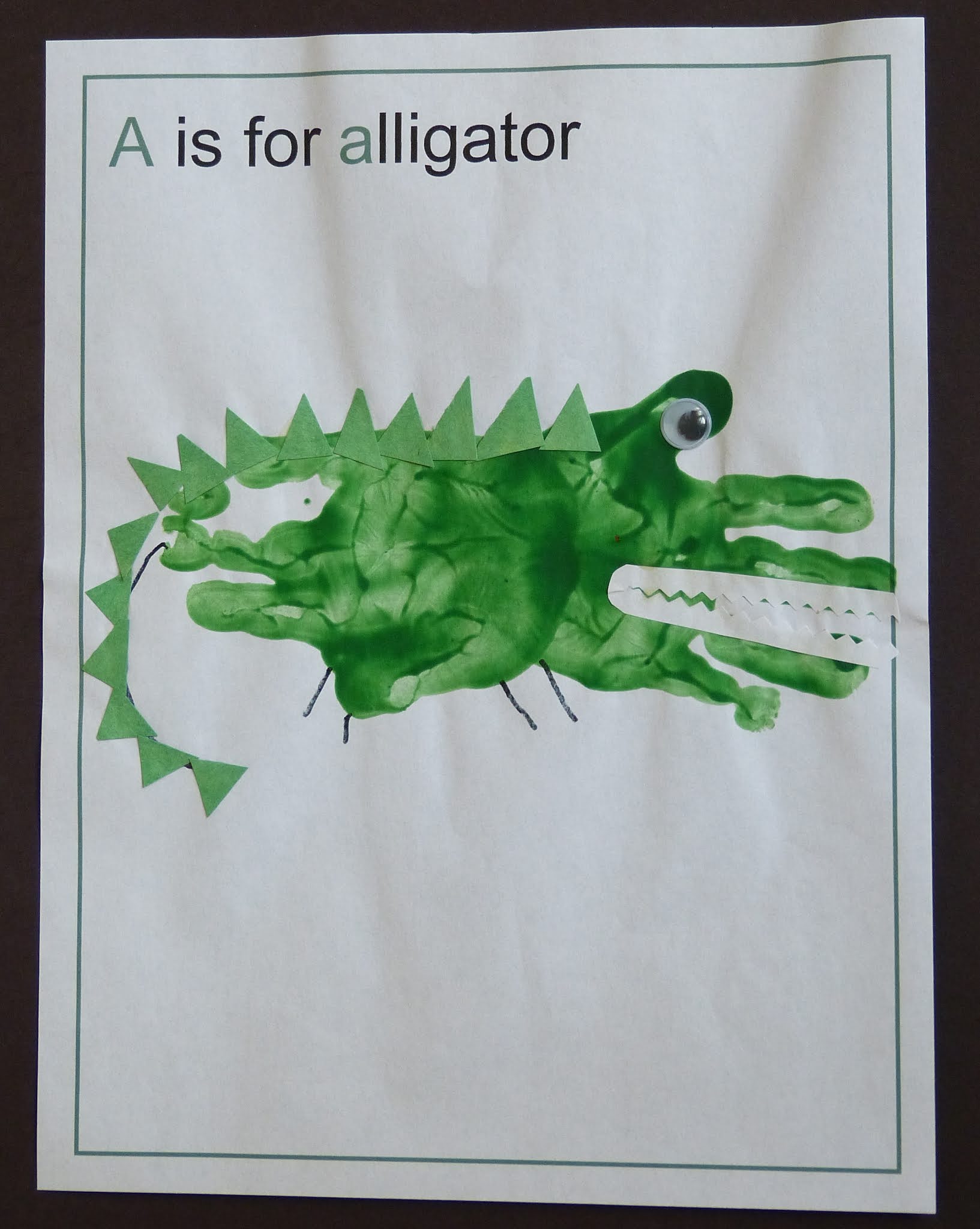


Hand prints from our little ones are something that we'll treasure forever - trust me on this one!  I had my children make their own alphabet books with hand and foot prints, by doing one each week.  I'm going to carry that over here for you, and if you can do one a week, you'll have a new favorite alphabet book!

I have the children hold out a hand for me to paint - and we talk about how the paint feels (cool, slippery, slimy, funny?) as I apply the paint.  Next we turn their hand over and place it on a paper, and I place my hand over theirs and push down firmly.  Finally, we lift their hand straight upwards so it doesn't smear everywhere.  The first few tries might be... interesting... but after a little while almost every child gets into it and masters the art of a good hand print.

For the alligator print we painted both hands, and overlapped the palms.  We used fancy scissors to cut the zig zag teeth, used a wiggle eye (wiggle eyes make everything cooler!), and added triangles for the back and tail. You are probably already really good with scissors and glue, so try to resist the urge to "help".  Children learn to use scissors by using them, and to use the right amount of glue through practice.  If they're trying, they're learning!

For the angel hand prints we paint the wings first, then make the robe when the paint for the wings is dry.  I take a photo of each child and print it out so I can trim around their face and have them add it to their angels.  

Does your little prefer an alien?  Paint just part of their hand for the print, and let them add  unusual numbers of wiggle eyes and draw on details when the paint is dry. 

What are they learning?  Scissor and glue skills, vocabulary, correlating the initial letter of words to the sound and shape of letter Aa.

 Extend the learning by adding a photo page to their alphabet book.  I like to insert the completed hand prints in a page protector and keep it in a binder.  On the facing page I add a photo of the children doing one of our activities for the letter, with a caption that includes the focus letter.  They love to "read" their books and talk about the letter and the activities, making that letter to sound connection!


Activity #4: Measuring with apples

This is a free download from my TeachersPayTeachers store. It comes with instructions, but basically you print out the pages and join the apples into a long strip.  Tape it to the wall to measure how many apples tall people and things in your house are, or let your child hold it like a ruler to measure.  Young children learn measurement with non-standard units - teacher talk for using various items to measure.
 
What are they learning?  An important concept to introduce is lining up the bottom of apple #1 with the end of the thing you're measuring.  They're practicing counting andnumber recognition -you can also use this as a number line for counting, and your children might also notice the color pattern of the apples.  Which brings us to ...

 
Activity #5 Making patterns


What are they learning?  Patterns, a very basic and essential math skill.  Picking up pompons works their finger muscles, helping their hands grow stronger - an important pre-writing skill.  Younger children may still be learning the color words, or may start counting the circles on the page.  They may ask about the question marks on the page - what question do they need to answer?  This page is included in my Apple Math Centers which is available to purchase and download.


Activity #6: Anansi the Spider! craft to follow up the book by Gerald McDermott
According to McMillan books, "Anansi the Spider is one of the great folk heroes of the world. He is a rogue, a mischief maker, and a wise, lovable creature who triumphs over larger foes."  
 
What are they learning? Folk lore from West Africa, vocabulary and story structure, and as they make their own Anansi or his sons they're cutting, pasting, creating art, and counting 8 legs.


I hope you and your little have enjoyed these activities!  For more apple activities click here, here, and here.  Find some of my favorite apple books here and see how to do a blind taste test with apples here! Join me next week for the letter Bb!

Friday, March 13, 2020

What you need to know to make it through school closures

With school closings happening to prevent the spread of  COVID 19, many parents are scrambling to figure out how to teach their children from home.  Sound familiar?  Feeling panicked?  Take a deep breath and read on.
What you need to know to make it through school closures

First, YOU CAN DO THIS!  You taught your child to eat, walk, talk, and use the bathroom, and you were probably sleep deprived when you did all that.  While juggling how to teach your children along with all the other things in your life might not be ideal, this isn't permanent, and you can do it.

Next, remember that you don't have to introduce new material, figure out which Common Core State Standards (or other set of standards) to cover, or document it all.  You and your child just need to stay afloat academically, and there are many simple things you can do to make that happen.

What you need to know to make it through school closures

1. READ
Reading is the most important thing to keep practicing, and it should be fun.  Unless your child's teacher has sent home a list of requirements, this is the time to let your child read for pleasure.  If that means reading their favorite book for the umpteenth time, so be it!  Bored with the books or magazines you have at home?

- This article suggests 7 websites with free online books for kids
- If you hop over to YouTube.com you'll find many books read aloud
- A quick search of TeachersPayTeachers found more than 20,000 FREE printable books including this one for young children from me. 
- I have 27 free resources for preschool - 3rd grade in my TeachersPayTeachers store - and you don't have to be a teacher to use the site!
-Try reading and preparing recipes.  There's nothing quite as motivating as food, and as you and your child cook together they'll also practice counting, measuring, and time (math skills), and experience changes in matter (science).  Bonus points if they want to start cooking regularly!

What you need to know to make it through school closures

2. WRITE
Think of all the times in a day when you pick up a pen and jot something down - writing with your child can be as simple as making a grocery list or brain storming activities they'd like to do.  As adults we write for many different purposes - making a list, texting or emailing, writing a story, making a photo album, recording a recipe, journaling our thoughts... they are all valid forms of writing and will keep your children learning and thinking.  Here are some things to consider:

 - Younger children might not write the same way you do - they're learning to listen to the sounds in words and to translate those sounds into letters - and that's okay for now. 
- Writing can be on a device.  Letting your child type an email or text message as you dictate it can be very motivating for some children, as is emailing a grandparent or other family member.
- Everything is more fun when they do it with you.  A reluctant writer might not get anything down on paper if left by themselves, but if you take turns adding a sentence to a story you make up together, it's infinitely more fun.
- Write down family stories together and let your child add illustrations. Bonus points if they want to read this over and over!
- Mix it up by letting them write with fancy pencils, markers, pens, etc, or pull out the magnetic letters, building blocks with letters on them, or cookie cutter letters or letter stamps if you have them. 
- Break out the scrabble and other word games and play - they're still making words and it's waaaaaay more fun than following a journal prompt!
- Print out this free observation journal, then head outside and find something to focus on and observe for a few minutes each day for a week.


What you need to know to make it through school closures

3. PRACTICE MATH FACTS
Depending on the age of your child, they may be working on addition, subtraction, multiplication, division or all of them.  Their teacher may have already given you suggestions for which facts they need to work on, or ways to practice at home.  Here are a few learning games you can do with a deck of cards or a pair of dice:

- Deal a deck of cards to you and your child(ren).  Agree on the skill you're working on (largest / smallest number, addition total, difference, multiplication).  Count to 3 and both flip a card over.  The first of you to say the correct answer takes both cards and adds them to the bottom of their pile.
- Play a memory game.  Make a set of cards with 2 of each number.  Shuffle, then deal them face down in a grid pattern.  Take turns flipping 2 cards over to see if they match.  If they do, the player who flipped them takes them and gets another try.  If they don't match, flip them back over and the other player gets a turn.
- Play the memory game above, but make a set of cards with pairs that add up to 10.  The goal is to flip 2 cards that total 10... or any other number you agree upon.
- Roll 2 dice and tell the sum or difference.
- Need to work on harder skills like adding or subtracting 3 digit numbers?  Remove the face cards from your deck of cards, and have your child lay 3 cards side by side (to represent a 3 digit number), then 3 more cards side by side below them.  Can they add them?  Subtract them? Multiply them?

Is this everything?  Goodness no - but I hope it gives you a place to start!   I'll be back again soon with more suggestions and resources.  If you haven't yet subscribed, go ahead and do it so you get notified when new posts go live.  Is there something specific you'd like to see?  Let me know in the comments!  We're all in this together, and we WILL get through this!

Wednesday, March 4, 2020

Help! How should I teach my child to read?


Parenting is hard - maybe the hardest job there is!  Our children are ever changing, ever growing, ever evolving, needing different things of us.  Add a little parental sleep deprivation and a thousand other responsibilities, and how on earth are we to manage it all?

The good news is that you are already your child's first teacher!  They have or will learn to talk, walk, feed themselves and most importantly, what kind of person to be - by watching you!

Someone is learning to be a person by watching you from Paula's Primary Classroom blog


Still, there are things we want to help our children learn that we don't necessarily know enough about to be sure we're doing it "right".  Reading is one of those things, so today I want to share some ideas that can help you teach your child from home.

 (Disclaimer:This post contains affiliate links. I earn a small commission each time someone makes a purchase using one of my links, which helps to support the blog.  All opinions are my own and I only promote brands and products that I have used myself and truly love.)

The most important thing you can do to help your child learn to read is read yourself.  Let them see you reading books and magazines, point out the signs on the freeway and storefronts, let them know that reading is important to you, and read to them.  There's nothing as powerful as snuggling up together with a book and enjoying some time together!

There is no app to replace your lap from Paula's Primary Classroom blog

Learning to read and write is not a quick process, and just like walking and talking, our children go through different stages along the way.  The things we do to help them are different at each stage, so let's look at some of those steps.

Letter learning
There's more to this than just singing the ABC song, although that is a great place to start!  Before they can read, children need to know what letters look and sound like, as well as the name of each letter. 


A great introduction to letter learning is to point out the first letter in your child's name where ever you see it, and to encourage them to find it too.  Have them look for "their letter" while you're driving, when you read with them, in the grocery store, on the cereal box.  Introduce other letters as they're interested in learning more.

It's important to remember that learning is fun!  If your child is tired of a book, tired of a game, or tired of learning, move on to other things for a while.  

We want our children to choose to read and learn, not to see it as a chore.  Forget the flashcards and worksheets unless your little one truly loves them, and instead put magnetic letters on your refrigerator, foam letters in the bathtub, and have crayons, pencils and markers to draw and write with together!

Is your child asking for more?  Check out these basic skill board games that turn letter practice and other basic skills into a game you play together,
https://www.teacherspayteachers.com/Product/Ready-For-Kindergarten-Games-for-Basic-Skills-2007144
play games with letter sounds like these, or try this free St. Patrick's Day word building game where your children match letter tiles to letters.
https://www.teacherspayteachers.com/Product/Saint-Patricks-Day-Word-Building-2392921


Early emergent and emergent readers
This is what educators call that magical stage when children begin to understand that letters and strings of letters (words) have specific sounds and meanings, and they begin to read them.  Every child is different, but most children will become emergent readers some time between preschool and first grade.

Early emergent readers aren't ready for most of the books you see at the library or may have at home.  These kiddos are going to read the pictures as much as the words, and the few words there are on each page will probably be repeated on most pages.  Early childhood educators likely have sets of books like this - and your public library may too.  Emergent Reader: Red is a free example you can download and print out to read with your child, and is part of my Emergent readers for color words set.
https://www.teacherspayteachers.com/Product/Emergent-reader-red-3327294

 
 https://www.teacherspayteachers.com/Product/Color-Word-Emergent-Readers-2727117#show-price-update

If your child is in kindergarten or first grade, their teacher may have asked you to practice "sight words" or "popcorn words".  These are words that either cannot be sounded out (like "why" or "two") or that are used so often that taking time to sound them out will really slow a reader down ("the", "and", "is").

You might think you need flashcards to practice these words - and you certainly can practice them that way, but my students have always preferred games like Polar Bear Sight Words and Three Little Pigs Sight Words for practicing.

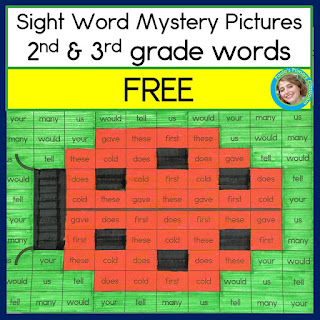
If your child enjoys coloring, or you need them to practice without you for a short time, sight word mystery pictures can be fun too!  These are worksheets you can print out, and your child can read the sight words and color by code.  As they color each space, a picture emerges.  Try this FREE fish sight word mystery picture with kindergarten words, or this FREE ladybug sight word mystery picture with 2nd and 3rd grade sight words to see if these are right for you! 

https://www.teacherspayteachers.com/Product/Sight-Word-Worksheets-Ladybug-Mystery-Picture-2nd-and-3rd-grade-FREE-4558136
If you and your child love them, I have many more sight word mystery pictures available at this link, with words for students from kindergarten to third grade.

As they move from early emergent readers to emergent readers, young readers are honing their skills and it's easy to see that they are indeed reading.  They still need lots of adult support, but they've moved beyond sounding out three letter words like "cat" and "dog" and can tackle slightly longer words with more complex spellings.

Help! How should I teach my child to read? blog post from Paula's Primary Classroom

These children are most motivated to read when they're offered something they're interested in, but still need a limited number of words on each page, and a limited vocabulary.  They may love reading Dr. Seuss books, or the Elephant and Piggie series by Mo Willems.  A lot of students at this stage also enjoy reading non-fiction or fables as they begin  "reading to learn" instead of "learning to read".

What if you're still not sure where to start?  Maybe you have more than one child and you want something easy you can do with both of them, perhaps you're really not at all sure where your child is on their reading journey, or you simply want to cover way more than just reading skills.  Good news!  You can cover all of those things while playfully learning and teaching with Bye Bye Summer Slide.
 https://www.teacherspayteachers.com/Product/Summer-Review-Packet-Bye-Bye-Summer-Slide-1857848
It's a HUGE packet, designed to be used at home to practice kindergarten, first and second grade skills.  It includes 4 game boards to print (and your child to color if desired), and cards for sight words, telling time, money, patterns and much more.  You and your child simply choose a game board and which skill you want to practice, grab a dice, and play!  If you have multiple children playing, each one can use their own set of skill cards, so one child might be working on addition and subtraction, while another identifies letters.

Yes, parenting is hard work.  Yes, it takes time and effort to help your child learn.  No, you'll probably never have ALL the answers - but
YOU can help your child learn to read!


Want some more ideas for teaching your children from home?  Click the pictures below to hear from Kelly at An Apple for the Teacher, and Melissa at Peas in a Pod!

https://l.facebook.com/l.php?u=https%3A%2F%2Fapplefortheteach.blogspot.com%2F2020%2F03%2Fhelping-your-child-learn-at-home.html%3Ffbclid%3DIwAR2-Um3utVlSI6MHRAPeymK9RWyye9uIt8ZoDHY0i-KiWCmMsJLe2FedEKQ&h=AT2CG4OIYOn5ynPMnJS3sEl0_vMIimWHWFyFIDYRlL-I4d4wC60Y2TlEn1Lw7G-Th1cJ3Qf1XYjjDpW5cFDocKod3TTGMob7LsCTKHr5q6rUZxLDAmKzGGLULLH4pPJrg87RCQ

https://peasinapodlessons.com/home-school/?fbclid=IwAR3Nf_Btc1bPJM91AX5oEDKEUa4Yo4cdqb-lWjnaVCazlMPGK65-xQGSbJI