I love teaching and learning with young children, this is where I share my ideas.
Welcome to Paula's Primary Classroom! This blog is where I share ideas for teaching and learning with families, friends and other early childhood educators. Please don't use the photos or text of this blog without permission, but please do use any ideas you find useful. Thank you for stopping by!
Showing posts with label free printables. Show all posts
Showing posts with label free printables. Show all posts
Yes, it's time for all things pirate, International Talk Like a Pirate Day is September 19th and anyone who doesn't want to join in the fun can walk the plank! So dust off your tricorn hat, slip on an eye patch, and ramp up that fake accent - let's have some fun!
Have you read Pirates Love Underpants? If you haven't, prepare yourself for giggles and silliness - there's not much that's funnier to a group of 5 or 6 year olds than underwear! (This is not an affiliate link, just a helpful suggestion).
After reading the book I love to do underwear math because math should always be fun! We practice counting, sorting, patterns and adding with underpants and even feed underpants to a dinosaur read color words.
Another awesome thing about pirates is their mustaches and beards - pirates are scruffy, just like it says in Tough Boris by Mem Fox! Why not add a little face paint and turn your students into pirates? Don't miss out on the fun, you definitely need a mustache too!
Want lots more ideas about pirates, including some of my favorite books? I've blogged about it here, here, here and here!
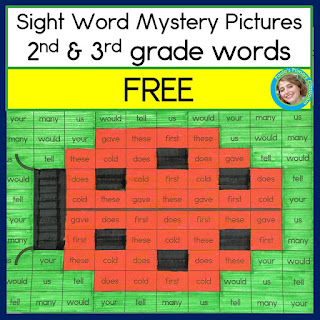
If your students are ready to add and subtract within 20, I have a FREE pirate themed activity for you! Students solve addition and subtraction facts, then color by number to reveal this burly fellow!
If you want more pictures like him, and want to differentiate for adding, subtracting, and a mix of both, each within 5, 10 or 20, then you'll love these guys!
I hope you treasure these pirate activities! Just in case you haven't had enough pirate puns yet, click here for more pirate jokes from Fatherly.com!
Have you ever made play dough with your children? It's a great sensory experience - this dough is even scented with sugar free Kool-Aid - and it is cheaper than buying, and lasts a LONG time! Making dough is this week's cooking activity!
While we're talking about sensory activities, I have some adorable hand print ideas for you this week!
It includes 2 sets of dino number cards 1 - 20, the addition mat pictured at top, and a worksheet. (Sorry, the plastic dinos and number tiles don't come with it.)
My students also had a blast making these dragons! I taped bubble wrap to the table (or to boxes), let the children paint all over the bubble wrap, and then we laid paper over the painted bubble wrap, pressed down to take a print, carefully lifted the paper, and ta-da! Scales! When its dry cut out your dragon, and provide paper scraps to add details!
Children choose a dog name card, count how many letters are in the name, and count out a matching number of doggy bones OR if they're working on letter recognition, they can match the letters in each doggy name with 1" letter tiles.
While we're focusing on letters, here's a fun initial sound activity for Dd! Go on a scavenger hunt for things that start with Dd (think duck, dragon, deer, donuts, dogs, etc.), a few things that do NOT start with D, and a non-breakable dish. Children go through the items one at a time, placing only those that start with D on the dish. As they do, they sing this song (to the tune of there's a spider on the floor):
"There's a d___ on the dish, on the dish. There's a d___ on the dish on the dish. If I had a wish, I'd put a d____ on a dish, there's a d____ on a dish, on a dish." (Click here to hear me sing it on my YouTube channel.)
Finally, you and your kiddos can make letter D crafts! There are a couple of ways to make the dotty D. For the one pictured below I offered wine bottle corks to dip in paint and stamp onto our D. They're a great size for small hands to hold, and make a lovely circular dot. Another way to do it is to use a circle punch and work finger muscles to make lots and lots of polka dots to glue on.
The lowercase d is a dinosaur - we added a head with mouth and eyes, and triangles for the tail. I had the children glue a piece of white paper behind the hole in the d, and in that space I wrote "First the dinosaur, then its tail." If you made the lowercase b craft, you can see that these two letter crafts complement each other, and help children remember the difference between the two letters.
Are YOU digging the letter Dd yet? Subscribe or come back next week for hands on ideas for the letter E - it's exciting!
Ants, apples, alligators and astronauts - it's time for fun while learning about the letter Aa! When you talk, read, sing and play with your child you're helping them learn. Preschool and kindergarten children really benefit from hands on activities like singing, finger plays, cooking, painting and more - so here are some of my favorites:
Activity #1: Songs and rhymes for the letter A
Way Up High in an Apple Tree
Alligator, Alligator
What are they learning? Rhyme, rhythm, vocabulary, musical pitch, and they're working finger muscles too!
Activity #2: Make applesauce
We all love food, so it's super engaging to make time to let your littles do some basic cooking activities with you! Applesauce is a great early cooking activity because most children love it, it's a very forgiving recipe, and the steps to make it are easy enough for young children to help.
Children can learn how to cook!
To make your applesauce you'll need some apples, a peeler, a butter
knife (for your child) a good knife (for you), water, a potato masher, a
pot and a stove... a little sugar or cinnamon is optional. Your child
can learn to peel apples by pushing the peeler away from them, to safely
hold a butter knife and point the end down to cut the apples (see the
picture above), and to put them into a pot. Add a little water to
cover, simmer until soft, then mash with a potato masher or immersible
blender. Add sugar and cinnamon if you want.
What are
they learning? Safe use of kitchen tools, life skills, the satisfaction
of preparing their own food, and spending special time with a loved
adult. As you cut the apple you can talk about cutting it in half and
into quarters - great math skills! Did you talk about the peel, flesh, core and stem? That's science
- and so is the changing state of matter that happens when heat causes
the apples to soften and change into applesauce. As you serve it count
how many scoops you put in a bowl - and if they want more, that's
coming back for seconds - ordinal numbers.
Extend the learning fun by having your child write the letter Aa in the applesauce. Simply put a small amount of applesauce on a plate, gently shake the plate to spread it evenly, and then let your child write in it. If they do a great job, they get to lick their finger. Gently shake the plate to reset, and write again!
Activity #3: Hand prints
Hand prints from our little ones are something that we'll treasure
forever - trust me on this one! I had my children make their own
alphabet books with hand and foot prints, by doing one each week. I'm
going to carry that over here for you, and if you can do one a week,
you'll have a new favorite alphabet book!
I have the children
hold out a hand for me to paint - and we talk about how the paint feels
(cool, slippery, slimy, funny?) as I apply the paint. Next we turn
their hand over and place it on a paper, and I place my hand over theirs
and push down firmly. Finally, we lift their hand straight upwards so
it doesn't smear everywhere. The first few tries might be...
interesting... but after a little while almost every child gets into it
and masters the art of a good hand print.
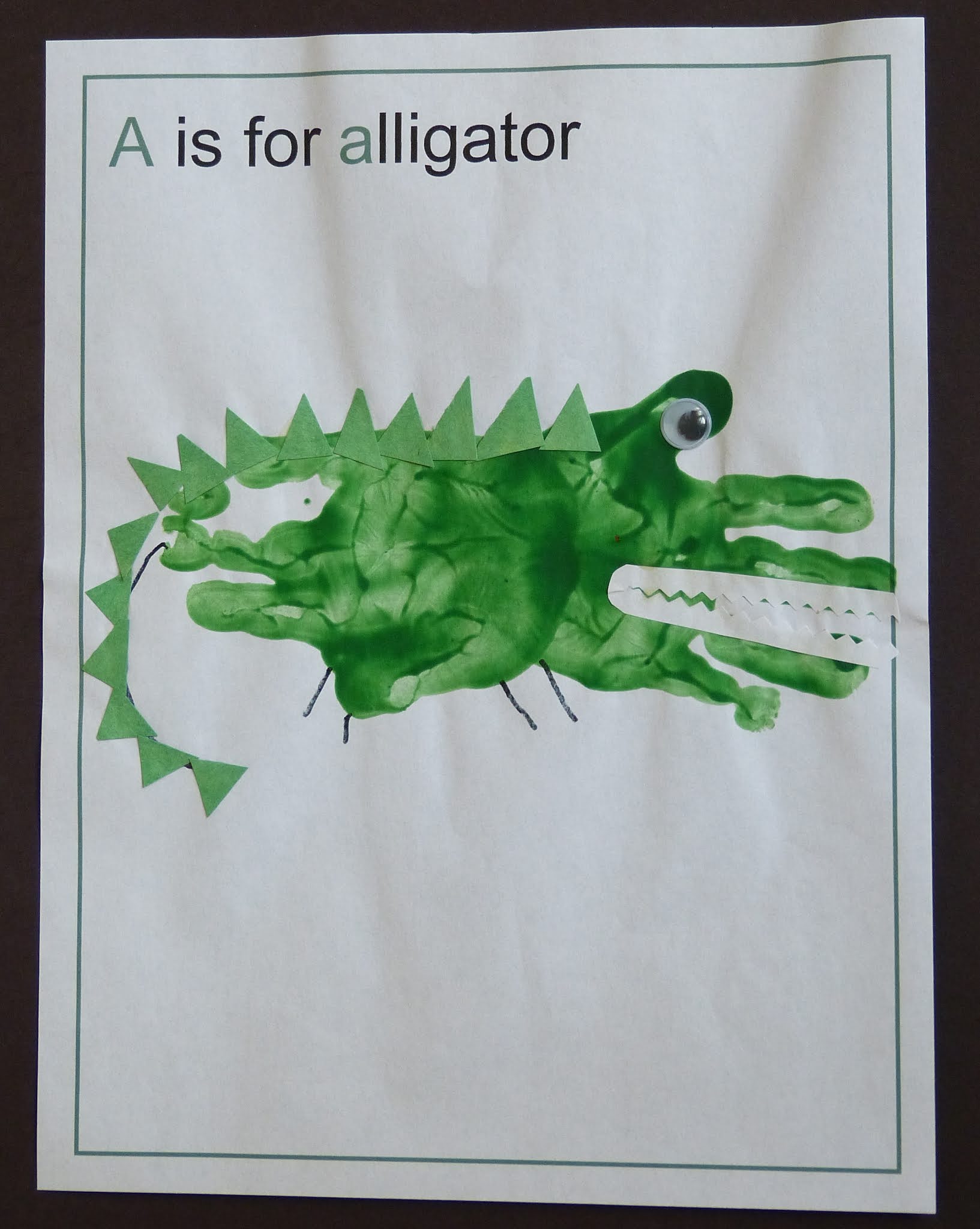
For the alligator print
we painted both hands, and overlapped the palms. We used fancy scissors
to cut the zig zag teeth, used a wiggle eye (wiggle eyes make
everything cooler!), and added triangles for the back and tail. You are
probably already really good with scissors and glue, so try to resist
the urge to "help". Children learn to use scissors by using them, and
to use the right amount of glue through practice. If they're trying,
they're learning!
For the angel hand prints we paint the wings
first, then make the robe when the paint for the wings is dry. I take a
photo of each child and print it out so I can trim around their face
and have them add it to their angels.
Does your little prefer an
alien? Paint just part of their hand for the print, and let them add
unusual numbers of wiggle eyes and draw on details when the paint is
dry.
What are they learning? Scissor and glue
skills, vocabulary, correlating the initial letter of words to the sound
and shape of letter Aa.
Extend the learning by adding a photo page to their alphabet book. I like to insert the completed hand prints in a page protector and keep it in a binder. On the facing page I add a photo of the children doing one of our activities for the letter, with a caption that includes the focus letter. They love to "read" their books and talk about the letter and the activities, making that letter to sound connection!
Activity #4: Measuring with apples
This is a free download from my TeachersPayTeachers store. It comes with instructions, but basically you print out the pages and join the apples into a long strip. Tape it to the wall to measure how many apples tall people and things in your house are, or let your child hold it like a ruler to measure. Young children learn measurement with non-standard units - teacher talk for using various items to measure.
What are they learning? An important concept to introduce is lining up the bottom of apple #1 with the end of the thing you're measuring. They're practicing counting andnumber recognition -you can also use this as a number line for counting, and your children might also notice the color pattern of the apples. Which brings us to ...
Activity #5 Making patterns
What are they learning? Patterns, a very basic and essential math skill. Picking up pompons works their finger muscles, helping their hands grow stronger - an important pre-writing skill. Younger children may still be learning the color words, or may start counting the circles on the page. They may ask about the question marks on the page - what question do they need to answer? This page is included in my Apple Math Centers which is available to purchase and download.
Activity #6: Anansi the Spider! craft to follow up the book by Gerald McDermott
According to McMillan books, "Anansi the Spider is one of the great folk
heroes of the world. He is a rogue, a mischief maker, and a wise,
lovable creature who triumphs over larger foes."
What are they learning? Folk lore from West Africa, vocabulary and story structure, and as they make their own Anansi or his sons they're cutting, pasting, creating art, and counting 8 legs.
Parenting is hard - maybe the hardest job there is! Our children are ever changing, ever growing, ever evolving, needing different things of us. Add a little parental sleep deprivation and a thousand other responsibilities, and how on earth are we to manage it all?
The good news is that you are already your child's first teacher! They have or will learn to talk, walk, feed themselves and most importantly, what kind of person to be - by watching you!
Still, there are things we want to help our children learn that we don't necessarily know enough about to be sure we're doing it "right". Reading is one of those things, so today I want to share some ideas that can help you teach your child from home.
(Disclaimer:This post contains affiliate links. I earn a small commission each time someone makes a purchase using one of my links, which helps to support the blog. All opinions are my own and I only promote brands and products that I have used myself and truly love.)
The most important thing you can do to help your child learn to read is read yourself. Let them see you reading books and magazines, point out the signs on the freeway and storefronts, let them know that reading is important to you, and read to them. There's nothing as powerful as snuggling up together with a book and enjoying some time together!
Learning to read and write is not a quick process, and just like walking and talking, our children go through different stages along the way. The things we do to help them are different at each stage, so let's look at some of those steps.
Letter learning
There's more to this than just singing the ABC song, although that is a great place to start! Before they can read, children need to know what letters look and sound like, as well as the name of each letter.
A great introduction to letter learning is to point out the first letter in your child's name where ever you see it, and to encourage them to find it too. Have them look for "their letter" while you're driving, when you read with them, in the grocery store, on the cereal box. Introduce other letters as they're interested in learning more.
It's important to remember that learning is fun! If your child is tired of a book, tired of a game, or tired of learning, move on to other things for a while.
We want our children to choose to read and learn, not to see it as a chore. Forget the flashcards and worksheets unless your little one truly loves them, and instead put magnetic letters on your refrigerator, foam letters in the bathtub, and have crayons, pencils and markers to draw and write with together!
Is your child asking for more? Check out these basic skill board games that turn letter practice and other basic skills into a game you play together,
Early emergent and emergent readers
This is what educators call that magical stage when children begin to understand that letters and strings of letters (words) have specific sounds and meanings, and they begin to read them. Every child is different, but most children will become emergent readers some time between preschool and first grade.
Early emergent readers aren't ready for most of the books you see at the library or may have at home. These kiddos are going to read the pictures as much as the words, and the few words there are on each page will probably be repeated on most pages. Early childhood educators likely have sets of books like this - and your public library may too. Emergent Reader: Red is a free example you can download and print out to read with your child, and is part of my Emergent readers for color words set.
If your child is in kindergarten or first grade, their teacher may have asked you to practice "sight words" or "popcorn words". These are words that either cannot be sounded out (like "why" or "two") or that are used so often that taking time to sound them out will really slow a reader down ("the", "and", "is").
You might think you need flashcards to practice these words - and you certainly can practice them that way, but my students have always preferred games like Polar Bear Sight Words and Three Little Pigs Sight Words for practicing.
As they move from early emergent readers to emergent readers, young readers are honing their skills and it's easy to see that they are indeed reading. They still need lots of adult support, but they've moved beyond sounding out three letter words like "cat" and "dog" and can tackle slightly longer words with more complex spellings.
These children are most motivated to read when they're offered something they're interested in, but still need a limited number of words on each page, and a limited vocabulary. They may love reading Dr. Seuss books, or the Elephant and Piggie series by Mo Willems. A lot of students at this stage also enjoy reading non-fiction or fables as they begin "reading to learn" instead of "learning to read".
What if you're still not sure where to start? Maybe you have more than one child and you want something easy you can do with both of them, perhaps you're really not at all sure where your child is on their reading journey, or you simply want to cover way more than just reading skills. Good news! You can cover all of those things while playfully learning and teaching with Bye Bye Summer Slide.
It's a HUGE packet, designed to be used at home to practice kindergarten, first and second grade skills. It includes 4 game boards to print (and your child to color if desired), and cards for sight words, telling time, money, patterns and much more. You and your child simply choose a game board and which skill you want to practice, grab a dice, and play! If you have multiple children playing, each one can use their own set of skill cards, so one child might be working on addition and subtraction, while another identifies letters.
Yes, parenting is hard work. Yes, it takes time and effort to help your child learn. No, you'll probably never have ALL the answers - but
YOU can help your child learn to read!
Want some more ideas for teaching your children from home? Click the pictures below to hear from Kelly at An Apple for the Teacher, and Melissa at Peas in a Pod!
The last time I wrote about polar bears I found very few children's books to include in my post. This time I found a LOT, and plenty of songs and rhymes too.
This post contains affiliate links. I earn a small commission each time someone makes a purchase using one of my links, which helps to support the blog. All opinions are my own and I only promote brands and products that I have used myself and truly love.
I absolutely fell in love with Sea Bear! This beautiful new book couples stunning illustrations with some of the most poetic language you'll find - and it's simple enough for young children to understand and connect with. It starts,
"Polar bears are patient beasts, as patient as glaciers. We know how to hope and how to wait. I learned to be patient long ago from my polar bear mother - "
The story follows a polar bear as it paddles across open ocean, searching for ice or land to stand on. As the journey goes on, you and your little ones will find yourself aching for land along with the polar bear. Without ever mentioning conservation, this book absolutely lends itself to further conversation about it. The text and illustrations show many other Arctic animals along the way, from orca and seals, to narwhal, walrus and sharks. I cannot recommend it highly enough!
This book also provides a perfect lead in for talking about how polar bears are insulated against the cold by their blubber and fur. Making a blubber glove to insulate little hands from ice water isn't difficult - and there are instructions for it in this previous post.
If you're reading to young children, you'll also love Polar Bears! Like the other books in this series, it couples beautiful photographs with simple but meaningful text. Each 2 page spread includes just 1 - 2 sentences about polar bears, which are closely tied to the photographs. The close text and picture connection is perfect to support emergent readers as they retell or read the pages. My teacher heart also appreciates the table of contents at the beginning, the labeled picture of a polar bear, and the vocabulary page in the back of the book. I would absolutely use this book with preschool, kindergarten and first grade.
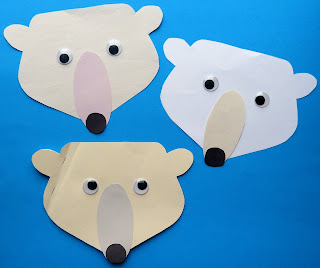
If you want a take home reader about polar bears, check out this craft and booklet I created. Like Polar Bears (above), each page includes 1-2 simple sentences about polar bears, but with black and white line drawings it's suitable to make a copy for each child to have their own. (The finished crafts also make a very impressive bulletin board!)
Polar Bear Night and the companion book Polar Bear Morning are also lovely for young children! Once again the text is simple and short, and the linocut pictures are easy to see from a short distance - important if you're using it for a story time with a big group. These books also include other Arctic animals, which I think is important for helping children build their schema of the Arctic. I've written before about including tangram puzzles in my teaching, and of course I have a puzzle for polar bears! This little sweetheart is part of my Polar Tangram set, which makes it easy to incorporate some math learning along with our polar fun.
All my tangram puzzles include the shape outline form so my youngest children can manipulate the shapes to match the picture, and a colorful picture version that offers far fewer clues. I've used these with children aged 3 - 8 and their parents, and it's amazing how engaging and challenging they can be for all ages.
My kiddos also enjoyed Please Bring Balloons. This lovely fantasy story isn't about polar bears per se, but features a beautiful carousel bear that comes to life and transports Emma to a carousel bear rumpus! I think the only other children's book with a "rumpus" is Sendak's Where the Wild Things Are, and I can see turning on kid friendly music and having a rumpus of our own after reading this book. This book also makes me want to get out polar bear shapes and a variety of craft materials for children to make their own carousel bears.
If you're like me, just reading about something isn't enough - you want to sing and dance and create and extend the learning, right? I went looking and found some adorable songs and rhymes to share with you, and I have one of my own to share too. I wrote this little song a few years ago because so many children (and adults) don't realize that polar bears and penguins don't live in the same place. Penguins live south of the equator, mostly in the Antarctic, and polar bears are north of the equator, in the Arctic. Click on the picture to download a printable song page, or click here to hear me sing it on YouTube.com.
I want to end today's post with a few more book recommendations. I've focused on books I use for story times with young children, but there are many more lovely books out there!