Welcome to Paula's Primary Classroom! This blog is where I share ideas for teaching and learning with families, friends and other early childhood educators. Please don't use the photos or text of this blog without permission, but please do use any ideas you find useful. Thank you for stopping by!
Showing posts with label caterpillar. Show all posts

Sunday, September 6, 2020

Can You C What I See?


C is for Cookie! - can you tell I grew up with Sesame Street?  My children did too, but even if we hadn't, we'd still love cookies for the letter C week.... and all the other weeks too!

Activity #1 this week is cooking!

Children love to cook, or at least, that's been my experience.  There's something almost magical about spending time with your favorite grown up, doing grown up things like cracking eggs and measuring flour, and turning all those ingredients into something delicious!  It definitely takes longer to cook when you have little hands helping you - but let me jump waaaaaaaay ahead and tell you that you'll be so glad you took the time to teach them when you have a teen who can make dinner for the family!  I've taught at least 100 children (age 3-5) how to crack an egg, and you can too!  You'll do a lot of explaining and hand holding, and you'll probably pick some egg shells out of the bowl and wipe some egg of the counter top, but how else will our little ones grow?  

I digress.  C is for cookie - so help each other make a simple sugar cookie dough, then roll it on the counter like you would to make play dough snakes, curl it a little into a C shape, and bake.

While they're baking, I recommend reading any one of the books about Who Stole the Cookies from the Cookie Jar.  Your kiddos will let you know what to do after you cook them 😄.

For times when you can't actually cook, making a camera cookie is a fun alternative!  You'll need a square of graham cracker, some peanut butter (or other spread), a small round cookie, and a few small round candies.  Give your child a butter knife, and let them spread the peanut butter on the graham cracker, then arrange the toppings to look like a camera.  Smile!

Activity #2:  Hungry Caterpillars

Surely you know the book The Very Hungry Caterpillar, by Eric Carle?  It's wonderful for learning about the life cycle of butterflies, but that little caterpillar lends itself to making a letter C shape to reinforce the letter sound too! For the upper case letter C we make a simple clown face on our letter cut out - and hey, cutting starts with C too, so remember to let your littles work their finger muscles and cut their letter out!


Activity #3 Hand prints - are you and your little ones loving the hand painting process as much as mine always have?  Here are some cute ideas for letter C!  (I've linked the original source for each handprint below, you can see many many more on my Handprints and footprints Pinterest board.)

Cake - paint your child's palm and enough fingers to show how old they are.  When the paint is dry use markers or glue on small pieces of paper to make the "flames" on the candles.

Camel - paint their whole hand, then let them add a neck and head to their camel.  When the paint is dry they can draw on the details.  For the sandy background on my example we tore some tissue paper, then used a glue stick on the solid paper, and stuck the tissue paper down.  (If you try to put the glue stick on the tissue it will probably tear.)

Caterpillar - perfect for anyone who is hesitant to get their whole hand painted, just finger tips and a leaf cut out.

Crab - paint one hand at a time, make the palm prints overlap slightly.  When it's dry let your child add wiggle eyes and claws.

Castle - paint their whole hand, when it's dry they cut and paste triangles to turn their finger prints into turrets, and add doors and windows.

Clifford - one big red hand print.  I have to admit I drew the outline for Clifford's features, then the children added a triangular nose and wiggle eyes. 

Activity #4: Crawl into a cave and find things that start with Cc.  "Sure," you're thinking, "Let me pop out to my local cave with my babies in tow and see if there just happen to be C things in it.  What could go wrong?" 

Well... nothing if your "cave" is a card table with a blanket thrown over it, and you and your child look in the toy box or around the house for things to put in the cave.  Think cup (I had a clown cup from the circus!), cows, caterpillars, cats, castles... it's amazing what you'll find when you start looking!


No room for a card table cave?  Put your letter Cc things on a table to play with!

Activity #5 Sensory play with construction vehicles or toy cars in corn.

If you've been following me a while you will know this, but for those of you who are new: if you can take sensory play outside, you'll have less clean up.  I love using feed corn for sensory play: it's super inexpensive, natural, and the squirrels clean up everything we spill.  One bag lasts a whole year, as long as you keep it dry.  I store it in our sensory play table in the garage, then scoot it out when we want to play with it.  Some people store sensory materials in tubs, and choose which one(s) to play with.  Some people don't like the mess of it at all, and choose not to do this kind of activity.  Do what works for YOU!

I hope these activities keep you and your little one happily busy learning!  If you post to social media about these activities I would LOVE to see!  Tag me on IG @PaulaBeckerman2399 or on FB Paula's Primary Classroom.  

Come back on Wednesday for 5 MORE ideas for the letter Cc!  


Monday, November 13, 2017

Can You Name This Children's Book?

Last week's Can You Name This Children's Book was a bit tricky, so this week I'm making it - I think - much easier.  Using the picture and the quote below it, can you figure it out?
Can You Name This Children's Book?  blog post series by Paula's Preschool and Kindergarten
If you said Eric Carle's The Very Hungry Caterpillar, you're right!  I think almost everyone has read this one, and it's actually one of my earliest book memories - Mrs. Potts read it to me waaaaay back when I was in first grade.

To be notified when I make new posts, follow my blog or my FaceBook page!

Tuesday, May 3, 2016

Butterfly Learning at Story Time

Have you ever raised caterpillars into butterflies, and watched the magical transformation up close? I've done it many times with classes of children, and we're doing it again at the library.
Lots of activities, ideas, and art projects to do while you're learning about butterflies with your preschool or kindergarten kiddos!
A week ago we received a special package, 5 tiny little caterpillars in a jar of food, and a net home for them to grow into.  We observed the tiny creatures, and talked about what they would soon do.  (You can see that post here.)

When we returned to story time this week, we no longer had caterpillars - we had 5 magnificent cocoons!  Ms. Debbie carefully showed them to the children, then transferred them into the net home they'll soon inhabit.
Lots of activities, ideas, and art projects to do while you're learning about butterflies with your preschool or kindergarten kiddos!

We read several butterfly books, both fiction and non-fiction, and learned some great new vocabulary: proboscis, metamorphosis, life cycle, symmetry, chrysalis and more.

To follow up we painted egg carton caterpillars, and gave them pipe cleaner antennae.
Lots of activities, ideas, and art projects to do while you're learning about butterflies with your preschool or kindergarten kiddos!

We made life butterfly life cycles from pasta (risotto for eggs, rotini for caterpillars, shells for the chrysalis, and of course bow-tie noodles for the butterflies!
Lots of activities, ideas, and art projects to do while you're learning about butterflies with your preschool or kindergarten kiddos!

We practiced the concept of symmetry by decorating some lovely die-cut butterflies.
Lots of activities, ideas, and art projects to do while you're learning about butterflies with your preschool or kindergarten kiddos!

We even made a pictograph: Do you prefer caterpillars or butterflies?  Can you guess which one was the most popular?
Lots of activities, ideas, and art projects to do while you're learning about butterflies with your preschool or kindergarten kiddos!

For all the learning and fun that we had, the best is yet to come.  We're waiting for our butterflies to hatch, and then we'll take them outside, where they belong, and set them free.  If we are very lucky the life cycle will start again in the garden around our library, and we'll have butterflies all summer!

Saturday, April 23, 2016

Celebrating Earth Day with Natural Materials - part 2

I wrote last week about some ways to celebrate Earth Day with natural materials - and this week we implemented those ideas at our library story time.  Here are the results!
Fun math and art activities celebrating Earth Day - lots of great ideas and projects for preschool and kindergarten kiddos! I love the technology tie in!

We (50 children and their caregivers!) took a walk around the library, collecting natural treasures as we went.  In our plants themed learning earlier this month we learned that plants breathe through their leaves, so we didn't want to pick any living leaves or flowers off our plants.  The children were incredibly respectful, choosing fallen leaves, petals, sticks, seed pods, bark and more, but leaving all the living and growing things outside where they belong.
Fun math and art activities celebrating Earth Day - lots of great ideas and projects for preschool and kindergarten kiddos! I love the technology tie in!
 It was an absolutely beautiful day for a nature walk! 
Fun math and art activities celebrating Earth Day - lots of great ideas and projects for preschool and kindergarten kiddos! I love the technology tie in!

Back inside, we provided blank pages for the children to arrange their treasures, but instead of giving them glue or another way to stick everything together permanently, we made our creations temporary works - and encouraged our families to teach their children how to use camera phones to capture their pictures!
Fun math and art activities celebrating Earth Day - lots of great ideas and projects for preschool and kindergarten kiddos! I love the technology tie in!
There was a lot of counting and lining up of materials, as well as some beautiful arrangements!
Fun math and art activities celebrating Earth Day - lots of great ideas and projects for preschool and kindergarten kiddos! I love the technology tie in!

Fun math and art activities celebrating Earth Day - lots of great ideas and projects for preschool and kindergarten kiddos! I love the technology tie in!

Fun math and art activities celebrating Earth Day - lots of great ideas and projects for preschool and kindergarten kiddos! I love the technology tie in!

Here a grandmother is teaching her little one how to use the camera phone, and to email it to mom and dad at work!  This is age appropriate use of technology, a way to use it to connect children and families.  I LOVE IT!
Fun math and art activities celebrating Earth Day - lots of great ideas and projects for preschool and kindergarten kiddos! I love the technology tie in!

Our caterpillars arrived this week, and we'll be watching them grow and metamorphose - we had out caterpillar books and magnifying glasses today.
Fun math and art activities celebrating Earth Day - lots of great ideas and projects for preschool and kindergarten kiddos! I love the technology tie in!

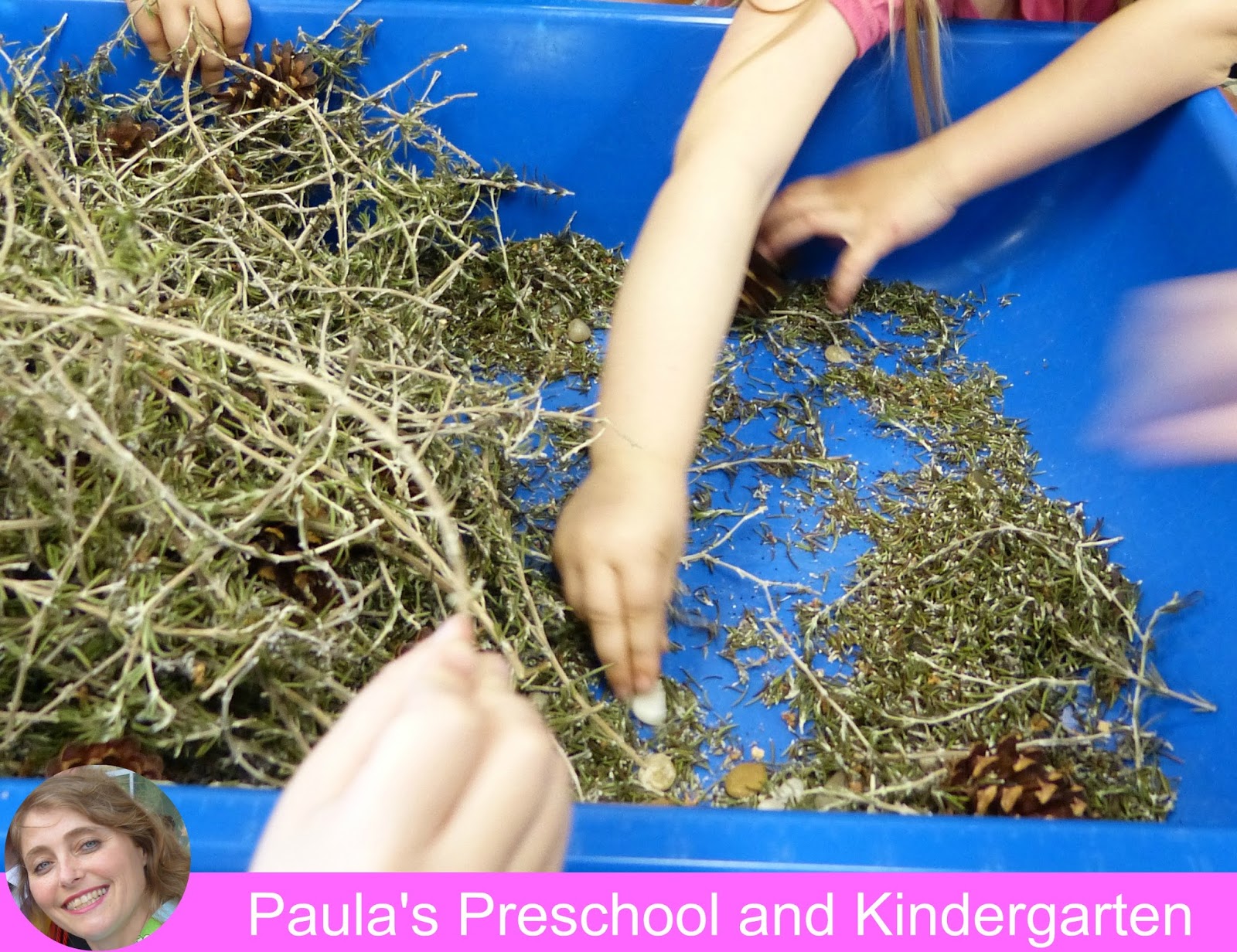
We also put out a lovely natural sensory bin for our little ones to explore.  I recently trimmed my rosemary bushes, and saved the fragrant leaves to use as a base for our bin.  We added pretty pebbles, pine cones and shells.  As the children searched through the bin, the rosemary leaves separated from their stems and released a beautiful scent.  This was a sensory bin in more ways than one!
Fun math and art activities celebrating Earth Day - lots of great ideas and projects for preschool and kindergarten kiddos! I love the technology tie in!

Small children seem to love collecting tiny things, and this group was no exception.  They carefully collected every pebble, shell and pine cone from the rosemary, then sorted and explored them.  (The long conical shells at the top of this picture turn out to be "unicorn horn shells".  Who would have known?)
Fun math and art activities celebrating Earth Day - lots of great ideas and projects for preschool and kindergarten kiddos! I love the technology tie in!

Seeing the kiddos sorting, we grabbed out some trays and had them work together to separate all the materials - wonderful for us, because we were planning to sort it all out to put it away when the children were done.
Fun math and art activities celebrating Earth Day - lots of great ideas and projects for preschool and kindergarten kiddos! I love the technology tie in!

There was one more fantastic learning opportunity today, but I'm not a skilled enough photographer to capture it well: we introduced the children to maple seeds.  If there was a maple tree anywhere in your neighborhood as a child, you may remember them as "helicopter seeds" - when tossed in the air they spiral down like little helicopters.  I had collected hundreds of them while walking this last week, and the children were, of course, fascinated.  There were 8 - 10 children at a time on the carpet throwing seeds up in the air, and laughing and jumping as they watched them spiral down.

Natural materials like these are free, just laying around at our feet, waiting for us to remember the wonder of being a child scientist, to joyfully explore and discover.

May all our days be filled with helicopter seeds, unicorn horn shells, and the laughter of children!

Wednesday, February 11, 2015

Learning about insects

I don't know about where you live, but here in Texas, spring is just around the corner.  In the last 10 days our first daffodil has bloomed, and the trees are covered in leaf buds.  They aren't opening yet, but there is definitely a promise of spring in the garden.

Spring is best enjoyed outdoors, and it's a great time to learn about all the little critters that share our world with us. 

While some children are lucky enough to experience nature in a big way every day - I'm thinking farm or country life, or frequent nature walks - not everyone is. One kind of animal almost every child gets to see up close and personal is insects.  All those amazing things that creep, crawl, and all too often "bug" us!

I can't tell you how many times I've taken children to the zoo, only to have them all oo-ing and ah-ing over a beetle or a roly poly.  Sound familiar?  There's a couple of things that make all those little critters so appealing: they're tiny, and kids seem to love tiny things, they move, and that's pretty cool, and there are so many of them that you can almost always find one to check out!

Sometimes it's best not to touch.  I never could identify this particular caterpillar (if you know what it is, I'd love you to leave a comment!), but I try to have the children leave hairy, spiky caterpillars alone. 
I try to teach my kiddos to be safe, without being scared.  Bees are scary to a lot of children, whether because they've been stung, heard about stings, or because their family members are afraid.  Instead of teaching the children to fear them, I like to talk about how to be safe around them.  I teach the children that bees are attracted to bright colors - like flowers.  If our clothes are brightly colored, a bee may want to investigate us, even land on us.  But as soon as they realize we aren't sugary sweet like a flower, they'll fly off.

It's amazing to see the relief on children's faces when they realize that bees aren't out to get them!  We also talk about how a bee's stinger is part of her body, and that she dies if she stings something.  If we aren't a threat - batting at her or bothering her, then she most likely won't bother us either.

 If you have a garden area, even a small one, you probably get lots of insect visitors that you can observe.  Try giving children a pencil and a notepad and encouraging them to draw what they see. 

 Check out the aphids on our cabbage plants!  (Yes, it really is cabbage.  I let them go to flower, and then we watch the insects come, and we also like to nibble on the tasty cabbage flowers ourselves - although not if they're covered in aphids!)

It's no surprise to find ladybugs crawling on the cabbage, and we often find ladybug pupa too!

 We also learn about insects a lot of other places.  With books, of course, but also on field trips.  We saw "Critter Man" at one of our local libraries over the summer, and he had some SERIOUS insects to show us!
 This looks like a bee, but it isn't.  On a trip to the Botanic Gardens one of the children pointed out the "big bee" by the flowers.  I was able to snap a few shots, and upon closer inspection realized it was a moth.  Cool!

I've blogged before about seeing the butterfly exhibit at the Fort Worth Botanic Gardens, but I'll mention it again anyway.  If there is an opportunity for you to walk through a live butterfly exhibit, I hope you will - unless your children are scared of them.  Last year I took 3 different groups of children to the exhibit, and the first 2 groups LOVED it.  There were 2 kiddos in the last group who didn't like bugs getting too close to them, and it didn't matter that they were harmless and beautiful.  I should have prepared those kiddos better for our trip, or let them skip it.  20 years of teaching, and yes, there is definitely still more for me to learn!

 Can you see the butterfly on the left using its proboscis to suck up sweet juice from the fruit?  How cool is that?!


If you don't have a garden area, and you can't get to an exhibit, you might consider raising butterflies.  I've had a lot of luck with painted lady butterflies, which I've ordered from Insect Lore before.  There are other companies too, that's just the one I've used.  The first time I raised butterflies I had them in a cardboard box enclosure with plastic side windows.  Please, please, don't use that!  It wasn't big enough for the butterflies to fly in, so they'd launch from one side, crash into the windows, and unable to hold onto the slick plastic, slip to the floor.  They were able to climb up the corners, between plastic  sheets.  Sad!  After that I made a wire frame that fit inside a large plastic bin, and added a fine mesh cover.
 Our butterflies only stayed in it a few days before we released them, and it was a much better arrangement!

I've bragged about Bella's book club at the Botanical Research Institute of Texas before too.  Check out the fun insect learning activities we enjoyed at one of their story times.  If you are in or near Fort Worth, I highly recommend joining them!

Of course there are times when you need to take the learning inside, and if you are a teacher, there are times you need paper and pencil activities too.  


 If you are interested in insect themed arts and crafts, please check out my Insect board on Pinterest,

there are so many people with so many amazing ideas!

I've put many of my best insect photographs into a fun sentence-picture matching activity.  (It is $3.50 to buy from my TeachersPayTeachers store).
A complete literacy and/or science center, Insect Photo Sentence Picture Match comes with 12 close up photographs of common insects, and sentences to match. With a focus on commonly used nouns, preprimer and primer words, these simple factual sentences will teach your students about insects including butterfly, dragonfly, katydid, ladybug, praying mantis, wasp, beetles, ants and bumblebees.
I used a lot of preprimer and primer words, and designed the activity for student success.  I tried it out with a former student, and as you can see from the look on her face, she was ecstatic  to discover she could really read all the sentences.  If you're working on early reading, or you have a junior entomologist on your hands, I hope you'll check it out!

If you'd like to see all my insect themed resources, just click here!

Have an awesome spring!