I love teaching and learning with young children, this is where I share my ideas.
Welcome to Paula's Primary Classroom! This blog is where I share ideas for teaching and learning with families, friends and other early childhood educators. Please don't use the photos or text of this blog without permission, but please do use any ideas you find useful. Thank you for stopping by!
Showing posts with label spring. Show all posts
Monday, March 20, 2017
Spring is in the air #Kinderfriends bloghop
Wouldn't it be nice if there was an activity that would bring out the very best in your students? Something that would get them excited about learning, behaving better, engaged in a writing activity, and eager to revisit their learning? While we're wishing for so much, we might as well make it age appropriate, and good for their physical well-being. And free, free is always good! Let's aim for the moon!
So what free miracle activity is healthy for our bodies and minds, age appropriate, and exciting too? It's really pretty simple - the simplest actually: fresh air and nature. This spring, I hope you can find a way to take your learning outside, to observe whatever plants and animals are available to you, and to incorporate them into your teaching and learning.
Step 1: Before they can concentrate and focus, our students need a chance to run, to stretch their bodies, and let loose. Remember in the olden days, we had a thing called recess? Students took a break from sitting and focusing on adult directed activities, and ran around outside. By the time they were done they were hot, sweaty, thirsty, and ready to sit down and focus again.
Step 2: Slow down and pay attention to the things around you. Kids are inherently good at this. Junior scientists from birth, they naturally observe and investigate the world. I like to make notebooks, pencils and magnifying glasses available during our outside time, it still amazes me how often students choose to draw and write about what they see. Stop and look with them - you won't be disappointed (although disgusted and freaked out are definitely possible).
Step 3: Take some "inside" activities outside. If you can do nothing else, simply take a basket of books outside and sit together to read. Maybe you could eat lunch outside...
...or take your sensory play outdoors...
... or explore physics for that matter!
Dig for worms, watch roly pollies, and compare slugs and snails.
I know for many of you, the reality is that you have to justify this kind of learning, to have paper and pencil grade-able tasks to show that learning is happening, and that you have a limited time to cover approximately 75,103 required skills. Well, I know it's just a bandaid on a gaping wound, but I've created a free printable for your students to document what they're learning as you do hands on fun learning activities.
There are 4 pages, each with room for a drawing (or photo) of the activity, and room for students to write about the experience. You can use the same printable over and again, and collect the pages in a bradded pocket chart to make individual writing books that will show the growth in students' drawing and writing over the course of the year. Best of all, students LOVE to read their own books, or those of their friends - so they'll be motivated to both write and read about the activities you set up for them. Field trip? Write about it! Cool bug on the playground? Write about it! Lost a tooth? Got new shoes? Did that exciting thing that you just have to tell your teacher all about? Write about it!
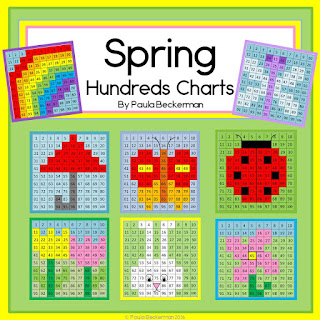
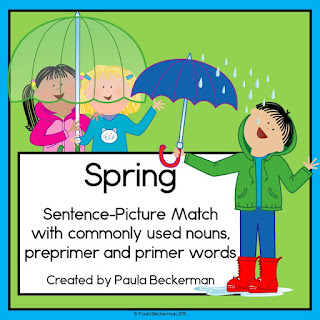
Yes, eventually you'll have to go back inside, but you'll all be invigorated, a bit hot, sweaty and thirsty, and maybe even ready to sit down and focus again. To help you be ready for those times, I've put all of my spring resources on sale for 20% off through 3/23/17. Here are just a few of them, including one more forever freebie!
Just search #KinderFriends on TpT to find discounted resources just right for spring!
Thank you for stopping by! Now hop on over to my friend Pamela at Pocketful of Centers, to find even more spring ideas, inspiration and freebies!
Sunday, March 19, 2017
Sunday, April 3, 2016
Learning about Plants
Spring time is in full swing, with flowers blooming, trees budding, and insects humming - so it's a great time to learn about plants!
Ms. Debbie found an activity online that looked very promising,so I tried it at home over the weekend, to see if it would work for our preschoolers.
The website suggested submerging leaves in water, then waiting to see the bubbles of oxygen that the leaves produce. What a cool idea! I tried it out with 7 different leaves that I had on hand in the garden, to see which one(s) would best demonstrate the phenomena.
I found that the herb leaves were too small to show it well, but large flat leaves were great! After one hour I could see some bubbles, and after 2 hours there were a lot.
I carefully set everything up, in 3 separate bowls, so lots of kiddos could see at the same time.
Unfortunately, with our tables being jostled by 90+ people in the room, any bubbles that formed soon were knocked free. This would make a great activity to do at home, or with a small group, but didn't go as planned for our kiddos. If you work with children though, you know this isn't the end of the story. I'll come back to it shortly!
At the other end of one of the table I set up another awesome plant experience for our children. There were large bean seeds that had been soaking for 2 days (I recommend 3 or even 4 days if you can), plus pea pods, seed diagrams, and magnifying glasses.
The children were encouraged to carefully open the pea pods, and to pull apart the beans and peas to discover their various parts. The seed coats on the beans came off fairly easily, and splitting the seeds revealed the embryonic plants waiting inside. They kiddos were fascinated!
So how did that interact with the oxygen experiment going on further down the table? Soup, of course! If you have peas and beans and leaves and rocks and water, of course the children are going to create "soup"! I didn't witness the process, but was delighted to find the result - because it is so very typical of this age group, and a resourceful young child found a way to turn my "dud" of an experiment into a developmentally appropriate experience. The children are always teaching me new things!
The library has some amazing resources - available for check out! - including kits full of thematic learning ideas. We pulled out all kinds of science materials to explore, including natural items....
...jigsaw puzzles...
... plant parts cards and leaf and seed samples to match to them...... and plant parts rubber stamps, so the children would think about the various parts of plants (which we talked about during story time) as they "built" their own.
The rubber stamps were a huge hit, and a lot of our friends went home with green thumbs... and green fingers too!
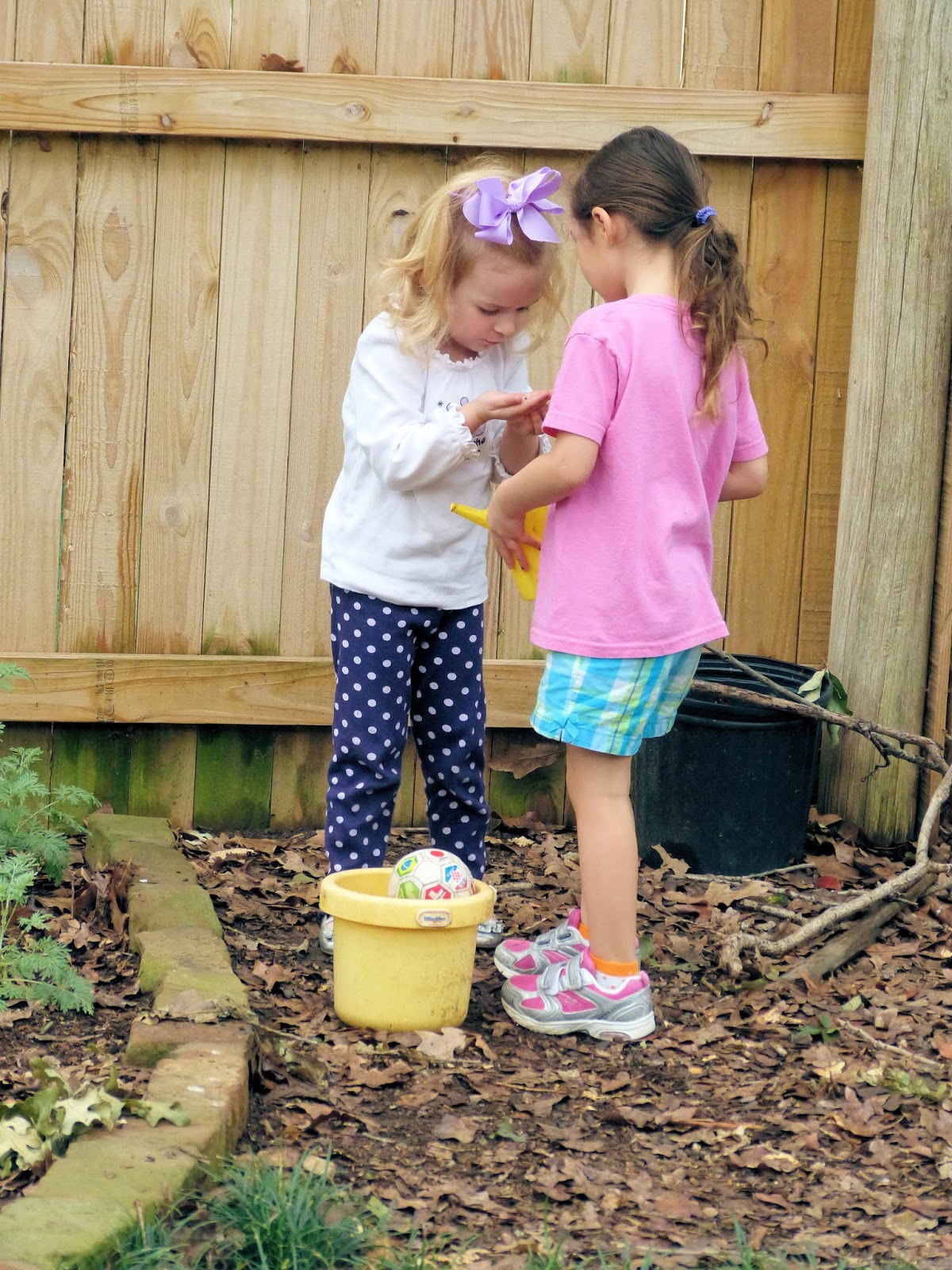
Finally, to take advantage of the lovely spring weather, we had some seriously hands on activities outside! There were soil and tiny cups for the children to plant a real bean seed to take home and water, and there was dirt to PLAY in!
Dirt, plastic pots, trowels and some trimmed pieces of plants made for a delightful pretend! While our young gardeners will have to wait at least a week to see their bean seeds sprout, this sensory bin satisfied their need for instant gratification, with a generous side helping of sunshine and dirt.
Sunshine and dirt, books and families... the recipe for a perfect spring day!
Wednesday, February 11, 2015
Learning about insects
I don't know about where you live, but here in Texas, spring is just around the corner. In the last 10 days our first daffodil has bloomed, and the trees are covered in leaf buds. They aren't opening yet, but there is definitely a promise of spring in the garden.
Spring is best enjoyed outdoors, and it's a great time to learn about all the little critters that share our world with us.
While some children are lucky enough to experience nature in a big way every day - I'm thinking farm or country life, or frequent nature walks - not everyone is. One kind of animal almost every child gets to see up close and personal is insects. All those amazing things that creep, crawl, and all too often "bug" us!
I can't tell you how many times I've taken children to the zoo, only to have them all oo-ing and ah-ing over a beetle or a roly poly. Sound familiar? There's a couple of things that make all those little critters so appealing: they're tiny, and kids seem to love tiny things, they move, and that's pretty cool, and there are so many of them that you can almost always find one to check out!
Sometimes it's best not to touch. I never could identify this particular caterpillar (if you know what it is, I'd love you to leave a comment!), but I try to have the children leave hairy, spiky caterpillars alone.
I try to teach my kiddos to be safe, without being scared. Bees are scary to a lot of children, whether because they've been stung, heard about stings, or because their family members are afraid. Instead of teaching the children to fear them, I like to talk about how to be safe around them. I teach the children that bees are attracted to bright colors - like flowers. If our clothes are brightly colored, a bee may want to investigate us, even land on us. But as soon as they realize we aren't sugary sweet like a flower, they'll fly off.
It's amazing to see the relief on children's faces when they realize that bees aren't out to get them! We also talk about how a bee's stinger is part of her body, and that she dies if she stings something. If we aren't a threat - batting at her or bothering her, then she most likely won't bother us either.
If you have a garden area, even a small one, you probably get lots of insect visitors that you can observe. Try giving children a pencil and a notepad and encouraging them to draw what they see.
Check out the aphids on our cabbage plants! (Yes, it really is cabbage. I let them go to flower, and then we watch the insects come, and we also like to nibble on the tasty cabbage flowers ourselves - although not if they're covered in aphids!)
We also learn about insects a lot of other places. With books, of course, but also on field trips. We saw "Critter Man" at one of our local libraries over the summer, and he had some SERIOUS insects to show us!
This looks like a bee, but it isn't. On a trip to the Botanic Gardens one of the children pointed out the "big bee" by the flowers. I was able to snap a few shots, and upon closer inspection realized it was a moth. Cool!
I've blogged before about seeing the butterfly exhibit at the Fort Worth Botanic Gardens, but I'll mention it again anyway. If there is an opportunity for you to walk through a live butterfly exhibit, I hope you will - unless your children are scared of them. Last year I took 3 different groups of children to the exhibit, and the first 2 groups LOVED it. There were 2 kiddos in the last group who didn't like bugs getting too close to them, and it didn't matter that they were harmless and beautiful. I should have prepared those kiddos better for our trip, or let them skip it. 20 years of teaching, and yes, there is definitely still more for me to learn!
Can you see the butterfly on the left using its proboscis to suck up sweet juice from the fruit? How cool is that?!
If you don't have a garden area, and you can't get to an exhibit, you might consider raising butterflies. I've had a lot of luck with painted lady butterflies, which I've ordered from Insect Lore before. There are other companies too, that's just the one I've used. The first time I raised butterflies I had them in a cardboard box enclosure with plastic side windows. Please, please, don't use that! It wasn't big enough for the butterflies to fly in, so they'd launch from one side, crash into the windows, and unable to hold onto the slick plastic, slip to the floor. They were able to climb up the corners, between plastic sheets. Sad! After that I made a wire frame that fit inside a large plastic bin, and added a fine mesh cover.
Our butterflies only stayed in it a few days before we released them, and it was a much better arrangement!
I've bragged about Bella's book club at the Botanical Research Institute of Texas before too. Check out the fun insect learning activities we enjoyed at one of their story times. If you are in or near Fort Worth, I highly recommend joining them!
Of course there are times when you need to take the learning inside, and if you are a teacher, there are times you need paper and pencil activities too.
If you are interested in insect themed arts and crafts, please check out my Insect board on Pinterest,
there are so many people with so many amazing ideas!
I've put many of my best insect photographs into a fun sentence-picture matching activity. (It is $3.50 to buy from my TeachersPayTeachers store).

I used a lot of preprimer and primer words, and designed the activity for student success. I tried it out with a former student, and as you can see from the look on her face, she was ecstatic to discover she could really read all the sentences. If you're working on early reading, or you have a junior entomologist on your hands, I hope you'll check it out!
If you'd like to see all my insect themed resources, just click here!
Have an awesome spring!
Spring is best enjoyed outdoors, and it's a great time to learn about all the little critters that share our world with us.
While some children are lucky enough to experience nature in a big way every day - I'm thinking farm or country life, or frequent nature walks - not everyone is. One kind of animal almost every child gets to see up close and personal is insects. All those amazing things that creep, crawl, and all too often "bug" us!
I can't tell you how many times I've taken children to the zoo, only to have them all oo-ing and ah-ing over a beetle or a roly poly. Sound familiar? There's a couple of things that make all those little critters so appealing: they're tiny, and kids seem to love tiny things, they move, and that's pretty cool, and there are so many of them that you can almost always find one to check out!
Sometimes it's best not to touch. I never could identify this particular caterpillar (if you know what it is, I'd love you to leave a comment!), but I try to have the children leave hairy, spiky caterpillars alone.
I try to teach my kiddos to be safe, without being scared. Bees are scary to a lot of children, whether because they've been stung, heard about stings, or because their family members are afraid. Instead of teaching the children to fear them, I like to talk about how to be safe around them. I teach the children that bees are attracted to bright colors - like flowers. If our clothes are brightly colored, a bee may want to investigate us, even land on us. But as soon as they realize we aren't sugary sweet like a flower, they'll fly off.
It's amazing to see the relief on children's faces when they realize that bees aren't out to get them! We also talk about how a bee's stinger is part of her body, and that she dies if she stings something. If we aren't a threat - batting at her or bothering her, then she most likely won't bother us either.
If you have a garden area, even a small one, you probably get lots of insect visitors that you can observe. Try giving children a pencil and a notepad and encouraging them to draw what they see.
Check out the aphids on our cabbage plants! (Yes, it really is cabbage. I let them go to flower, and then we watch the insects come, and we also like to nibble on the tasty cabbage flowers ourselves - although not if they're covered in aphids!)
It's no surprise to find ladybugs crawling on the cabbage, and we often find ladybug pupa too!
We also learn about insects a lot of other places. With books, of course, but also on field trips. We saw "Critter Man" at one of our local libraries over the summer, and he had some SERIOUS insects to show us!
This looks like a bee, but it isn't. On a trip to the Botanic Gardens one of the children pointed out the "big bee" by the flowers. I was able to snap a few shots, and upon closer inspection realized it was a moth. Cool!
I've blogged before about seeing the butterfly exhibit at the Fort Worth Botanic Gardens, but I'll mention it again anyway. If there is an opportunity for you to walk through a live butterfly exhibit, I hope you will - unless your children are scared of them. Last year I took 3 different groups of children to the exhibit, and the first 2 groups LOVED it. There were 2 kiddos in the last group who didn't like bugs getting too close to them, and it didn't matter that they were harmless and beautiful. I should have prepared those kiddos better for our trip, or let them skip it. 20 years of teaching, and yes, there is definitely still more for me to learn!
Can you see the butterfly on the left using its proboscis to suck up sweet juice from the fruit? How cool is that?!
If you don't have a garden area, and you can't get to an exhibit, you might consider raising butterflies. I've had a lot of luck with painted lady butterflies, which I've ordered from Insect Lore before. There are other companies too, that's just the one I've used. The first time I raised butterflies I had them in a cardboard box enclosure with plastic side windows. Please, please, don't use that! It wasn't big enough for the butterflies to fly in, so they'd launch from one side, crash into the windows, and unable to hold onto the slick plastic, slip to the floor. They were able to climb up the corners, between plastic sheets. Sad! After that I made a wire frame that fit inside a large plastic bin, and added a fine mesh cover.
Our butterflies only stayed in it a few days before we released them, and it was a much better arrangement!
I've bragged about Bella's book club at the Botanical Research Institute of Texas before too. Check out the fun insect learning activities we enjoyed at one of their story times. If you are in or near Fort Worth, I highly recommend joining them!
Of course there are times when you need to take the learning inside, and if you are a teacher, there are times you need paper and pencil activities too.
If you are interested in insect themed arts and crafts, please check out my Insect board on Pinterest,
there are so many people with so many amazing ideas!
I've put many of my best insect photographs into a fun sentence-picture matching activity. (It is $3.50 to buy from my TeachersPayTeachers store).

I used a lot of preprimer and primer words, and designed the activity for student success. I tried it out with a former student, and as you can see from the look on her face, she was ecstatic to discover she could really read all the sentences. If you're working on early reading, or you have a junior entomologist on your hands, I hope you'll check it out!
If you'd like to see all my insect themed resources, just click here!
Have an awesome spring!
Subscribe to:
Posts (Atom)