Welcome to Paula's Primary Classroom! This blog is where I share ideas for teaching and learning with families, friends and other early childhood educators. Please don't use the photos or text of this blog without permission, but please do use any ideas you find useful. Thank you for stopping by!
Showing posts with label counting. Show all posts

Sunday, November 22, 2020

Nine things you need to know about N

Number 1: Nutcrackers

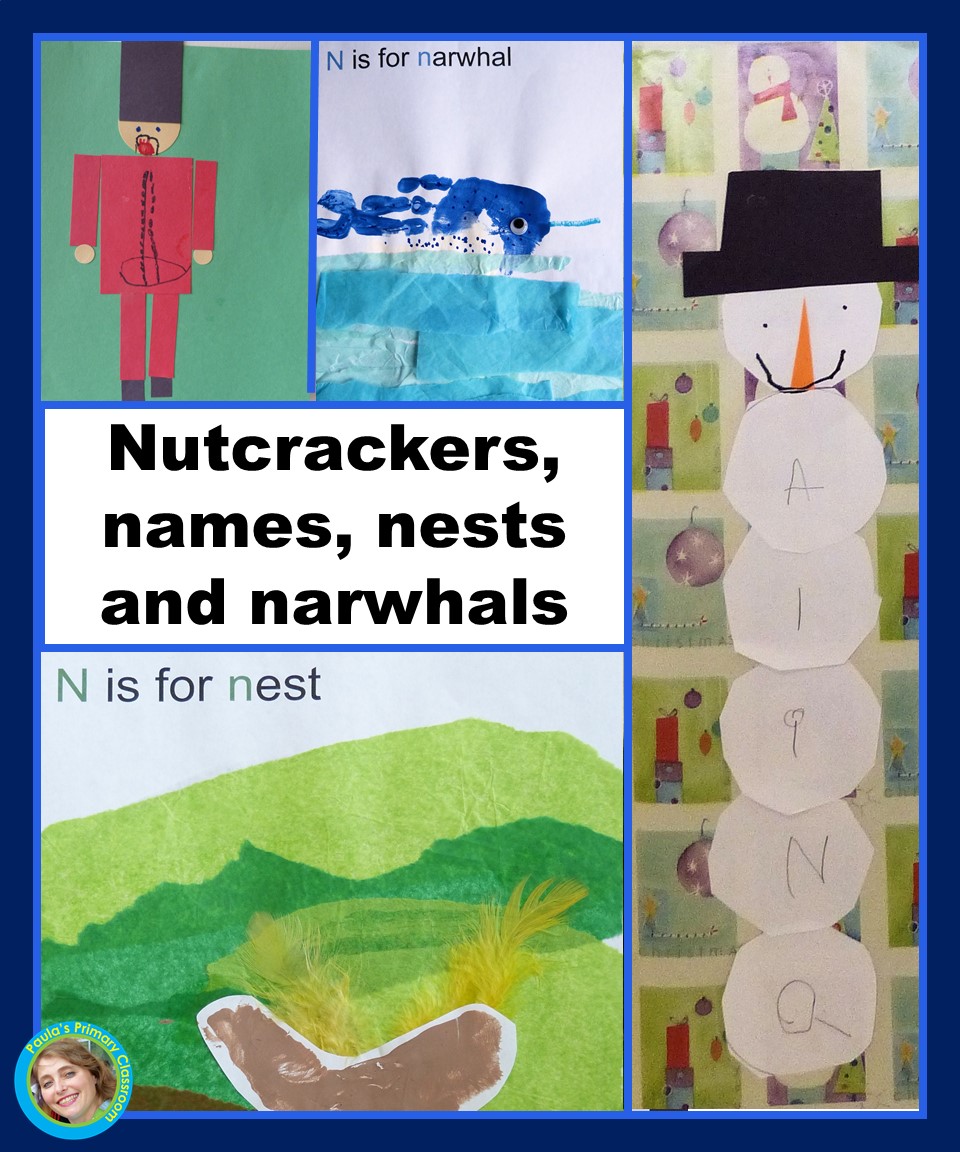
Since I'm writing this post in late November, it's a great time to think about holiday decorations and activities, and nutcrackers come to mind!  The nutcracker art project I'm showing here was all about cutting and pasting and shapes.  As you can see we've used a variety of rectangles and some circles to create our nutcrackers, and then decorated them with markers.  One of the lovely things about doing this project in my preschool was that the children could do it 2 or 3 years in a row, with different results that showed off their improved scissor and drawing skills.

Number 2: Names!

Learning their name is a big deal for a child - being able to identify it, read it, and write the letters is something that takes a long time, but since their name is THE most important word in the whole world, it never gets old!  For our snowmen names we cut out circles (one for each letter plus one for the head) and glued them down, wrote one letter on each circle, and decorated the snowman.  We did a similar project with green triangles that stacked to make a Christmas tree - but you could also practice writing it with different pens, pencils and markers, stamp it, find the letters on a cereal box, etc, the possibilities are endless!

Number 3 and 4: Nests and Narwhals

Yes, I really did teach the kiddos about narwhals.  It's easy to find a short video on YouTube about them, and then to talk about how awesome they are!  The hand prints were inspired by these from Red Ted Art - she has SO many awesome ideas, you should definitely check out her blog!

The first nest was inspired by this one from Crystal and Co. but I later modified it by printing the side of a hand from the tip of the pinkie finger to the wrist, and I think it looks more nest like this way.

Number 5: Nuts

Clearly this isn't a good activity if you have a child with nut allergies.  For those of you who can use nuts in the classroom, I found a bag of mixed nuts in the shell one December, used it for sensory play for a while, then later was still able to shell and eat the nuts.  This was one of my first sensory bins to put together, and because the nut shells felt very wood-y, I included other wood like craft supplies: clothes pins, corks and popsicle sticks.  They started out all sorted in small boxes (as you can see) and were used in various ways.  I initially put them out with cardboard tubes, and the children slid them down, discovering that the nuts rolled and the sticks and clothes pins just slid down.  Unfortunately some of the children decided the cardboard tubes made good arm cannons, so I decided to cut holes in a box and secure the tubes in the box for more purposeful play. (Yes, that's Paula talk for let's not pretend to kill each other.)  Sometimes we dumped the nuts down the tubes, sometimes we sorted, sometimes they ended up in the toy farm. Overall it was a good introduction to sensory bins for both me and the children, as we all learned something.


Number 6: Numbers

Sure, your child can count to 10, or maybe 20, isn't that everything they need to know about numbers?  Well, no.  Once children have the counting sequence memorized it's time to start counting objects.  Can they point to one object as they say each number?  Do they know to stop counting when they run out of objects to count?  Can they read the numbers and show you the correct number of fingers (apples, erasers, legos, etc.) to match the numeral?  This Christmas themed counting activity covers numerals and number words up to 20, and is a fun way to practice numbers. 

As they get a little bigger, you'll want your children to learn your phone number.  I've found that chanting it together regularly makes it so much easier to remember!  When my boys were little we'd recite our address and phone number every time we pulled into the driveway, and they had it memorized just in time for us to move to a new address. (You win some, you lose some)!


Number 7: Letter Nn crafts, of course!

For the uppercase letter N, I put out number stickers and challenged the children to put them on their letter in number order. The lowercase n was on either black paper, and decorated with stars to represent the night sky.


Number 8: Noise

The good news is, you don't even have to plan for this activity, chances are that your little one(s) will make plenty of noise anyway!  This is a good week to provide musical instruments (outside is really best) or to have your child make their own noise makers.  Not into noise?  Substitute in Nature - there is always something to explore and discover outside!


Number 9: Nine little reindeer song

I wrote this counting rhyme several years ago, perhaps your littles will enjoy singing it with me!

That's it for this week!  See you next time for the letter Oo.  Until then, have a lovely week, a delicious Thanksgiving, and stay safe!  

Paula

Wednesday, September 16, 2020

We're digging Dd!

Happy Wednesday friends!  I hope you're enjoying learning about the letter D with all our activities this week - and I'm here to share even more!

Have you ever made play dough with your children? It's a great sensory experience - this dough is even scented with sugar free Kool-Aid - and it is cheaper than buying, and lasts a LONG time! Making dough is this week's cooking activity!


While we're talking about sensory activities, I have some adorable hand print ideas for you this week! 

I found the idea for the dinosaur here, and the duck inspiration here.  You can also find a lot more great ideas on my Hand print and Foot print Pinterest board.

If your child is a junior paleontologist - a dinosaur scientist - I have an abundance of dinosaur themed learning activities, including this free counting and adding activity!

It includes 2 sets of dino number cards 1 - 20, the addition mat pictured at top, and a worksheet. (Sorry, the plastic dinos and number tiles don't come with it.)
 

My students also had a blast making these dragons! I taped bubble wrap to the table (or to boxes), let the children paint all over the bubble wrap, and then we laid paper over the painted bubble wrap, pressed down to take a print, carefully lifted the paper, and ta-da! Scales!  When its dry cut out your dragon, and provide paper scraps to add details!

For dog lovers (please tell me you're ALL dog lovers!) I have this cute letter counting activity.  

Children choose a dog name card, count how many letters are in the name, and count out a matching number of doggy bones OR if they're working on letter recognition, they can match the letters in each doggy name with 1" letter tiles.  

While we're focusing on letters, here's a fun initial sound activity for Dd!  Go on a scavenger hunt for things that start with Dd (think duck, dragon, deer, donuts, dogs, etc.), a few things that do NOT start with D, and a non-breakable dish.  Children go through the items one at a time, placing only those that start with D on the dish.  As they do, they sing this song (to the tune of there's a spider on the floor):

"There's a d___ on the dish, on the dish.  There's a d___ on the dish on the dish.  If I had a wish, I'd put a d____ on a dish, there's a d____ on a dish, on a dish."  (Click here to hear me sing it on my YouTube channel.)


Finally, you and your kiddos can make letter D crafts!  There are a couple of ways to make the dotty D.  For the one pictured below I offered wine bottle corks to dip in paint and stamp onto our D.  They're a great size for small hands to hold, and make a lovely circular dot.  Another way to do it is to use a circle punch and work finger muscles to make lots and lots of polka dots to glue on.  

The lowercase d is a dinosaur - we added a head with mouth and eyes, and triangles for the tail.  I had the children glue a piece of white paper behind the hole in the d, and in that space I wrote "First the dinosaur, then its tail."  If you made the lowercase b craft, you can see that these two letter crafts complement each other, and help children remember the difference between the two letters.

Are YOU digging the letter Dd yet?  Subscribe or come back next week for hands on ideas for the letter E - it's exciting!


Sunday, January 27, 2019

Ferociously Good Fun with Tyrannosaurus Rex and Friends

Ferociously Good Fun with Tyrannosaurus Rex and Friends, by Paula's Primary Classroom
I'd like to think I'm an innovative teacher, constantly learning new things and sharing them with the children I get to see, but recently I realized something dreadful.  I had sunk into a dinosaur rut!

Perhaps you've been there too - I have so many favorite dinosaur books that I stopped paying attention to new ones.  Between Saturday Night at the Dinosaur Stomp, all the wonderful dinosaur books by Bernard Most, Bones, Bones, Bones, and Ten Terrible Dinosaurs, who had time for more?

Thank goodness I spent a little time recently rediscovering the dinosaur books available!  Now I have some new favorites to share, just in time for my dinosaur theme. 

Ferociously Good Fun with Tyrannosaurus Rex and Friends, by Paula's Primary Classroom
Dancing with the Dinosaurs by Jane Clarke - so cute!  Who would have expected all the dinosaurs to have moves like these?  The ending shouldn't have taken me by surprise, but it did - and when I read it to my kiddos they squealed with joy.  I won't spoil it for you - go read it!

Dinosaurs Love Underpants by Claire Freedman.  I know, I'm really behind, the underpants series has been around for a while.  I have no excuse.  I do wish dinosaurs and cavemen weren't depicted together, but the way the children enjoy this one more than makes up for it.

Dinosaur vs. the Library (and all kinds of other things) by Bob Shea.  If this doesn't get your junior paleontologists excited, I don't know what will.  Simple pictures, lots of roaring, and an adorable dinosaur that every 3 or 4 year old will imagine being.  Prepare yourself for lots of roaring!

Chalk by Bill Thomson. OH MY GOODNESS!  This is a phenomenal book, as is Fossil, also by Bill Thomson.  The illustrations show extreme perspectives in a super realistic way, and tell the whole story in this wordless book.  You'll want to use this with pre-readers, but even adults will enjoy this gem.  I recently paired it with The Book With No Pictures to teach reading skills to kindergarten and first grade students.

Ferociously Good Fun with Tyrannosaurus Rex and Friends, by Paula's Primary Classroom

I started by showing the children The Book With No Pictures, and enough of them had seen it before to know that it's a very funny book - of course they wanted me to read it to them!  Of course I obliged!  (Is there anything better than reading to kids?!)  One of the magical things about this book is the use of font size, color and type to show you how to read it.  Even children who aren't comfortable readers yet can analyze the way the text looks.  Big font = big voice.  Different colors?  Must mean different voices!  Text about a robot monkey is written in a very robot like font - so we read it with robot voices.  I love how expressive the children can be as we reread parts of the book with the font choices in mind!

Late in the book it uses the word "preposterous".  I like to reread that page, and then ask the children what they think that word means.  Have they ever heard it before?  No (at least so far no-one has), yet they all tell me more or less correctly what it means.  This opens up a discussion of context clues, and how good readers can figure out what words mean!

After reading The Book With No Pictures, we read a book with no words: Chalk.  This is important to me because at this age so many children realize the importance of print that they don't necessarily want to read the pictures - but it is such a useful part of decoding text for them!  As a reading teacher I've often told students to look at the pictures for clues, but I don't model doing that often enough, and I think many children begin to think of it as "how a baby reads", or not "real" reading.  By taking away all words, readers get to focus on the pictures and on how they tell a story, creating meaning and telling the narrative.  What great skills!

 It makes sense to follow up our reading lessons with some reading practice, so we work on dinosaur sight word mystery pictures.  Click on the picture and check out this pre-primer one.
https://www.youtube.com/watch?v=iuTqYSMyQW8

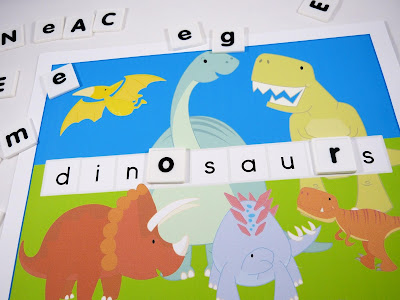
My preschool and early kindergarten students also enjoy working on dinosaur words with this word building activity.  With 14 pages of dinosaur words to build, this is a fun, hands on center for letter learners - I slip the pages into sheet protectors (easier than laminating!) and put out our 1" letter tiles.  Ta-da! Instant literacy station!
https://www.teacherspayteachers.com/Product/Dinosaur-Word-Building-Vocabulary-Posters-2914982


If you read my blog very often, you know I like to include a free resource in my posts - and here's a free counting, sequencing, and addition activity.  Click the picture to go to my TeachersPayTeachers store and download it - and if you like it, please take a moment to leave feedback so I know to keep offering freebies!
https://www.teacherspayteachers.com/Product/Dinosaur-Counting-and-Sequencing-1-20-2552564

There are a lot of other dinosaur learning activities in my TeachersPayTeachers store - I hope you'll stop by and check it out when you're prepping your dinosaur unit.  Until then, thanks for stopping by!

Paula

Tuesday, February 27, 2018

Insanely easy math fun that will make your children beg to learn!


 As I walked by the Target Dollar Spot this week, I spotted this little treasure!  200 mini erasers for $3 - and it's packaged in a divided container! 

This is a perfect math activity for our little ones to enjoy this spring.  Think of all the math they can learn as they play:  counting, sorting, graphing, patterning, 1-1 correspondence... there are so many possibilities.
I came up with a few more too - how could you use these for a Venn Diagram?  It's easy enough to make your own blank diagram - simply trace around a large bowl twice, overlapping the two circles as you do.  Can your child sort eggs/things with blue/eggs with blue?  How about bunnies/pink things/pink bunnies?

It would be easy to graph these too: have your child take a handful, and sort them.  Then line them up, and compare the rows of erasers.  What are there the most of?  The fewest?  How many more bunnies than carrots?

Have a slightly older child?  Can they add 3 bunnies and 6 eggs?  Two carrots with blue edges, and 4 carrots with yellow edges?  Can they use the erasers to answer a word problem: If I had 7 eggs, but gave 3 away, how many eggs would be left?

If your child has mastered addition and subtraction, try having them work on early multiplication skills by making a grid with the erasers.  How many is 3 rows of 5?  Can they show 12 erasers in rows and columns?  Can they do it another way?

I'm looking forward to sharing my new eraser collection with the kiddos!  How would you use it?!

Saturday, June 4, 2016

My favorite tricks for teaching children to count money

Are your children struggling to learn to count coins?  A lot of children do - but it doesn't have to be hard!  Today I'm going to share some of the tricks I've learned in over 20 years of teaching.
This post has lots of fun ideas and activities to help teach children how to count coins. Great for both parents and teachers!

(Side note: I have always used real coins with my students because fake coins just aren't the same.  Fake coins cost more than using real ones - so why on earth would I spend more to use something less useful?!  Worried they'll be stolen? In all my years teaching, I had one single dollar bill disappear from my first grade classroom one time.)  Use the real thing!

#1 Start simple, start early, repeat often

Counting mixed coins is a pretty complex task - children have to identify each coin, know it's value, start counting from the largest denomination, count by 25, 10, 5 and 1, and be able to count on while switching between those counting methods.  For most counting tasks our children will have encountered, we;ve expect them to count 1 item for each number, practicing 1-1 correspondence.  With mixed coins, they really need a whole new set of skills!  So what is a teacher (or parent) to do?

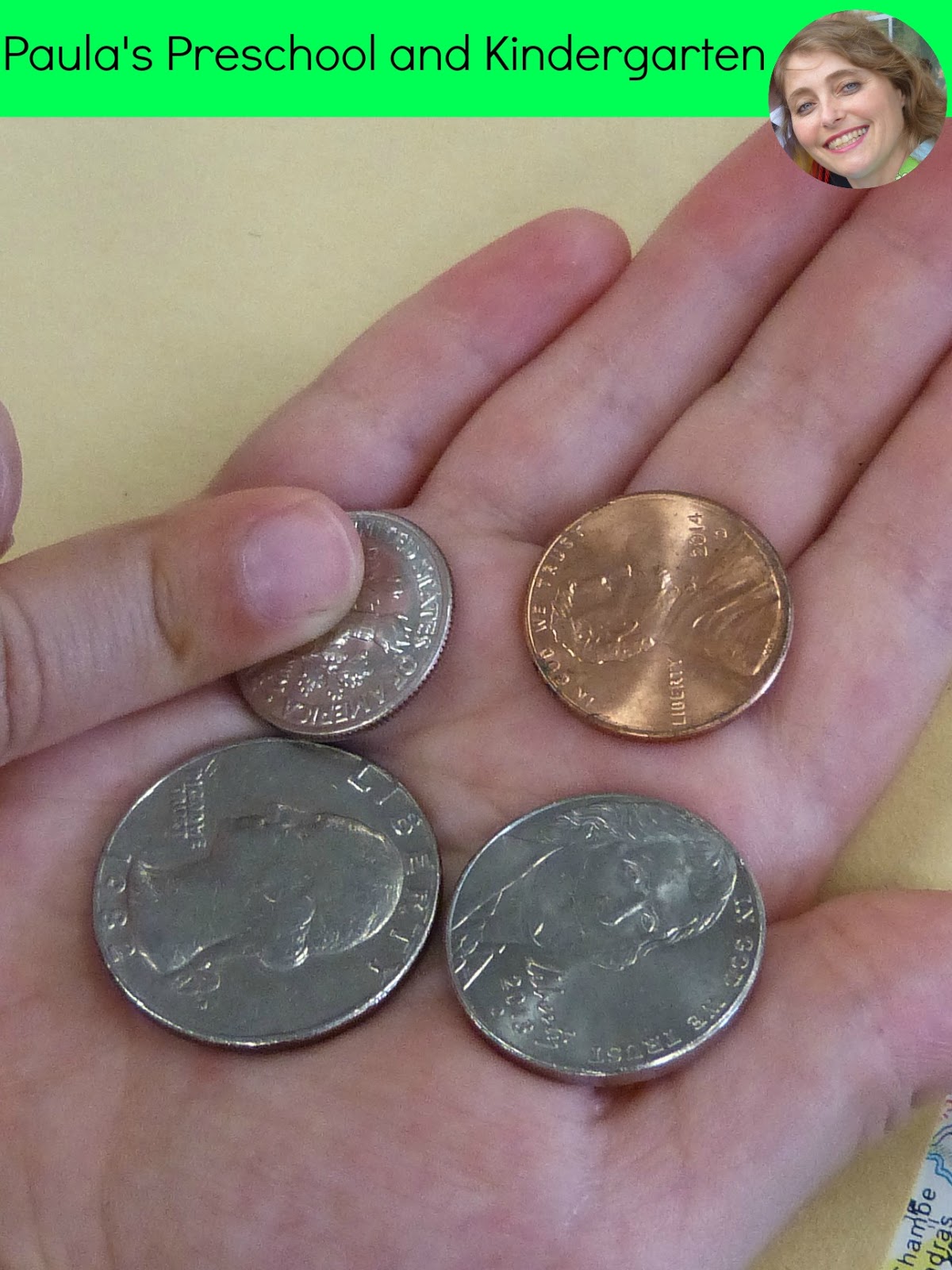
We break it down into baby steps, and we take it slowly.  We start by teaching our children to identify coins and their value.  When I still had my preschool (yes, I did say start early!) I had a stack of 3 oz plastic cups, each containing a penny, a nickel, a dime and a quarter.  Part of our daily routine was singing and dancing, and I often included a money song, such as Show Me The Money, by Jack Hartman and Money Money Money by Rhonda Crigger.  As each song began the children would spread the coins on one flat hand, so that they could point to each coin as it was named in the song.
This post has lots of fun ideas and activities to help teach children how to count coins. Great for both parents and teachers!
I could quickly monitor to see who needed help, and point to the correct coin for those children.  When the song finished, each child poured their coins back into the cup, ready for the next day. 

As simple as this sounds, the children LOVED it - they got to hold REAL money! Frequent repetition meant the children had lots of chances to master the skill, and singing about identifying each coin helped to cement the knowledge in their minds.

#2 Skip counting is essential!

Way back in the olden days, when I was student teaching, my mentor teacher was AMAZING.  One of the tricks I learned from her was to teach skip counting from the first day of school, and to modulate my voice differently for each kind of skip counting (2, 5, 10, 25).  She incorporated skip counting into our calendar or circle time, and there were movements to go along with each one.  Movement helps many children learn, and helps keep the pulse rate up a little, getting oxygen to the brain for maximum learning.

When we counted by 2, we all held up 2 fingers on each hand, and alternated extending the arms as we skip counted to 20.  To count by 5 we alternated raising left and right hands (or feet!) with five fingers (or toes) extended...
This post has lots of fun ideas and activities to help teach children how to count coins. Great for both parents and teachers!
...and for 10s we reached all 10 fingers (or toes) up each time. 
This post has lots of fun ideas and activities to help teach children how to count coins. Great for both parents and teachers!

 #3 Have fun with it!

To really grasp any new concept, we need to play around with it for a while.  Another favorite part of our day was our math play time.  After lunch each day, after we cleared the tables, I put out a variety of manipulatives for the children to explore.  We sorted, measured, organized, graphed, built shapes - and yes, you guessed it, worked with money.  Here's one of the children sorting coins.
This post has lots of fun ideas and activities to help teach children how to count coins. Great for both parents and teachers!

 An even easier way to sort is to have a pile of pennies and a pile of "not pennies" - a concept you can apply to any coin, but also to shapes, toy animals, blocks... almost anything.

As a parent I found some other ways of making money concepts fun, and I often recommended these to parents of my students too.  Try "count it and keep it" for starters.  At the end of the day you probably have some coins in your purse or your pocket.  Pull them out, and choose some that you are fairly certain your child can either identify or count - you want them to win at this game!  Show them the coins, and let them know that if they can count it, they can keep it.  They'll be begging to play this game every day, and mastering a difficult skill as they do!  Start simple (see trick #1) with just pennies, then just nickels, or just dimes.  When they have mastered counting each kind of coin, slowly increase the difficulty by mixing nickels and pennies, helping them to count the highest denomination first and the lower ones next.  I like to let the children master counting 2 kinds of coins in all the possible variations before moving on to 3 and finally all 4 kinds of coins together.

To keep my boys on their toes during summer break, I put together some super simple coin counting activities for them to do each day.  When they were in the younger grades, I put mixed coins in a film canister (do you even remember those?!) for them to count each day, just like the "count it keep it" game above.  As they got older and more skilled, I had to up the ante - and not only by putting more and more coins in each box.  I would have quickly gone broke, they were great coin counters!

Our next game was "What have I got?"  Again, I would get a small pile of coins, but this time I did the counting, and they had to figure out what I had.  I would give just 2 clues: how many coins I had, and the total value of them.  For example, if I have 9 coins worth 53 cents, what have I got?  (4 dimes, 2 nickels, 3 pennies)  If they could figure it out, they got to keep it.  Guess whose children were really good at figuring it out?  One of the beautiful things about this game was that I would give this type of clues to my oldest son, who had to figure it out, and he then put those coins in a small container for his younger brother to count.  He loved the responsibility of setting it up for his brother (or maybe he just liked that he could do something his brother couldn't), and I really liked having his help.

Another way to take this kind of play up a notch is to have children figure out change from $1.  In my classroom I had some toy grocery items, which I marked with imaginary prices, and the children had to figure out how much change they should get if they "bought" it with $1.  It doesn't sound so difficult, but it's a completely different way of thinking about money.  If you "buy" a 37 cent item, you then have to count on with pennies to get to 40 cents, a dime to get to 50 cents, and quarters to make it to $1.  (You may also have a super smart kiddo who figures 100 cents - 37 cents = 63 cents, and then counts out the coins that way!)

#4 Use other resources if you need to.

Of course, there are times when we need help to teach these skills to our children, so I've also made some money counting games available in my TpT store.  The simplest one is:
https://www.teacherspayteachers.com/Product/Ocean-Theme-Under-The-Sea-Money-1635636
Children work with just pennies, nickels and dimes, and count 2 - 4 coins at a time - great for early in the process of learning to count money!

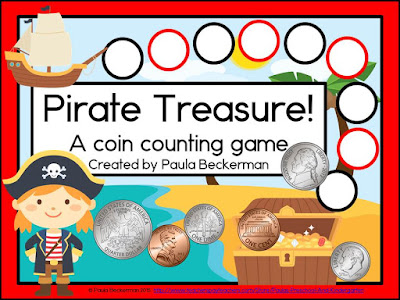
Next up is this cool pirate themed game, because everyone knows buccaneers love treasure!
https://www.teacherspayteachers.com/Product/Pirate-Treasure-A-Coin-Counting-Game-1864228
Included with this game are 96 coin counting cards, with mixed coins worth up to 35 cents.  The total values aren't huge, but each card includes from 1 - 11 coins to count, and includes many different ways to make each amount.  

For children who are ready for a little more, Bye-Bye Summer Slide includes counting cards for mixed coins up to 75 cents, and also includes game style review of sight words, addition and subtraction, telling time and much more!  I designed this resource to be reproduced and sent home with children to review during the summer, so everything is included in b&w, but the coin pages are also included in color.
https://www.teacherspayteachers.com/Product/Bye-Bye-Summer-Slide-1857848

 Do you have some nifty tricks for teaching children to count money?  I'd love to hear your ideas in the comments!


Saturday, May 7, 2016

Don't Let the Pigeon run Story Time!

Don't let the Pigeon run Story Time - ideas for extending the Mo Willems books.
Guess who showed up to story time this week?!  Hot dog, Duckling friend, buses and all.  Pigeon!
Don't let the Pigeon run Story Time - ideas for extending the Mo Willems books.

Don't let the Pigeon run Story Time - ideas for extending the Mo Willems books.
Sometimes Pigeon is a little.... shall we say... insistent.  Apparently that is HIS hotdog!  Fortunately for Duckling, Pigeon did eventually agree to share the hotdog.

Our friends painted Pigeon handprints.
Don't let the Pigeon run Story Time - ideas for extending the Mo Willems books.
 They counted stars on buses (no Pigeons were permitted to drive)!
Don't let the Pigeon run Story Time - ideas for extending the Mo Willems books.
They even pretended to help him take a bath.  We were planning real water and washcloths outside, but the weather was a bit too cold for it, so we had nice warm bath play inside.
Don't let the Pigeon run Story Time - ideas for extending the Mo Willems books.

We did venture outside for a few minutes to release our lovely butterflies.
Over the last 3 story times we've watched them grow from tiny caterpillars, to cocoons, to butterflies.
Don't let the Pigeon run Story Time - ideas for extending the Mo Willems books.
What an amazing metamorphosis!  Today it was time to release them.  The breeze seemed to excite our butterfly friends, but none of them ventured out of their net home until Ms. Debbie and I gently guided them out.  This one hung around behind the others, and everyone had a chance to see it up close.
Don't let the Pigeon run Story Time - ideas for extending the Mo Willems books.
It's just as well the Pigeon was inside doing fun activities, and not bothering these beauties! 

Wednesday, April 13, 2016

Celebrating Earth Day With Natural Materials


Earth Day is just around the corner, April 22nd.  #Kinderfriends, a group of early childhood educators, decided to do a blog hop to showcase some of the fun ways we've found to celebrate Earth Day - thank you for stopping by!

I like to use natural materials with my kiddos whenever I can, so I thought I'd share some ways to use free, natural items from your environment to teach important concepts!  The only item you need to provide for this is a way for students to contain their collection - a lunch sack or reused grocery bag works really well.  Take a walk outside, and see what natural items your students can find!  Have them make a collection of treasures.
These natural materials are beautiful and free, and just right for teaching math concepts too! I love the Earth Day tie in, and that anyone can do this with whatever natural treasures they can find.
My collection includes a variety of leaves and fallen flowers, plus some seed pods - but your collection will vary, depending on where you live.  Your students might find rocks, sticks, pine cones, sea shells - what ever you have around your school or home will work!

Have students sort their collections into piles of similar things - they're working on sorting and classifying skills.  How many different ways can they sort them?
These natural materials are beautiful and free, and just right for teaching math concepts too! I love the Earth Day tie in, and that anyone can do this with whatever natural treasures they can find.

Natural materials make excellent counters too.  I found a lot of acorn caps in pairs - time to count by 2s.  How about making groups of 10s and 1s, then figuring out how many items you have?
These natural materials are beautiful and free, and just right for teaching math concepts too! I love the Earth Day tie in, and that anyone can do this with whatever natural treasures they can find.

Maybe your students would rather make a design, like this mandala - and practice symmetry while they are at it. 
These natural materials are beautiful and free, and just right for teaching math concepts too! I love the Earth Day tie in, and that anyone can do this with whatever natural treasures they can find.
For slightly older students, counting the individual items in a mandala will reveal multiples of the number of axis it has.  For example, this mandala has 6 leaves, but 12 pink seeds and 12 crepe myrtle seed pods - because everything is in multiples of 6.  Can they add items in another multiple of 6?

These natural materials are beautiful and free, and just right for teaching math concepts too! I love the Earth Day tie in, and that anyone can do this with whatever natural treasures they can find.
Designs don't have to be math inspired - check out these insects!  While they are all symmetrical, this is also a great way to show understanding of other concepts that you've covered - such as insects have 3 body parts, antennae, and 6 jointed legs.

There are so many ways to use natural materials in our teaching and learning, I'd love to hear how you and your students integrate them into your Earth Day celebrations!

For more Earth Day ideas, continue the blog hop and check out the free ideas from our clever #Kinderfriends!  Next stop: Class of Kinders
Class of Kinders

Sunday, April 10, 2016

Dogs and Cats themed Stories - Fun!


Fun preschool or kindergarten activities and ideas for learning about cats and dogs. (Includes Pete the Cat color walk and groovy button counting)
This week Ms. Debbie and I thought we'd have a dogs and cats themed story time.  There are so many awesome children's books that star our furry friends, the hard part was choosing which books to read!  To make this day even more special, we had visitors from our local shelter join us - 2 cats and a dog, and all available for adoption!
Fun preschool or kindergarten activities and ideas for learning about cats and dogs.

Real furry friends is a wonderful start, but if you've been reading this blog, you know we like to offer a LOT of fun learning experiences.  This week we also counted the letters in some popular dog names, and put the corresponding number of doggy bones into doggy dishes.
Fun preschool or kindergarten activities and ideas for learning about cats and dogs.

Fun preschool or kindergarten activities and ideas for learning about cats and dogs.

We also counted buttons - groovy buttons - to put on Pete The Cat's shirt.  (I drew the Pete shape, made copies, and wrote numbers 3-9 on them.)  Fine motor and counting skills anyone?
Fun preschool or kindergarten activities and ideas for learning about cats and dogs. (Pete the Cat groovy buttons)

The library has some beautiful doggy counters, so we put those out with a suggestion to find ways to sort them.
Fun preschool or kindergarten activities and ideas for learning about cats and dogs.
Of course, some friends enjoyed pretend play with them (I think they are kissing!),
Fun preschool or kindergarten activities and ideas for learning about cats and dogs.
some friends lined them up (another common way for young children to explore materials),
Fun preschool or kindergarten activities and ideas for learning about cats and dogs.
and some sorted them.  I feel so sorry for this little blue dog - it looks like the yellow dogs aren't playing very nicely!

Our final activity was another super messy one, but SO incredibly worth it.  I know I've said before that something was my favorite, but.... this was really my favorite! 
Fun preschool or kindergarten activities and ideas for learning about cats and dogs. (Pete the cat color walk)
 We reenacted the story of Pete the Cat I Love My White Shoes, by James Dean and Eric Litwin.  If you haven't heard it performed by Eric Litwin, you are missing something special!  In the story, Pete steps in strawberries, blueberries, mud and water, and his shoes change colors each time.  We chose to use paint instead of fruit and mud, but the results were similar!
Fun preschool or kindergarten activities and ideas for learning about cats and dogs. (Pete the Cat color walk)
Between the trays of paint and bucket of water, I rolled out some paper for the kiddos to walk on and make their own little foot prints.  They loved it so much, and repeated it so often, we saturated and tore up not only the first set of paper, but a second as well!  There was much washing of feet, and a few families even came prepared with a change of clothes - and there were so many smiles!  Even better, perhaps, was hearing our families talking about doing this again, at home!  (To see how I did this activity in my home-based preschool, check out this blog post.)

After the kiddos left, Ms. Debbie and I snuck out for a quick play in the paint too.  I truly thought that would be the end of this particular story.
Fun preschool or kindergarten activities and ideas for learning about cats and dogs. (Pete the Cat color walk)

Post Script: When I got in the shower later that day, I discovered blue tempera paint under my toe nails.  If that's not proof that I'm an early childhood teacher, I don't know what is!  But like Pete says, "It's all good!"