Welcome to Paula's Primary Classroom! This blog is where I share ideas for teaching and learning with families, friends and other early childhood educators. Please don't use the photos or text of this blog without permission, but please do use any ideas you find useful. Thank you for stopping by!
Showing posts with label sensory play. Show all posts

Sunday, November 22, 2020

Nine things you need to know about N

Number 1: Nutcrackers

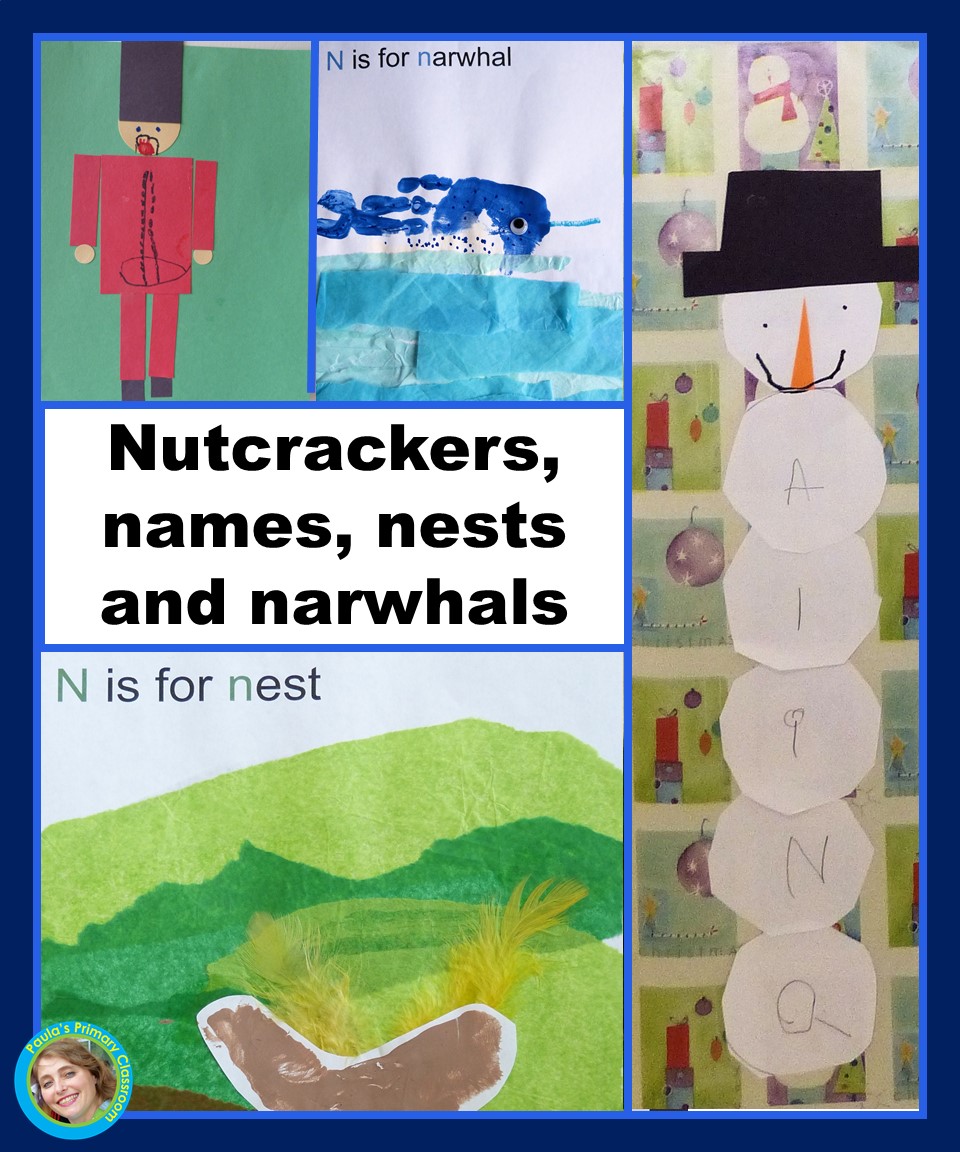
Since I'm writing this post in late November, it's a great time to think about holiday decorations and activities, and nutcrackers come to mind!  The nutcracker art project I'm showing here was all about cutting and pasting and shapes.  As you can see we've used a variety of rectangles and some circles to create our nutcrackers, and then decorated them with markers.  One of the lovely things about doing this project in my preschool was that the children could do it 2 or 3 years in a row, with different results that showed off their improved scissor and drawing skills.

Number 2: Names!

Learning their name is a big deal for a child - being able to identify it, read it, and write the letters is something that takes a long time, but since their name is THE most important word in the whole world, it never gets old!  For our snowmen names we cut out circles (one for each letter plus one for the head) and glued them down, wrote one letter on each circle, and decorated the snowman.  We did a similar project with green triangles that stacked to make a Christmas tree - but you could also practice writing it with different pens, pencils and markers, stamp it, find the letters on a cereal box, etc, the possibilities are endless!

Number 3 and 4: Nests and Narwhals

Yes, I really did teach the kiddos about narwhals.  It's easy to find a short video on YouTube about them, and then to talk about how awesome they are!  The hand prints were inspired by these from Red Ted Art - she has SO many awesome ideas, you should definitely check out her blog!

The first nest was inspired by this one from Crystal and Co. but I later modified it by printing the side of a hand from the tip of the pinkie finger to the wrist, and I think it looks more nest like this way.

Number 5: Nuts

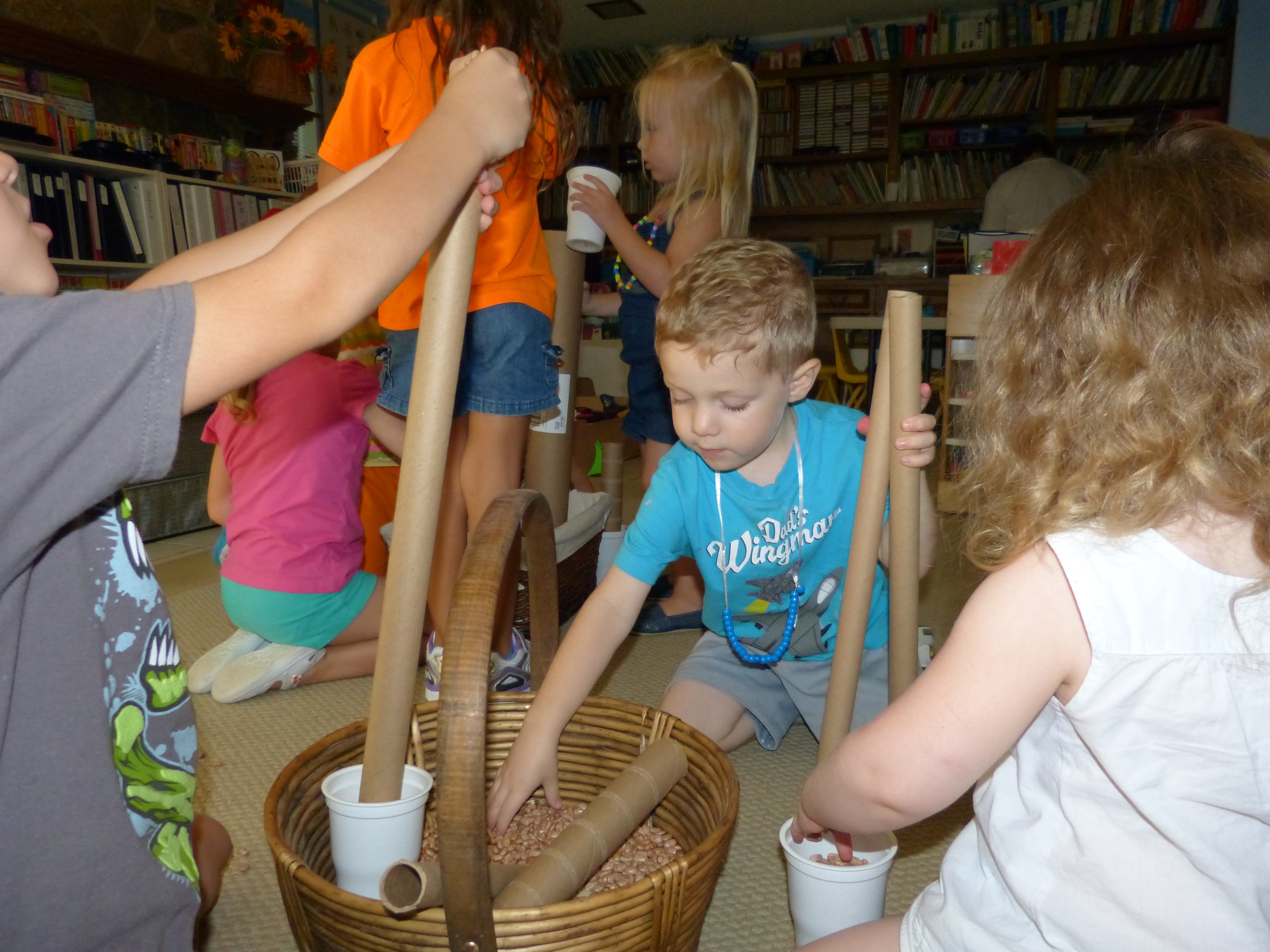
Clearly this isn't a good activity if you have a child with nut allergies.  For those of you who can use nuts in the classroom, I found a bag of mixed nuts in the shell one December, used it for sensory play for a while, then later was still able to shell and eat the nuts.  This was one of my first sensory bins to put together, and because the nut shells felt very wood-y, I included other wood like craft supplies: clothes pins, corks and popsicle sticks.  They started out all sorted in small boxes (as you can see) and were used in various ways.  I initially put them out with cardboard tubes, and the children slid them down, discovering that the nuts rolled and the sticks and clothes pins just slid down.  Unfortunately some of the children decided the cardboard tubes made good arm cannons, so I decided to cut holes in a box and secure the tubes in the box for more purposeful play. (Yes, that's Paula talk for let's not pretend to kill each other.)  Sometimes we dumped the nuts down the tubes, sometimes we sorted, sometimes they ended up in the toy farm. Overall it was a good introduction to sensory bins for both me and the children, as we all learned something.


Number 6: Numbers

Sure, your child can count to 10, or maybe 20, isn't that everything they need to know about numbers?  Well, no.  Once children have the counting sequence memorized it's time to start counting objects.  Can they point to one object as they say each number?  Do they know to stop counting when they run out of objects to count?  Can they read the numbers and show you the correct number of fingers (apples, erasers, legos, etc.) to match the numeral?  This Christmas themed counting activity covers numerals and number words up to 20, and is a fun way to practice numbers. 

As they get a little bigger, you'll want your children to learn your phone number.  I've found that chanting it together regularly makes it so much easier to remember!  When my boys were little we'd recite our address and phone number every time we pulled into the driveway, and they had it memorized just in time for us to move to a new address. (You win some, you lose some)!


Number 7: Letter Nn crafts, of course!

For the uppercase letter N, I put out number stickers and challenged the children to put them on their letter in number order. The lowercase n was on either black paper, and decorated with stars to represent the night sky.


Number 8: Noise

The good news is, you don't even have to plan for this activity, chances are that your little one(s) will make plenty of noise anyway!  This is a good week to provide musical instruments (outside is really best) or to have your child make their own noise makers.  Not into noise?  Substitute in Nature - there is always something to explore and discover outside!


Number 9: Nine little reindeer song

I wrote this counting rhyme several years ago, perhaps your littles will enjoy singing it with me!

That's it for this week!  See you next time for the letter Oo.  Until then, have a lovely week, a delicious Thanksgiving, and stay safe!  

Paula

Sunday, November 15, 2020

M might look like a mess


M might look like a mess... but then, we're talking about young children and learning, so there's a probably a lot of getting messy!  Not to worry, I have ideas for varying degrees of mess and mud, and you can always modify or skip things that don't appeal to you.

Let's start with mixing and measuring to make muffins - which combines math, life skills, motor skills and everyone's favorite - eating! My preschool kiddos and their parents love my pumpkin gingerbread muffins, and you'll love that they're moist, tasty and full to the brim with healthy pumpkin!  You can find the recipe here, along with a couple of other recipes that my students always asked for.

If your child wants to continue exploring the muffin theme, consider making a sensory bin.  For mine I put dried beans in a tub, added some empty spice and vanilla containers (they still smell marvellous!) and some plastic cookware and food, and the children had a fine old time!


Another fun cooking activity for letter M is to make "mud" for a treat.  Simply mix up chocolate pudding, crush chocolate cookies, then serve the pudding topped with the crushed cookies.  Mmmmm-mmmmm!
I like to have the children make this as a special treat on International Mud Day - yes, there really is such a thing - in June.  It's warm enough then (in the Northern Hemisphere anyway) to get in the mud and get thoroughly messy.  (We literally hose off outside afterwards.)
 
A much less messy way to enjoy Mm is with painted hand prints.  These are the ones we use, most of which I found via Pinterest, and have pinned to my Handprint and Footprint pinterest board.  The monkey was inspired by a post from Craftymorning.com, the mermaid from education.com, the mouse idea is from puttisworld.com and the mask from funhandprintart.blogspot.com .
 

If you haven't started talking to your children about money yet, this is a great time to introduce it!  (You know your child best, if they are likely to put coins in their mouth, don't offer them yet.)  I start by having children sort the coins - in the USA that means pennies, nickels, dimes and quarters.  This is a simple fine motor task that introduces children to the names of the coins and if you talk more about it, to their values. 


Here are a couple of other things you might want to add to your letter M studies:

- Take a trip to a museum (I've taken children as young as 3 to the science museum and as young as 4 to art museums.  Make sure you practice appropriate behavior ahead of time, and make your first visits short and sweet, build on them over time as your child develops the self control each situation requires.)

- Paint on mustaches.  We did this for pirate week, letter M, and circus themes, and these are some funny pictures you'll look back on years from now!

- Learn about mandalas, collect natural materials, and create symmetrical patterns - fun for math, exploring nature, and fine motor skills too.

What other activities for the letter M do you like to do?  Let me know in the comments! 

Until next week,

Paula


Wednesday, September 30, 2020

Fabulous fantastic foot prints for Ff

Okay, so only the frog is a foot print... you could definitely make Frankie from a foot print too!   If you haven't yet tried painting your child's foot, you definitely should - but maybe I should give you a few tips first.

Number 1: You need wipes handy.  You probably don't want those little feet running through the house spreading paint everywhere.  Gather everything you need before you start!

Number 2: Work over a hard and washable floor surface. 

Number 3: Sit in chairs facing each other.  It's best if your child has a child sized chair (or a step stool or something else low to sit on).

Number 4: Give them a heads up that it might tickle - and be prepared to take the time to giggle and wiggle a little bit!

Number 5: Put the paper you want to print on down on the floor between you and your child, and know that their heel will be towards them, toes towards you.  If you've written "F is for frog" on your page, you want the words to be facing you so the frog is right side up.  Unless your child wants an upside down frog, in which case I say go for it!

Another fun letter Ff activity is to make a fall sensory bin.

It's possible that I am an overachiever, and that I had 15 years of teaching to collect all this junk treasure. Do what works for YOU!  I had several scarecrow and pumpkin crafty looking things that students gave me over the years, so in they went.  The green and orange leaf trays came from the dollar store, as did a giant red felt maple leaf.  I had pompons on hand, and found the tiny pumpkins and leaves at a garage sale... You might have real fall leaves, mini pumpkins and pine cones, you could also use dry corn as a base for your bin. (I use feed corn and do it outside so squirrels and birds eat what we spill and it isn't wasted).  Get creative - let your child help!  

Another favorite activity for Ff is fish hats.

Click the link above to get full details, including the silly backstory, a link to a song you'll never get out of your head, credit for the idea, and a pattern for your own fish hats.

I keep thinking this hat would be a great reward system, if I had the children earn each scale.  Try a new food?  Get a scale.  Cleaned your room?  Get a scale.  Used your manners? Get a scale!  If there's something you've been working on with your little one, perhaps you can entice them to keep at it with a fish hat reward?  Let me know if you try this, and how it goes!

Books

Of course we need books!!  #AllTheBooks #IWantThem #PictureBooks  #NotAddicted .  I'm going to make this a list, because there are always too many for me to take pictures of... but not too many to read!


Have a wonderful week exploring the letter Ff with your child, and stop back next Sunday for ideas for Letter Gg!                                                                        Hugs!

                                                                                        Paula


Wednesday, September 16, 2020

We're digging Dd!

Happy Wednesday friends!  I hope you're enjoying learning about the letter D with all our activities this week - and I'm here to share even more!

Have you ever made play dough with your children? It's a great sensory experience - this dough is even scented with sugar free Kool-Aid - and it is cheaper than buying, and lasts a LONG time! Making dough is this week's cooking activity!


While we're talking about sensory activities, I have some adorable hand print ideas for you this week! 

I found the idea for the dinosaur here, and the duck inspiration here.  You can also find a lot more great ideas on my Hand print and Foot print Pinterest board.

If your child is a junior paleontologist - a dinosaur scientist - I have an abundance of dinosaur themed learning activities, including this free counting and adding activity!

It includes 2 sets of dino number cards 1 - 20, the addition mat pictured at top, and a worksheet. (Sorry, the plastic dinos and number tiles don't come with it.)
 

My students also had a blast making these dragons! I taped bubble wrap to the table (or to boxes), let the children paint all over the bubble wrap, and then we laid paper over the painted bubble wrap, pressed down to take a print, carefully lifted the paper, and ta-da! Scales!  When its dry cut out your dragon, and provide paper scraps to add details!

For dog lovers (please tell me you're ALL dog lovers!) I have this cute letter counting activity.  

Children choose a dog name card, count how many letters are in the name, and count out a matching number of doggy bones OR if they're working on letter recognition, they can match the letters in each doggy name with 1" letter tiles.  

While we're focusing on letters, here's a fun initial sound activity for Dd!  Go on a scavenger hunt for things that start with Dd (think duck, dragon, deer, donuts, dogs, etc.), a few things that do NOT start with D, and a non-breakable dish.  Children go through the items one at a time, placing only those that start with D on the dish.  As they do, they sing this song (to the tune of there's a spider on the floor):

"There's a d___ on the dish, on the dish.  There's a d___ on the dish on the dish.  If I had a wish, I'd put a d____ on a dish, there's a d____ on a dish, on a dish."  (Click here to hear me sing it on my YouTube channel.)


Finally, you and your kiddos can make letter D crafts!  There are a couple of ways to make the dotty D.  For the one pictured below I offered wine bottle corks to dip in paint and stamp onto our D.  They're a great size for small hands to hold, and make a lovely circular dot.  Another way to do it is to use a circle punch and work finger muscles to make lots and lots of polka dots to glue on.  

The lowercase d is a dinosaur - we added a head with mouth and eyes, and triangles for the tail.  I had the children glue a piece of white paper behind the hole in the d, and in that space I wrote "First the dinosaur, then its tail."  If you made the lowercase b craft, you can see that these two letter crafts complement each other, and help children remember the difference between the two letters.

Are YOU digging the letter Dd yet?  Subscribe or come back next week for hands on ideas for the letter E - it's exciting!


Sunday, September 6, 2020

Can You C What I See?


C is for Cookie! - can you tell I grew up with Sesame Street?  My children did too, but even if we hadn't, we'd still love cookies for the letter C week.... and all the other weeks too!

Activity #1 this week is cooking!

Children love to cook, or at least, that's been my experience.  There's something almost magical about spending time with your favorite grown up, doing grown up things like cracking eggs and measuring flour, and turning all those ingredients into something delicious!  It definitely takes longer to cook when you have little hands helping you - but let me jump waaaaaaaay ahead and tell you that you'll be so glad you took the time to teach them when you have a teen who can make dinner for the family!  I've taught at least 100 children (age 3-5) how to crack an egg, and you can too!  You'll do a lot of explaining and hand holding, and you'll probably pick some egg shells out of the bowl and wipe some egg of the counter top, but how else will our little ones grow?  

I digress.  C is for cookie - so help each other make a simple sugar cookie dough, then roll it on the counter like you would to make play dough snakes, curl it a little into a C shape, and bake.

While they're baking, I recommend reading any one of the books about Who Stole the Cookies from the Cookie Jar.  Your kiddos will let you know what to do after you cook them 😄.

For times when you can't actually cook, making a camera cookie is a fun alternative!  You'll need a square of graham cracker, some peanut butter (or other spread), a small round cookie, and a few small round candies.  Give your child a butter knife, and let them spread the peanut butter on the graham cracker, then arrange the toppings to look like a camera.  Smile!

Activity #2:  Hungry Caterpillars

Surely you know the book The Very Hungry Caterpillar, by Eric Carle?  It's wonderful for learning about the life cycle of butterflies, but that little caterpillar lends itself to making a letter C shape to reinforce the letter sound too! For the upper case letter C we make a simple clown face on our letter cut out - and hey, cutting starts with C too, so remember to let your littles work their finger muscles and cut their letter out!


Activity #3 Hand prints - are you and your little ones loving the hand painting process as much as mine always have?  Here are some cute ideas for letter C!  (I've linked the original source for each handprint below, you can see many many more on my Handprints and footprints Pinterest board.)

Cake - paint your child's palm and enough fingers to show how old they are.  When the paint is dry use markers or glue on small pieces of paper to make the "flames" on the candles.

Camel - paint their whole hand, then let them add a neck and head to their camel.  When the paint is dry they can draw on the details.  For the sandy background on my example we tore some tissue paper, then used a glue stick on the solid paper, and stuck the tissue paper down.  (If you try to put the glue stick on the tissue it will probably tear.)

Caterpillar - perfect for anyone who is hesitant to get their whole hand painted, just finger tips and a leaf cut out.

Crab - paint one hand at a time, make the palm prints overlap slightly.  When it's dry let your child add wiggle eyes and claws.

Castle - paint their whole hand, when it's dry they cut and paste triangles to turn their finger prints into turrets, and add doors and windows.

Clifford - one big red hand print.  I have to admit I drew the outline for Clifford's features, then the children added a triangular nose and wiggle eyes. 

Activity #4: Crawl into a cave and find things that start with Cc.  "Sure," you're thinking, "Let me pop out to my local cave with my babies in tow and see if there just happen to be C things in it.  What could go wrong?" 

Well... nothing if your "cave" is a card table with a blanket thrown over it, and you and your child look in the toy box or around the house for things to put in the cave.  Think cup (I had a clown cup from the circus!), cows, caterpillars, cats, castles... it's amazing what you'll find when you start looking!


No room for a card table cave?  Put your letter Cc things on a table to play with!

Activity #5 Sensory play with construction vehicles or toy cars in corn.

If you've been following me a while you will know this, but for those of you who are new: if you can take sensory play outside, you'll have less clean up.  I love using feed corn for sensory play: it's super inexpensive, natural, and the squirrels clean up everything we spill.  One bag lasts a whole year, as long as you keep it dry.  I store it in our sensory play table in the garage, then scoot it out when we want to play with it.  Some people store sensory materials in tubs, and choose which one(s) to play with.  Some people don't like the mess of it at all, and choose not to do this kind of activity.  Do what works for YOU!

I hope these activities keep you and your little one happily busy learning!  If you post to social media about these activities I would LOVE to see!  Tag me on IG @PaulaBeckerman2399 or on FB Paula's Primary Classroom.  

Come back on Wednesday for 5 MORE ideas for the letter Cc!  


Wednesday, September 2, 2020

The best activities for learning Bb

 Welcome to part 2 of letter Bb preschool activities you can do at home or at school!  In the last installment I talked about baking bread, going on a bear hunt, enjoying a teddy bears' picnic, and lots of fun backyard activities you and your child will love.  Let's explore even more ideas today!


Activity 1: Songs  

You had to know there would be songs!  You probably already know Take Me Out to the Ball Game, and if you do, you might even have a baseball bat and ball you and your littles can enjoy.  Here are two more letter Bb songs:

Beetles in the Basin in the Bathroom


Here is the Bee Hive


If you'd like to check out the counting clip cards and other early math activities with a bee theme, click here to see them in my TeachersPayTeachers store. 

Want more songs for Bb?  I have a Letter Bb playlist on my YouTube channel - click here to check it out!

Activity #2: This week's hand (and foot!) print ideas are a bumble bee, bear, and butterfly. Bea-u-ti-ful!


Last week some of you shared your hand print creations with me on Instagram 💗💗💗💗💗!  I would LOVE to see how you and your littles use any or all of these learning activities!  Please tag me @paulabeckerman2399, or leave comments on this blog - it absolutely makes my day!

Activity #3: Make binoculars

You'll need 2 paper tubes, a sheet of paper, a hole punch, and about 18' of yarn.

Start by measuring the length of your paper tubes, and cutting your sheet of paper to that width - keep all the length.  You'll have a long rectangle.  Tape or glue it to one of the paper tubes, carefully lining it up the ends of the tube and the paper.  Wrap it around both tubes, then tape or glue it in place.  (Remember, your little one can do the taping and gluing, only help with the parts they can't do well, and always let them do as much as they can!)

Use the hole punch (this part is probably too difficult for your child) to punch one hole on the outside of each tube.  Thread the yarn through and tie the ends so your child can put the binoculars around their neck.  It's fun to look through the binoculars to look for things that start with the letter B!


Activity #4  Butterfly paintings

You probably remember doing something like this when you were little: fold a paper in half, apply paint to one side, fold the paper shut, smush it, then open it again to find a symmetrical painting.  I recommend having plenty of paper on hand, because most children LOVE the magic of this simple activity.  


This is a great time to introduce the word symmetrical - being the same on both sides.  It's a great word, and once they start looking they'll notice LOTS of things are symmetrical: their face, many doors, lamps, the fireplace, the tv, the couch and more!  If they ask - and someone's child will ask - things that are not symmetrical are asymmetrical.  

Activity #5 Sensory play with a basket of beads / buttons / dry beans.

A lot of children really enjoy sensory play.  Just running your hands through a bowl of beads feels marvelous, and this is something our children don't get to enjoy often enough.  Sensory play can include water play, mud and sand play, soft animals, finger painting, smelling jars and much more - all staples of early childhood learning.  You can connect sensory play to letter learning by choosing materials that start with your focus letter, such as beads, buttons, or dry beans.  

Sensory play can get very messy - children are scientists who explore the world with wild abandon, and don't always keep materials in a container as parents and teachers might wish.  There are some easy ways to make sensory play a happier experience for both you and your child:

1. Know it will get messy to some degree, and put this kind of material out when you have the time and patience to deal with it. Stay close enough to supervise and redirect if your child starts throwing small pieces all over.  Make sure they know your expectations (Do you them to keep the materials in or near the container?  Do you expect them to help pick it up afterwards? Is there a time limit on how long you can keep it available?)

2. Place your sensory bin on a large towel or sheet, so when they're done most of the materials can easily be scooped back into the bin.

3. Consider taking water, sand and dry food materials outside to play, where clean up is easier.  I used to buy feed corn for our outside sensory bin, and whatever we didn't clean up, the squirrels would take care of.

4. Consider the ages and stages of your child(ren) and make sure materials won't be a choking hazard.

5. If the materials don't offer a way to play, your children will invent something - so put in a couple of scoops or bowls for them to fill, add some toys to hide and dig up, or add a favorite bath toy - the kind you pour water through - so they can pour materials through it.  Bored children WILL find a way to be entertained.


Activity #6: Letter Bb crafts

When I taught preschool one of our weekly activities was to cut out both the upper and lower case letter of the week, and to decorate them with things that represented the letter.  I had a copy of our alphabet letters posted along the top of the wall, and many of my students put their letters up on their bedroom walls and created their own alphabet wall at home.  These activities evolved over time, and your letters don't have to look like mine - there are many right ways of doing things in this world!  I'll share my ideas with you, but if there is something that is more meaningful to you and your child, do that instead.  I've taught a lot of children, and know a fair amount about early childhood education - but YOU know YOUR child best.

B is for butterfly.  You (or your child) can draw or cut out an upper case letter B from a piece of construction or printer paper.  Notice how the top and bottom half of the B are symmetrical?  Remember our symmetrical butterfly painting?  How could your child turn their B into a symmetrical butterfly?  We glued on shapes, and I guided children to find 2 of each shape, and to place one on the top and one on the bottom of the B.  A pipe cleaner bent in half, with the ends curled around my fingers make simple antennas, which we stapled on.  If your child wants to add a couple of wiggly eyes, or long thin oval to represent the butterfly's body, go for it!

b is for bat and ball.  When I was in kindergarten Mrs. Potts taught us "first the bat and then the ball for b" - and it stuck with me.  I could tell the difference between b and d because d was "first the dog and then its tail". Thank you to Mrs. Potts, my students made their letter b crafts with a paper baseball bat and paper baseball, and I printed the words on it so they and their parents would remember.  

If your child is starting to pay attention to letters, and enjoys coloring, you may like this FREE activity to practice Bb, Cc and Dd.  Please follow their lead on what is enjoyable - the most important thing they're learning in preschool and kindergarten is that learning is FUN!  We're setting the stage for their attitude towards school for the rest of their life - that's a big responsibility!  If they don't want to color or do worksheets, please don't make them.


Most of the resources I make for preschool and early kindergarten are games.  If you want more play based learning activities, I'd love for you to check out my resources on TeachersPayTeachers - and no, you don't have to be a school teacher to use the site, parents are teachers too!  

Thank you for reading all the way through.  I really would love to know how you're using these ideas!  Let me know in the comments, or tag me on Instagram: @PaulaBeckerman2399 .  See you next week for the letter Cc!


Monday, March 16, 2020

Spider songs and activities

With so many schools closing due to COVID-19, I've been thinking of parents and children who may be stuck at home trying to figure out how to teach and learn together.  Here's my way to help: Story Time Online with Paula.  I hope you find these videos and ideas helpful, and that you'll share them with others who might like them too!  Today let's learn about spiders!

You know about the Itsy Bitsy Spider, but do you know about the Great Big Hairy Spider?  My kiddos LOVE this silly variation!


How else could you rework it with the things you have on hand.... how about the big brown horse climbed up on the barn, or the knight in shining armor climbed up a castle wall?  Get silly and have fun making up your own versions with your children - they'll be using their imaginations and working on rhyming words!

For the preschool crowd, consider making an Itsy Bitsy Spider sensory bin like this one:


Of course, There's A Spider On the Floor is always fun:


Don't have any toy spiders to use as you sing the song?  I searched my toy box and couldn't find a single one this morning, so I made my own.  Here are simple instructions in case your child would like to make their own spider too!


How else could you follow up these spider songs? Here are a couple of my thoughts:


You may also like our Anansi the Spider activity,  these fun spider snacks and our Very Busy Spider retelling activity.

Thanks for stopping by!  If you have requests for songs or stories you'd like me to record, let me know, I'd love to hear from you!


Friday, January 20, 2017

Polar Bears

Learning about polar bears, from Paula's Preschool and Kindergarten
It seems to me that there are two great times to learn about polar animals: in the winter, when they come to mind along with snow and ice, and in the summer time, when the idea of cooling off sounds lovely.  We've done both, and either way, the children love it!

You surely know by now that children's books are a huge part of my planning and teaching!  I try to also include both fiction and non-fiction.  While it's more traditional to tell our little ones stories, I've found that they're very interested in learning how their world works, and find non-fiction fascinating too.
Learning about polar bears, from Paula's Preschool and Kindergarten
I love to make this cute polar bear craft with my youngest kiddos, but for my first graders I'd add the non-fiction booklet to it too.  Either way, these sure look cute for a display!
Learning about polar bears, from Paula's Preschool and Kindergarten
We love to do hands on activities!  Here we are, exploring the idea of the arctic ocean, using killer whales, seals, polar bears, Alaskan crabs and more.  Do you see the ice cubes in the second picture?  Some of our animals like to get out on the ice, and float along or rest for a bit.  (Some of our friends like to play with ice and water when it's hot outside too!)
Learning about polar bears, from Paula's Preschool and Kindergarten

We often make hand prints or foot prints to go along with our learning themes, and polar bears are no exception.  We even made narwhal prints, and watched an awesome video about narwhals!
Learning about polar bears, from Paula's Preschool and Kindergarten

Learning about polar bears, from Paula's Preschool and Kindergarten

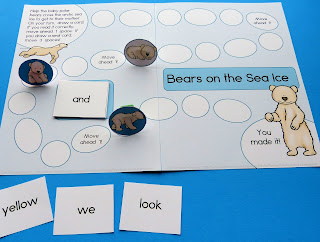
Learning to read sight words is an important part of kindergarten and first grade,  so I made this sight word game for us to practice with.  (It includes cards for letter learners, and PP, P and 1st grade sight words, so it's pretty flexible. Who wouldn't want to help those baby bears get to their momma, right?
https://www.teacherspayteachers.com/Product/Bears-on-the-Sea-Ice-Sight-Word-Game-1600295

I've found a lot of children - and adults for that matter - don't realize that polar bears and penguins don't share the ice.  Polar bears live in the Arctic, near the north pole, and penguins (mostly) live in the Antarctic, near the south pole.  Here's a little song I wrote to help the children remember the difference: 
https://www.teacherspayteachers.com/Product/Polar-Bears-and-Penguins-Song-FREE-2972278
Download it free by clicking on the link or the picture!  If you have a map or globe in your classroom, have a child point to the correct location as you sing each verse.

While you're reading and singing the song, how about some more facts about polar bears and other arctic animals?  I laid them flat for a picture, but they work really well in a pocket chart (but pocket charts don't photograph well, with all the reflections off the plastic).
Learning about polar bears, from Paula's Preschool and Kindergarten
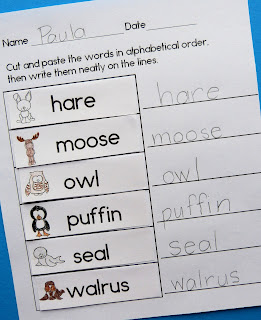
I like to use sentence to picture matching activities as a literacy center, and most of my students are really good about working with the materials.  Still, sometimes we need to show written work, or have some kind of accountability for the students, so they all come with follow up worksheets.  Here's one of them:
https://www.teacherspayteachers.com/Product/Arctic-Sentence-Picture-Match-Reading-Center-1633241

Another fun, hands on sensory activity to do is to build with ice cubes.  You can certainly use plain old regular ice cubes, chances are good that you have some on hand, or if not, you can buy a bag of ice at any grocery store or gas station.  I like to make over-sized ice cubes, using whatever empty containers are available and headed for the recycling bin.  It's amazing how much fun giant ice cubes are as a building tool, and they take a nice long time to melt too.
Learning about polar bears, from Paula's Preschool and Kindergarten

Learning about polar bears, from Paula's Preschool and Kindergarten
If you're building with ice cubes, you might also want to show the children a video of how an igloo is built!  I like this one.  After you watch this, be prepared to see a lot of building going on - and have some nice large blocks on hand.

We've also explored how polar bears thick layer of fat, or blubber, helps to insulate them - you can see that post here.

So what other activities do you like to do when you're learning about polar bears?  I'd love to know! 
Paula

P.S. Stop back by next week to see how we like to learn about penguins.