Welcome to Paula's Primary Classroom! This blog is where I share ideas for teaching and learning with families, friends and other early childhood educators. Please don't use the photos or text of this blog without permission, but please do use any ideas you find useful. Thank you for stopping by!

Sunday, June 26, 2016

Shark Week Blog Hop (and Freebie!)

Are you ready for Shark Week?!  I'm excited to be joining a Shark Week blog hop for the first time, many thanks to Jenny at LuckyFrog's Lilypad and Matt at Digital: Divide & Conquer for putting this together!

I want to show you a couple of jawsome shark resources I've made recently, because summer and ocean themed learning just seem to go together!

Shark Math covers lots of first grade math concepts: measurement, graphing, addition and subtraction, word problems, and sequencing by size.  This one really takes a bite out of your math curriculum!
https://www.teacherspayteachers.com/Product/Shark-Math-for-First-Grade-2565521

 Shark Patterns is great for a math center, where students can manipulate shark pictures to extend patterns (on a table top or in a pocket chart), then follow up with cut and paste worksheets to complete patterns and to create their own. 
https://www.teacherspayteachers.com/Product/Shark-Patterns-2569049

If you're working on numbers to 100, these hundreds charts are super popular with kiddos!  Students read numbers 1 - 100 and color each one on the chart, revealing a mystery picture as they do.  I have hundreds chart mystery pictures for over 20 different themes, but if there's something else you're looking for, let me know, I'd love to hear your suggestions for new sets!

I also made this FREE resource for you - just click on the picture to go to my TeachersPayTeachers store to download it.  If you like it, please take a moment to rate it and leave feedback!
https://www.teacherspayteachers.com/Product/Sharks-Reading-Fun-2607044
Sharks! Reading Fun includes 12 sentences and pictures for students to read and match...
... and a shark poster to display.

Thanks for stopping by and checking out my shark resources!  For LOTS more resources, ideas, and freebies, continue the blog hop and head over to
Button


Saturday, June 4, 2016

My favorite tricks for teaching children to count money

Are your children struggling to learn to count coins?  A lot of children do - but it doesn't have to be hard!  Today I'm going to share some of the tricks I've learned in over 20 years of teaching.
This post has lots of fun ideas and activities to help teach children how to count coins. Great for both parents and teachers!

(Side note: I have always used real coins with my students because fake coins just aren't the same.  Fake coins cost more than using real ones - so why on earth would I spend more to use something less useful?!  Worried they'll be stolen? In all my years teaching, I had one single dollar bill disappear from my first grade classroom one time.)  Use the real thing!

#1 Start simple, start early, repeat often

Counting mixed coins is a pretty complex task - children have to identify each coin, know it's value, start counting from the largest denomination, count by 25, 10, 5 and 1, and be able to count on while switching between those counting methods.  For most counting tasks our children will have encountered, we;ve expect them to count 1 item for each number, practicing 1-1 correspondence.  With mixed coins, they really need a whole new set of skills!  So what is a teacher (or parent) to do?

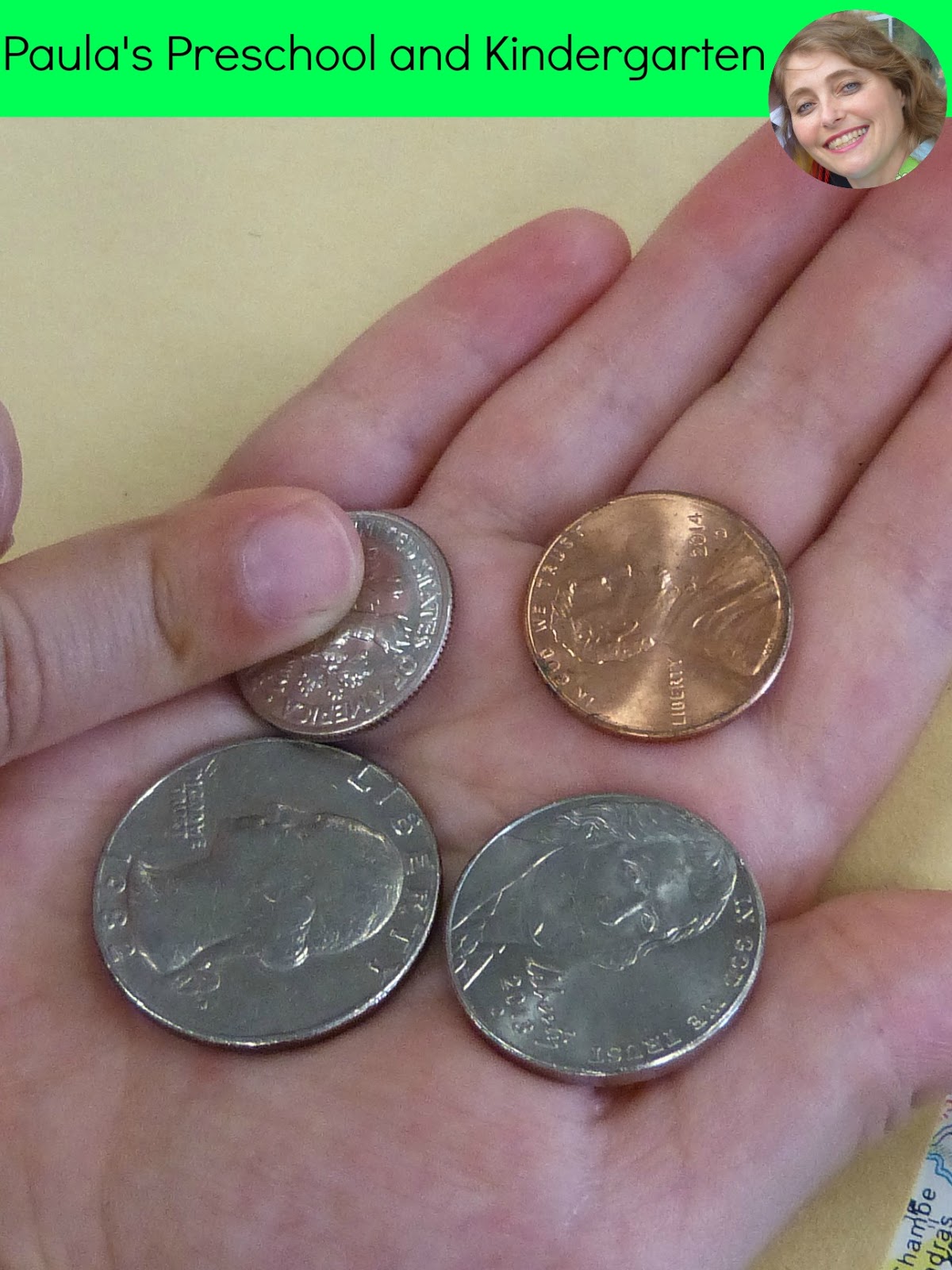
We break it down into baby steps, and we take it slowly.  We start by teaching our children to identify coins and their value.  When I still had my preschool (yes, I did say start early!) I had a stack of 3 oz plastic cups, each containing a penny, a nickel, a dime and a quarter.  Part of our daily routine was singing and dancing, and I often included a money song, such as Show Me The Money, by Jack Hartman and Money Money Money by Rhonda Crigger.  As each song began the children would spread the coins on one flat hand, so that they could point to each coin as it was named in the song.
This post has lots of fun ideas and activities to help teach children how to count coins. Great for both parents and teachers!
I could quickly monitor to see who needed help, and point to the correct coin for those children.  When the song finished, each child poured their coins back into the cup, ready for the next day. 

As simple as this sounds, the children LOVED it - they got to hold REAL money! Frequent repetition meant the children had lots of chances to master the skill, and singing about identifying each coin helped to cement the knowledge in their minds.

#2 Skip counting is essential!

Way back in the olden days, when I was student teaching, my mentor teacher was AMAZING.  One of the tricks I learned from her was to teach skip counting from the first day of school, and to modulate my voice differently for each kind of skip counting (2, 5, 10, 25).  She incorporated skip counting into our calendar or circle time, and there were movements to go along with each one.  Movement helps many children learn, and helps keep the pulse rate up a little, getting oxygen to the brain for maximum learning.

When we counted by 2, we all held up 2 fingers on each hand, and alternated extending the arms as we skip counted to 20.  To count by 5 we alternated raising left and right hands (or feet!) with five fingers (or toes) extended...
This post has lots of fun ideas and activities to help teach children how to count coins. Great for both parents and teachers!
...and for 10s we reached all 10 fingers (or toes) up each time. 
This post has lots of fun ideas and activities to help teach children how to count coins. Great for both parents and teachers!

 #3 Have fun with it!

To really grasp any new concept, we need to play around with it for a while.  Another favorite part of our day was our math play time.  After lunch each day, after we cleared the tables, I put out a variety of manipulatives for the children to explore.  We sorted, measured, organized, graphed, built shapes - and yes, you guessed it, worked with money.  Here's one of the children sorting coins.
This post has lots of fun ideas and activities to help teach children how to count coins. Great for both parents and teachers!

 An even easier way to sort is to have a pile of pennies and a pile of "not pennies" - a concept you can apply to any coin, but also to shapes, toy animals, blocks... almost anything.

As a parent I found some other ways of making money concepts fun, and I often recommended these to parents of my students too.  Try "count it and keep it" for starters.  At the end of the day you probably have some coins in your purse or your pocket.  Pull them out, and choose some that you are fairly certain your child can either identify or count - you want them to win at this game!  Show them the coins, and let them know that if they can count it, they can keep it.  They'll be begging to play this game every day, and mastering a difficult skill as they do!  Start simple (see trick #1) with just pennies, then just nickels, or just dimes.  When they have mastered counting each kind of coin, slowly increase the difficulty by mixing nickels and pennies, helping them to count the highest denomination first and the lower ones next.  I like to let the children master counting 2 kinds of coins in all the possible variations before moving on to 3 and finally all 4 kinds of coins together.

To keep my boys on their toes during summer break, I put together some super simple coin counting activities for them to do each day.  When they were in the younger grades, I put mixed coins in a film canister (do you even remember those?!) for them to count each day, just like the "count it keep it" game above.  As they got older and more skilled, I had to up the ante - and not only by putting more and more coins in each box.  I would have quickly gone broke, they were great coin counters!

Our next game was "What have I got?"  Again, I would get a small pile of coins, but this time I did the counting, and they had to figure out what I had.  I would give just 2 clues: how many coins I had, and the total value of them.  For example, if I have 9 coins worth 53 cents, what have I got?  (4 dimes, 2 nickels, 3 pennies)  If they could figure it out, they got to keep it.  Guess whose children were really good at figuring it out?  One of the beautiful things about this game was that I would give this type of clues to my oldest son, who had to figure it out, and he then put those coins in a small container for his younger brother to count.  He loved the responsibility of setting it up for his brother (or maybe he just liked that he could do something his brother couldn't), and I really liked having his help.

Another way to take this kind of play up a notch is to have children figure out change from $1.  In my classroom I had some toy grocery items, which I marked with imaginary prices, and the children had to figure out how much change they should get if they "bought" it with $1.  It doesn't sound so difficult, but it's a completely different way of thinking about money.  If you "buy" a 37 cent item, you then have to count on with pennies to get to 40 cents, a dime to get to 50 cents, and quarters to make it to $1.  (You may also have a super smart kiddo who figures 100 cents - 37 cents = 63 cents, and then counts out the coins that way!)

#4 Use other resources if you need to.

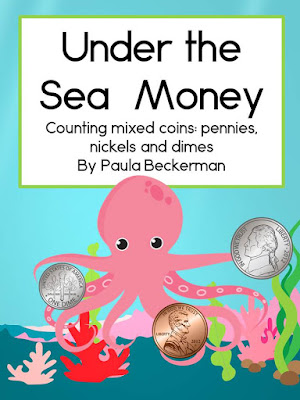
Of course, there are times when we need help to teach these skills to our children, so I've also made some money counting games available in my TpT store.  The simplest one is:
https://www.teacherspayteachers.com/Product/Ocean-Theme-Under-The-Sea-Money-1635636
Children work with just pennies, nickels and dimes, and count 2 - 4 coins at a time - great for early in the process of learning to count money!

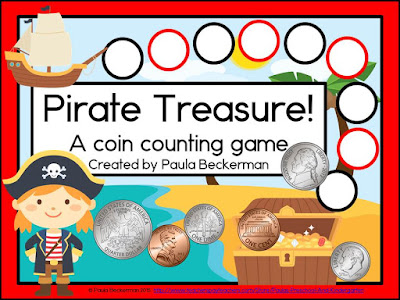
Next up is this cool pirate themed game, because everyone knows buccaneers love treasure!
https://www.teacherspayteachers.com/Product/Pirate-Treasure-A-Coin-Counting-Game-1864228
Included with this game are 96 coin counting cards, with mixed coins worth up to 35 cents.  The total values aren't huge, but each card includes from 1 - 11 coins to count, and includes many different ways to make each amount.  

For children who are ready for a little more, Bye-Bye Summer Slide includes counting cards for mixed coins up to 75 cents, and also includes game style review of sight words, addition and subtraction, telling time and much more!  I designed this resource to be reproduced and sent home with children to review during the summer, so everything is included in b&w, but the coin pages are also included in color.
https://www.teacherspayteachers.com/Product/Bye-Bye-Summer-Slide-1857848

 Do you have some nifty tricks for teaching children to count money?  I'd love to hear your ideas in the comments!


Sunday, May 29, 2016

Erupting With Fun: Preschool Volcano Activities

What is cold when it is dormant, hot when it erupts, and totally cool all the time?
Do you teach your kids about volcanoes? Here are some fun art and science activities to take you beyond baking soda and vinegar!
Check out all the awesome volcano pictures Ms. Debbie pulled to show the children - they were fascinated by the glowing lava  - who isn't?!  The kiddos even got to act out being volcanoes, and going from dormant to erupting. Jumping up to erupt was their favorite part!
Do you teach your kids about volcanoes? Here are some fun art and science activities to take you beyond baking soda and vinegar!
Debbie had a bottle covered in clay to look like a volcano, which we partially filled with some baking soda ahead of time.  When she poured in vinegar (dyed red), the chemical reaction had "lava" flowing out of the vent hole.  Oh my goodness were the kiddos excited!
Do you teach your kids about volcanoes? Here are some fun art and science activities to take you beyond baking soda and vinegar!

We followed up our reading, singing, dancing and demonstration, with science and art activities that also stretched our fine motor skills.  To make our volcano diagram, the kiddos tore construction and tissue paper, glued them, wrote their names, and then cut and pasted labels for some of the important parts of a volcano: magma, vent hole, ash, and lava.
Do you teach your kids about volcanoes? Here are some fun art and science activities to take you beyond baking soda and vinegar!
(The label for magma is on the back, because it is only magma while it is underground.  As soon as it emerges from the vent hole it is called lava.)

We had fun sorting out things that are hot (like a volcano) and things that are cold.
Do you teach your kids about volcanoes? Here are some fun art and science activities to take you beyond baking soda and vinegar!

The highlight of the whole time was definitely letting the children build their own pebble volcanoes, and mixing baking soda and red vinegar.  They wanted to do it over and over - and with almost 60 children attending this week, we used 3/4 gallon of vinegar, and 4 pounds of baking soda!
Do you teach your kids about volcanoes? Here are some fun art and science activities to take you beyond baking soda and vinegar!

Do you teach your kids about volcanoes? Here are some fun art and science activities to take you beyond baking soda and vinegar!
The awe on their faces was worth every drop!

Sunday, May 22, 2016

Dinosaur activities and books - roaring good fun!

Dinosaur activities and books - fun science, math, and of course literacy.  I love the Jurassic sand idea!
We love dinosaurs!  There's so much to love: they're big (mostly), make awesome noises (especially when voiced by small children), stomp through the prehistoric forests, chase each other, and generally get away with behavior that isn't often encouraged in children.  Who doesn't sometimes want to live vicariously as a dinosaur?!

For story time this week we read 3 lovely dinosaur fiction books: Harry and the Bucketful of Dinosaurs, Bones, Bones, Dinosaur Bones, and Saturday Night at the Dinosaur Stomp.  I talked about how much I love Saturday Night at the Dinosaur Stomp in my last blog post, and it is, in fact, the reason we focused on dinosaurs this week - I really wanted to read it again!  Then big question was what we could do along with the books.

If you Pinterest (I believe that really should be a verb, because I do it all the time), you know there are a gazillion fantastic and fun activities to go along with any subject.  Here's a link to my dinosaurs board for those of you who also use Pinterest as a verb. 

We sorted dinosaurs by color.  I made some very simple sorting mats by cutting brightly colored copy paper into quarters, and then mounting 4 of the resulting rectangles on white construction paper.  We had a supply of red, blue, green and yellow dinosaurs in one of our resource kits, so a simple sorting activity was born.
Dinosaur activities and books - fun science, math, and of course literacy.  I love the Jurassic sand idea!
 I say simple, because yes, it is simple.  Simple to prepare, and simple for the children to use, but still very satisfying for young learners!
Dinosaur activities and books - fun science, math, and of course literacy.  I love the Jurassic sand idea!

 I brought in a couple of fossils for the children to explore (carefully).  This child was fascinated with the small vug of crystals in my amonite.
Dinosaur activities and books - fun science, math, and of course literacy.  I love the Jurassic sand idea!

There was dough for the children to make imprints in, much like fossils, but without the millions of years of waiting. (Nobody has time for that!)
Dinosaur activities and books - fun science, math, and of course literacy.  I love the Jurassic sand idea!
Of course, what I have in mind as I put the activities together, and the possibilities the children see, are not always the same thing.  Dinosaur skeletons dancing in the dough?  Why not, after Saturday Night at the Dinosaur Stomp?!
Dinosaur activities and books - fun science, math, and of course literacy.  I love the Jurassic sand idea!

Here's another possibility I never considered.  Tyrannosaurus Rex balancing on his tail and doing the splits.  Bet you never thought of that either!
Dinosaur activities and books - fun science, math, and of course literacy.  I love the Jurassic sand idea!

Here's another early math concept we worked on this week: patterning.  I made AB, ABC, AAB and ABB dinosaur patterns, and the children (and parents) read the patterns, then extended them. 
Dinosaur activities and books - fun science, math, and of course literacy.  I love the Jurassic sand idea!

Our final activity was digging for dinosaur in the Jurassic sand.  There were usually 6 - 8 children gathered around this sensory bin, pretending, digging, or just running the sand through their fingers.  Little do they know they're working on their finger muscle strength, preparing their hands for all the jobs they will do!
Dinosaur activities and books - fun science, math, and of course literacy.  I love the Jurassic sand idea!

As the children left, we asked them to put one stamp on today's graph: Which book did you like best today?
Dinosaur activities and books - fun science, math, and of course literacy.  I love the Jurassic sand idea!
They loved Bones, Bones, Dinosaur Bones best of all.  After all, who doesn't like dinosaurs?!

Wednesday, May 18, 2016

Book Bash: Saturday Night at the Dinosaur Stomp

This week I'm participating in another blog hop with #Kinderfriends - we're going to share some of our favorite books.
Dinosaur Stomp: dinosaur books, activity and FREE counting game!

If you're a regular reader, you know how hard it is for me to come up with just one favorite book - or even genre of books!  (Check out some more of my favorites on this blog post.)  Since I have dinosaurs on my mind for story time this week, I decided to share my favorite dinosaur book with you: Saturday Night At the Dinosaur Stomp.  (No, I'm not being compensated for linking this.)

Dinosaur Stomp: dinosaur books, activity and FREE counting game!

I'm on my second paperback copy of this fun book by Carol Diggory Shields, illustrated by Scott Nash.  The first copy fell apart due to excessive loving on by lots of children, and my current copy isn't pristine either.  The book has been around since 1997, and I have yet to meet a group of children who don't love the rhythm and rhyme, the upbeat fun and gorgeous pictures.  I read Saturday Night at the Dinosaur Stomp to my first graders, to my own children when they were little, and to 16 years of preschool and kindergarten kiddos.

This page was my oldest son's favorite!
Dinosaur Stomp: dinosaur books, activity and FREE counting game!

There are so many fun ways to extend the dinosaur themed learning- like sorting them by color or shape.  I made this simple sorting mat by cutting colored copy paper into quarters, and gluing one rectangle of each color onto a piece of 9" x 12" construction paper.
Dinosaur Stomp: dinosaur books, activity and FREE counting game!

Want to have your students work on numbers 1 - 20?  I made this freebie just for this book bash!
https://www.teacherspayteachers.com/Product/Dinosaur-Counting-and-Sequencing-1-20-2552564
If you are looking for even more dinosaur learning activities, I hope you'll check out my Dinosaur resources on TeachersPayTeachers, and check out my Dinosaur Board on Pinterest.

Here are some more of my favorite dinosaur stories:
Dinosaur Stomp: dinosaur books, activity and FREE counting game!

To see more favorite books from #KinderFriends, continue our blog hop by going to
 Photobucket

Sunday, May 15, 2016

Insects, bugs and things that creep

Insects, bugs and things that creep: Science, literacy and math activities for preschool (with a healthy dose of sensory fun!)
Oh yes, we got buggy this week!  This is a great time of year to learn about insects, and it seemed natural to follow up our caterpillar and butterfly learning by learning about other insects.  Do I even need to  tell you that the children loved it?!

In between our insect books (both fiction and non-fiction, of course!) we sang a song about insect body parts: Head, Thorax, Abdomen, and labeled a large diagram with the parts mentioned in the song.  Fun!  We saw pictures - including a life size drawing - of one of the biggest insects to ever live on earth, the meganeura.  Meganeura looked like a dragonfly, but it was up to 36 inches from wing tip to wing tip!  While the adults in the room seemed to all be grateful it is extinct (it lived 300 million years ago), we had the children graph whether or not they would like to meet one, and they overwhelmingly said yes!
Insects, bugs and things that creep: Science, literacy and math activities for preschool (with a healthy dose of sensory fun!)

We also had a live ladybug visit us, along with a nice supply of aphids for it to eat. (Unfortunately they all came from my oleander bush, which is yellow with aphids in some places.)  I need all the ladybug help I can get in my garden!
Insects, bugs and things that creep: Science, literacy and math activities for preschool (with a healthy dose of sensory fun!)

We also had ladybug dough play, with black beans to make spots.  We revisited a word we worked on last week, symmetry, and enjoyed the feeling of mushy dough and hard, slick beans.
Insects, bugs and things that creep: Science, literacy and math activities for preschool (with a healthy dose of sensory fun!)
We're going to use the dough again next week to make our own fossil type imprints, so a couple of kiddos borrowed their parents' phones again to take pictures of their creations.  I love seeing them remember this idea from past story time sessions!

Insects, bugs and things that creep: Science, literacy and math activities for preschool (with a healthy dose of sensory fun!)
We had out lots of magnifying glasses, plastic insects, informational cards and the like, as well as puzzles, all out of one of the early learning kits that are available for check out.

The most popular use of the plastic insects was the dirt sensory bins - with tall, tall grass, just like in Denise Flemings' book.  We set 5 of these sensory bins up on the patio outside our community room, so our families could enjoy the spring sunshine along with the bugs and dirt. 
Insects, bugs and things that creep: Science, literacy and math activities for preschool (with a healthy dose of sensory fun!)

While enjoying the sensory play bins outside, some of the children helped me to look on the day lilies for "evidence" of bugs.  We found some!  The children told me they think these petals were chewed by caterpillars, probably very hungry caterpillars!
Insects, bugs and things that creep: Science, literacy and math activities for preschool (with a healthy dose of sensory fun!)

Finally, since we did read In The Tall, Tall Grass, we followed it up with making our own tall, tall grass, an idea I saw here.  The children glued on words, wrote their names, fringe cut the paper to make "grass", and decorated it with brightly colored insects.
Insects, bugs and things that creep: Science, literacy and math activities for preschool (with a healthy dose of sensory fun!)
So much fine motor development, preparing those little fingers for writing and much, much more!

Next week we'll learn about another kind of animal that is extinct - and much bigger than the insects.  Can you guess what it is?  Come back next week to see what we learn!