Welcome to Paula's Primary Classroom! This blog is where I share ideas for teaching and learning with families, friends and other early childhood educators. Please don't use the photos or text of this blog without permission, but please do use any ideas you find useful. Thank you for stopping by!
Showing posts with label STEAM learning. Show all posts

Sunday, November 12, 2017

STEAM (Science, Technology, Engineering, Art and Math) skills: learning the content

Are you old enough to remember the short films schools used to show when teaching science content?  I am.  They were usually old, grainy, black and white films (and I mean film, on film strips, presented on a noisy film projector), but the worst thing about them was how incredibly boring they were.  That kind of teaching just didn't inspire a whole lot of learning!

 There are so many other, more exciting ways to present content information, and to help our students learn the facts they need to know.  Today I'm going to show you some of my favorites.
STEAM: 7 ways to teach the content, from Paula's Preschool and Kindergarten

My students love to observe and explore, so I have always included real animals in my classrooms.  My first year teaching I had a fish tank (good plan), raised caterpillars (good plan), had plants in the classroom (good plan), and raised two ducklings (NOT a good plan - they poop a LOT, smell, and need fresh water a couple of times a day).  Since then we've also had tadpoles and frogs, earth worms, various insects, herb, vegetable and flower gardens, a hamster, and an outside area full of possibilities.  Children (and adults) find nature fascinating, and can learn a tremendous amount from observing the plants and animals in our world. Why not provide a way for them to record what they see?
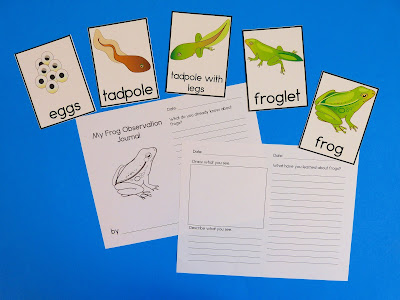
https://www.teacherspayteachers.com/Product/Frog-Life-Cycle-3-Part-Cards-Observation-Journal-and-Worksheets-2440386

Of course, some things are best learned about at a safe distance (sharks and piranhas for example), or are inaccessible.  When we use awesome pictures and information presented at an age appropriate level, factual content can be fascinating and engaging.   To make it easier to find just the right text, most of my guided reading books include texts at multiple levels.
https://www.teacherspayteachers.com/Product/Rainforest-Readers-Piranhas-Guided-Reading-Book-1782868

Even emergent readers want to learn about the world around them, so it's important to find non-fiction texts they can master.  
Solution #3: informational craftivities
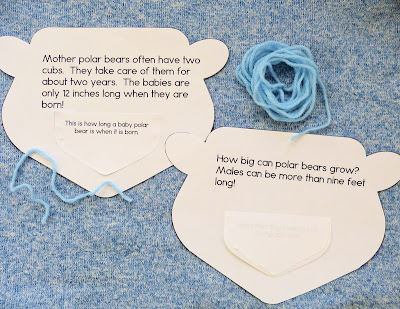
https://www.teacherspayteachers.com/Product/Polar-Bear-Craft-and-Non-Fiction-Guided-Reading-Book-2277562
https://www.teacherspayteachers.com/Product/Sleepy-Bear-Guided-Reading-Book-Craft-2276061

 Read and write the room activities can include non-fiction learning...
https://www.teacherspayteachers.com/Product/Tide-Pool-Write-the-Room-Matching-Games-and-Reading-Comprehension-3202339

... and so can logic puzzles....
Solution #5: Non-fiction logic puzzles
https://www.teacherspayteachers.com/Product/Insect-Logic-Puzzles-2510348

... and simple sentence picture match activities!
Solution #6: sentence picture match
https://www.teacherspayteachers.com/Product/Arctic-Sentence-Picture-Match-Reading-Center-1633241

https://www.teacherspayteachers.com/Product/Arctic-Sentence-Picture-Match-Reading-Center-1633241

If you've been reading this series about STEAM learning, you know I also like to make thematic resources, to incorporate science, technology, engineering, art and math.  I love it when everything I need is together, ready to go.

What are your favorite ways to make learning content engaging?  Is there a subject you wish you could find this kind of resources for?  (I'm always looking for ideas of resources to create!)  Let me know in the comments!

Saturday, November 4, 2017

STEAM skills (Science, Technology, Engineering, Art & Math) - measurement and graphing

Welcome to part 3 of my STEAM skills series!  If you haven't already seen them, here are links to part 1 and part 2.  If you've been reading along, you've probably already figured out how much fun I have incorporating STEAM into my teaching!
STEAM learning: measurement & graphing, by Paula's Preschool and Kindergarten
Today I'm going to focus on measurement and graphing - they're important skills for science, math, and engineering, and they're super easy to add to your day to day classroom life.

There are lots of ways to include measurement, because there are so many things to measure!  It's developmentally appropriate for young children to measure with non-standard units, that is, they don't need to use inches, centimeters, pounds or kilograms.  For young children measurement should involve how many _____ long something is, filling and counting scoops, or how many _____ something weighs.

One of my favorite ways to measure with children is to cook: they can measure and count how many cups or teaspoons of each ingredient, weigh things, and of course, there's the fun of eating the finished product! (Look at the concentration on these little faces, and look how they're also developing hand strength and pouring skills as they make a birthday cake.)
STEAM learning: measurement & graphing, by Paula's Preschool and Kindergarten

STEAM learning: measurement & graphing, by Paula's Preschool and Kindergarten
You can measure with real objects - like pumpkin candies, paper clips, or toy blocks, or you can use a measurement tool with pictures of objects.
https://www.teacherspayteachers.com/Product/Pumpkin-STEAM-investigations-2784260

https://www.teacherspayteachers.com/Product/Shark-Math-for-First-Grade-measurement-graphing-addition-subtraction-2565521

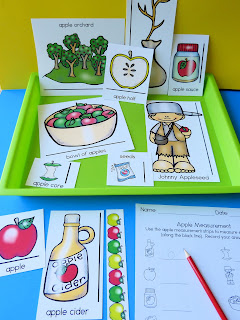
https://www.teacherspayteachers.com/Product/Apple-STEAM-investigations-3320766

Measurement can also be a matter of comparing: longer or shorter, heavier or lighter.  We wondered which of our vegetables was heavier than a glue bottle - and then checked to find out.
STEAM learning: measurement & graphing, by Paula's Preschool and Kindergarten

STEAM learning: measurement & graphing, by Paula's Preschool and Kindergarten
Children like to measure themselves too of course, so we laid on the floor, cut ribbon to the length of each child, and then made a cute display to show our heights.
https://www.teacherspayteachers.com/Product/Flower-Measurement-Back-to-School-Activity-3097563

 There are so many ways to measure - but what about graphing?  Isn't that more challenging?  I don't find it to be!  If you have a full day school program, you likely already graph daily to see who brought lunch, and who needs a cafeteria meal - our cafeteria needed that information each morning to help them prep, so the children moved their name to the correct side of the lunch count graph each morning.  There's so many more things you can graph though!

How about which day each child brought something to school?
STEAM learning: measurement & graphing, by Paula's Preschool and Kindergarten
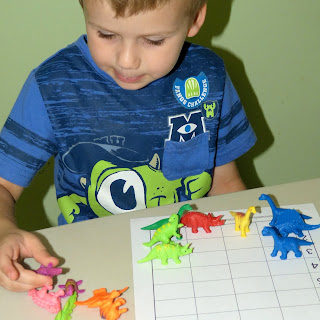
You'll notice the children's names are on this one with sticky notes - so I can use this graph time and again.  Children can graph with math manipulatives...
https://www.teacherspayteachers.com/Product/Dinosaur-Math-Graphing-Sorting-and-Venn-Diagram-Math-Centers-1505643
 ...or by stamping or coloring a space on a paper...
STEAM learning: measurement & graphing, by Paula's Preschool and Kindergarten
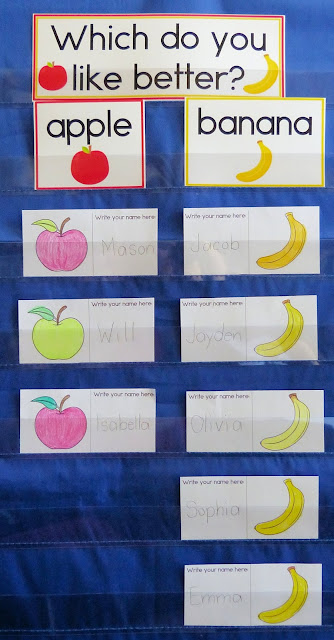
 or in a pocket chart!
https://www.teacherspayteachers.com/Product/First-Grade-Math-Centers-Month-2-3420740
If you need help coming up with graphing activities, check out these resources in my TeachersPayTeachers store - including 3 FREE resources!  Some of the other photos included in this blog are of resources I've created, you can also click on those to see more.

I hope you've found some new ideas in this blog post, and that you'll come back next week to continue this STEAM skill series!  Happy Teaching!
                                                                                                                           Paula

Monday, October 23, 2017

More easy steps for amazing STEAM learning

Recently I began a blog post series about STEAM learning (STEAM stands for Science, Technology, Engineering, Art and Math) by looking at some ways to practice observing and recording data - 2 of the most basic science skills.  Today I want to continue with sorting, classifying, and labeling.
More easy steps for amazing STEAM learning, from Paula's Preschool and Kindergarten

My students have always loved sorting / classifying.  Whether it's sorting building blocks by color, finding all the big buttons in my button box, or separating the mini erasers by shape, sorting seems to be a basic part of coming to understand their world.  Why not encourage it with fun materials, and add labels to those categories?!
https://www.teacherspayteachers.com/Product/Dinosaur-Math-Graphing-Sorting-and-Venn-Diagram-Math-Centers-1505643

https://www.teacherspayteachers.com/Product/Seasons-Sorting-2025351

https://www.teacherspayteachers.com/Product/Leaves-in-Fall-STEAM-investigations-2748942

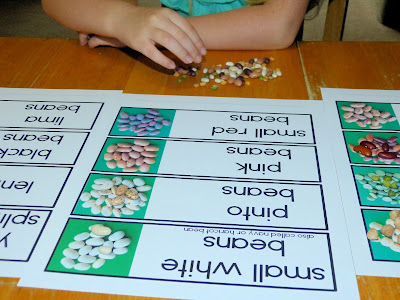
https://www.teacherspayteachers.com/Product/Beans-STEAM-Investigations-2979664

It's easy to take sorting a step further with Venn Diagrams - which make us consider more than one sort-able attribute at a time. Do you see the red t-rex in this picture?  It isn't green, and doesn't walk on 4 legs, so the child asked me where it should go.  I helped him think it through - can it go in the green circle?  No.  Can it go in the 4 legs circle?  No. Is there a place on your sorting mat that isn't for green and isn't for 4 legs?  Children can do some amazing thinking!
https://www.teacherspayteachers.com/Product/Dinosaur-Math-Graphing-Sorting-and-Venn-Diagram-Math-Centers-1505643

Once children have begun categorizing things - not just sorting them, but also identifying how they've sorted them, it's a natural progression to count those things, and to compare what has more or less.  Graphs make it easy to compare several categories. (More on graphs next time!)
https://www.teacherspayteachers.com/Product/Apple-STEAM-investigations-3320766

https://www.teacherspayteachers.com/Product/Dinosaur-Math-Graphing-Sorting-and-Venn-Diagram-Math-Centers-1505643

Children can also begin to label things they observe, from a single word for each item...
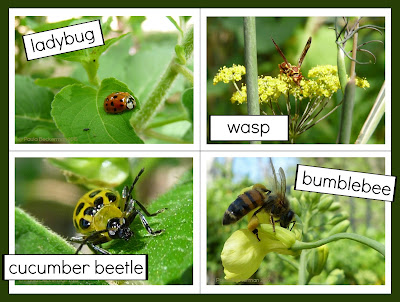
https://www.teacherspayteachers.com/Product/Insect-Photo-Sentence-Picture-Match-Reading-and-Science-Center-1646977
... to details as they develop vocabulary.
https://www.teacherspayteachers.com/Product/Spider-STEAM-investigations-3380944

Don't you love teaching STEAM skills?!


Sunday, October 8, 2017

Surprisingly easy ways to teach STEAM skills in early childhood (STEAM learning, post #1)

I think I've always taught STEAM learning, although we certainly didn't call it that back in the early 90's when I started teaching.  Back then it was thematic teaching - building our teaching and learning activities around a topic, and incorporating reading, writing, math, science and social studies skills within that topic.  Learning about apples in the fall?  We'd read about them, write innovations on favorite apple stories, use them in math centers, observe them, cut them up to cook applesauce, and make graphs about which kinds we liked best.  We painted with apples, practiced our scissor skills as we made apple crafts - you know the one, the mostly eaten apple with a core and seeds visible, as well as a stem and skin at the top and bottom.  We displayed them on the wall, or hung them above the children's desks.  Everything was as hands on as possible, and thankfully we didn't have to present any of it in the same format as "the test."  If you're smiling and nodding right now, you've probably been teaching a long time!

One of the hot teaching buzz words now is STEAM learning: Science, Technology, Engineering, Art and Math, and incorporating skills for them throughout our curriculum.   Are they important?  Yes!  Can you do it without thinking about it?  Probably not.  Is it going to be hard to include them?  NO!

In this blog series, I want to take a look at some STEAM skills, and show you some of the ways I like to incorporate them.  I hope you find a few new ideas!  Today I want to write about two of the very first, most basic skills:
 Observing and Recording
If you've ever spent time around a child, you know children need to observe and explore everything.  They want to dig in the dirt, find small critters, see what is inside a tomato, feel how bumpy a pumpkin is, taste the honeysuckle, and roll themselves down a hill.  This is science - exploring, investigating and observing everything. 
 
Developing skills for STEAM (science, technology, engineering, art & math) - post 1 of 5

 Recording data can be challenging with young children, especially in preschool, before they learn to write.  Photographs are one of my favorite ways to record young children's learning!  Every one of the photos in the collage above went into my students' school photo albums - and provided opportunities to revisit and discuss the hands on experiences we enjoyed.

As children develop their fine motor skills, and begin to write and draw, more options for recording data become available.  They can draw...
https://www.teacherspayteachers.com/Product/Leaves-in-Fall-STEAM-investigations-2748942
They can color in spaces to create graphs...
https://www.teacherspayteachers.com/Product/Beans-STEAM-Investigations-2979664
https://www.teacherspayteachers.com/Product/Apple-STEAM-investigations-3320766
 They can choose a favorite and color a picture to match...
https://www.teacherspayteachers.com/Product/Apple-STEAM-investigations-3320766
They can imagine, create, and write about what they see.
https://www.teacherspayteachers.com/Product/Sometimes-It-Looked-Like-A-Class-Book-with-Fall-Leaves-2123801

Chances are good that you are already doing many of these things in your classroom!  What are your class' favorite activities for observing and recording data?  I'm always looking for new ideas, so please share your tips in the comments!  Finally, please stop back again next week, when I'll write about the skills of sorting, classifying and comparing!