Welcome to Paula's Primary Classroom! This blog is where I share ideas for teaching and learning with families, friends and other early childhood educators. Please don't use the photos or text of this blog without permission, but please do use any ideas you find useful. Thank you for stopping by!
Showing posts with label apples. Show all posts

Sunday, August 23, 2020

A is Absolutely Amazing!

 Ants, apples, alligators and astronauts - it's time for fun while learning about the letter Aa!  When you talk, read, sing and play with your child you're helping them learn.  Preschool and kindergarten children really benefit from hands on activities like singing, finger plays, cooking, painting and more - so here are some of my favorites:

 Activity #1: Songs and rhymes for the letter A

Way Up High in an Apple Tree

Alligator, Alligator

What are they learning?  Rhyme, rhythm, vocabulary, musical pitch, and they're working finger muscles too!


Activity #2: Make applesauce

We all love food, so it's super engaging to make time to let your littles do some basic cooking activities with you!  Applesauce is a great early cooking activity because most children love it, it's a very forgiving recipe, and the steps to make it are easy enough for young children to help.

Children can learn how to cook! 

 To make your applesauce you'll need some apples, a peeler, a butter knife (for your child) a good knife (for you), water, a potato masher, a pot and a stove... a little sugar or cinnamon is optional.  Your child can learn to peel apples by pushing the peeler away from them, to safely hold a butter knife and point the end down to cut the apples (see the picture above), and to put them into a pot.  Add a little water to cover, simmer until soft, then mash with a potato masher or immersible blender.  Add sugar and cinnamon if you want.

What are they learning?  Safe use of kitchen tools, life skills, the satisfaction of preparing their own food, and spending special time with a loved adult.  As you cut the apple you can talk about cutting it in half and into quarters - great math skills!  Did you talk about the peel, flesh, core and stem?  That's science - and so is the changing state of matter that happens when heat causes the apples to soften and change into applesauce.  As  you serve it count how many scoops you put in a bowl - and if they want more, that's coming back for seconds - ordinal numbers.

 Extend the learning fun by having your child write the letter Aa in the applesauce.  Simply put a small amount of applesauce on a plate, gently shake the plate to spread it evenly, and then let your child write in it.  If they do a great job, they get to lick their finger.  Gently shake the plate to reset, and write again!


Activity #3:  Hand prints
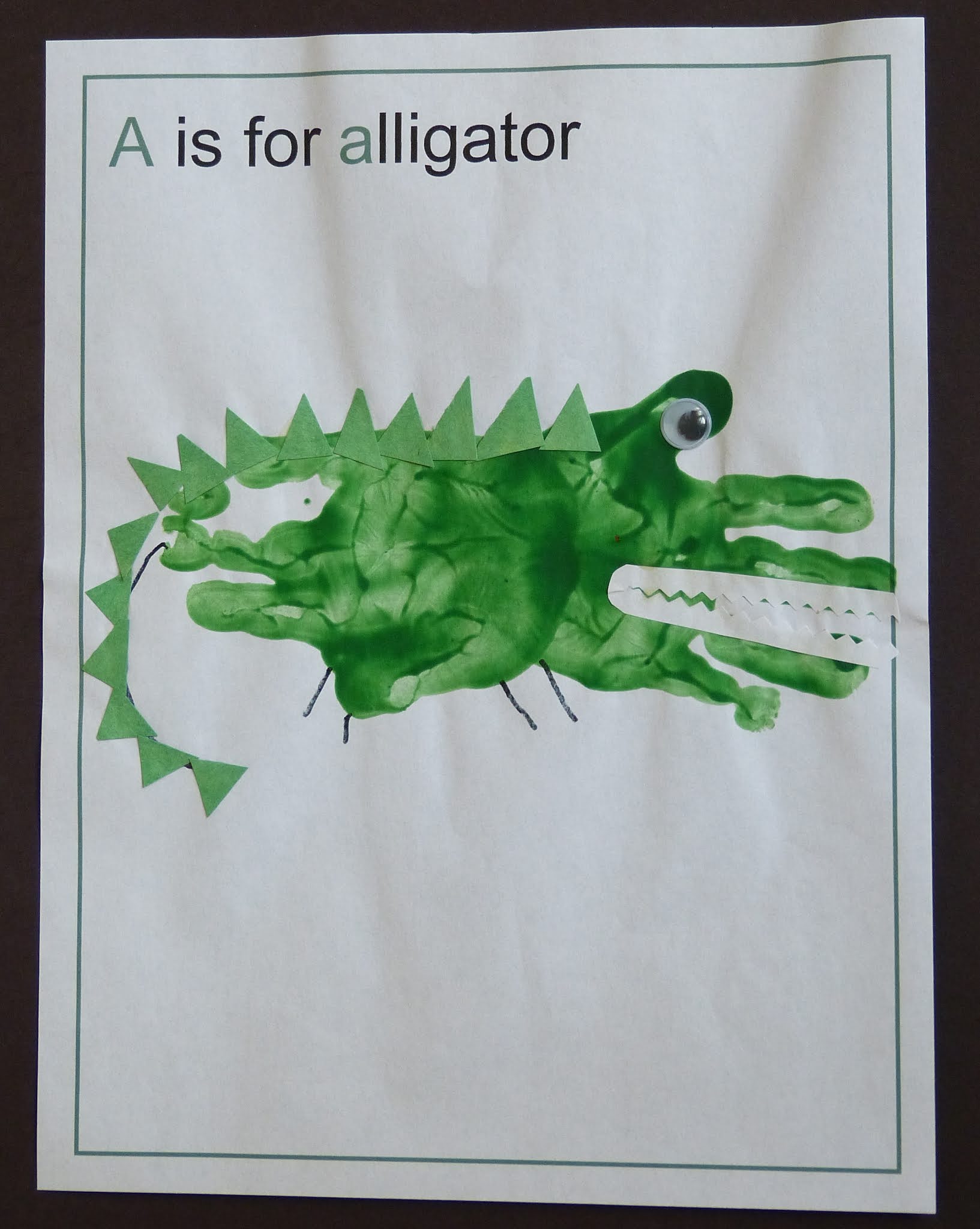


Hand prints from our little ones are something that we'll treasure forever - trust me on this one!  I had my children make their own alphabet books with hand and foot prints, by doing one each week.  I'm going to carry that over here for you, and if you can do one a week, you'll have a new favorite alphabet book!

I have the children hold out a hand for me to paint - and we talk about how the paint feels (cool, slippery, slimy, funny?) as I apply the paint.  Next we turn their hand over and place it on a paper, and I place my hand over theirs and push down firmly.  Finally, we lift their hand straight upwards so it doesn't smear everywhere.  The first few tries might be... interesting... but after a little while almost every child gets into it and masters the art of a good hand print.

For the alligator print we painted both hands, and overlapped the palms.  We used fancy scissors to cut the zig zag teeth, used a wiggle eye (wiggle eyes make everything cooler!), and added triangles for the back and tail. You are probably already really good with scissors and glue, so try to resist the urge to "help".  Children learn to use scissors by using them, and to use the right amount of glue through practice.  If they're trying, they're learning!

For the angel hand prints we paint the wings first, then make the robe when the paint for the wings is dry.  I take a photo of each child and print it out so I can trim around their face and have them add it to their angels.  

Does your little prefer an alien?  Paint just part of their hand for the print, and let them add  unusual numbers of wiggle eyes and draw on details when the paint is dry. 

What are they learning?  Scissor and glue skills, vocabulary, correlating the initial letter of words to the sound and shape of letter Aa.

 Extend the learning by adding a photo page to their alphabet book.  I like to insert the completed hand prints in a page protector and keep it in a binder.  On the facing page I add a photo of the children doing one of our activities for the letter, with a caption that includes the focus letter.  They love to "read" their books and talk about the letter and the activities, making that letter to sound connection!


Activity #4: Measuring with apples

This is a free download from my TeachersPayTeachers store. It comes with instructions, but basically you print out the pages and join the apples into a long strip.  Tape it to the wall to measure how many apples tall people and things in your house are, or let your child hold it like a ruler to measure.  Young children learn measurement with non-standard units - teacher talk for using various items to measure.
 
What are they learning?  An important concept to introduce is lining up the bottom of apple #1 with the end of the thing you're measuring.  They're practicing counting andnumber recognition -you can also use this as a number line for counting, and your children might also notice the color pattern of the apples.  Which brings us to ...

 
Activity #5 Making patterns


What are they learning?  Patterns, a very basic and essential math skill.  Picking up pompons works their finger muscles, helping their hands grow stronger - an important pre-writing skill.  Younger children may still be learning the color words, or may start counting the circles on the page.  They may ask about the question marks on the page - what question do they need to answer?  This page is included in my Apple Math Centers which is available to purchase and download.


Activity #6: Anansi the Spider! craft to follow up the book by Gerald McDermott
According to McMillan books, "Anansi the Spider is one of the great folk heroes of the world. He is a rogue, a mischief maker, and a wise, lovable creature who triumphs over larger foes."  
 
What are they learning? Folk lore from West Africa, vocabulary and story structure, and as they make their own Anansi or his sons they're cutting, pasting, creating art, and counting 8 legs.


I hope you and your little have enjoyed these activities!  For more apple activities click here, here, and here.  Find some of my favorite apple books here and see how to do a blind taste test with apples here! Join me next week for the letter Bb!

Monday, October 23, 2017

More easy steps for amazing STEAM learning

Recently I began a blog post series about STEAM learning (STEAM stands for Science, Technology, Engineering, Art and Math) by looking at some ways to practice observing and recording data - 2 of the most basic science skills.  Today I want to continue with sorting, classifying, and labeling.
More easy steps for amazing STEAM learning, from Paula's Preschool and Kindergarten

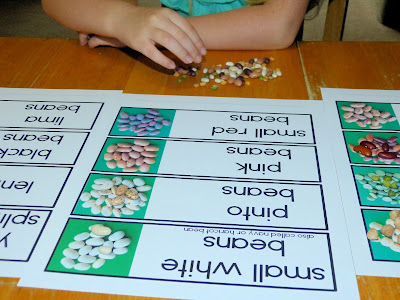
My students have always loved sorting / classifying.  Whether it's sorting building blocks by color, finding all the big buttons in my button box, or separating the mini erasers by shape, sorting seems to be a basic part of coming to understand their world.  Why not encourage it with fun materials, and add labels to those categories?!
https://www.teacherspayteachers.com/Product/Dinosaur-Math-Graphing-Sorting-and-Venn-Diagram-Math-Centers-1505643

https://www.teacherspayteachers.com/Product/Seasons-Sorting-2025351

https://www.teacherspayteachers.com/Product/Leaves-in-Fall-STEAM-investigations-2748942

https://www.teacherspayteachers.com/Product/Beans-STEAM-Investigations-2979664

It's easy to take sorting a step further with Venn Diagrams - which make us consider more than one sort-able attribute at a time. Do you see the red t-rex in this picture?  It isn't green, and doesn't walk on 4 legs, so the child asked me where it should go.  I helped him think it through - can it go in the green circle?  No.  Can it go in the 4 legs circle?  No. Is there a place on your sorting mat that isn't for green and isn't for 4 legs?  Children can do some amazing thinking!
https://www.teacherspayteachers.com/Product/Dinosaur-Math-Graphing-Sorting-and-Venn-Diagram-Math-Centers-1505643

Once children have begun categorizing things - not just sorting them, but also identifying how they've sorted them, it's a natural progression to count those things, and to compare what has more or less.  Graphs make it easy to compare several categories. (More on graphs next time!)
https://www.teacherspayteachers.com/Product/Apple-STEAM-investigations-3320766

https://www.teacherspayteachers.com/Product/Dinosaur-Math-Graphing-Sorting-and-Venn-Diagram-Math-Centers-1505643

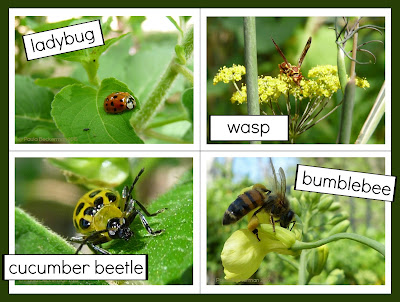
Children can also begin to label things they observe, from a single word for each item...
https://www.teacherspayteachers.com/Product/Insect-Photo-Sentence-Picture-Match-Reading-and-Science-Center-1646977
... to details as they develop vocabulary.
https://www.teacherspayteachers.com/Product/Spider-STEAM-investigations-3380944

Don't you love teaching STEAM skills?!


Monday, September 25, 2017

My Favorite Books For Fall - a blog hop with the #KinderFriends

I think every teacher has favorite children's books - maybe a whole lot of favorites!  Still, even knowing there are some books I will absolutely read with my students doesn't stop me from wanting to find more favorites.  I'm a bibliophile through and through, and for all the other bibliophiles out there, the #KinderFriends are sharing our favorite fall books.  Take a look, see what you discover, and if there's something amazing we're missing, leave it in the comments!
 To me fall means leaves, apples, pumpkins, and animals getting ready for winter, so I focused on books about those topics.  

Red Leaf, Yellow Leaf by Lois Ehlert is a classic for a reason; it's a beautiful read aloud, full of gorgeous illustrations and information about maple trees.  I can't imagine teaching and learning about leaves without it!  While you're learning about leaves, you have to also check out Leaf Man, also by Lois Ehlert.  This story is illustrated with pictures made from a variety of beautiful fall leaves, of every shape, size and color imaginable.  It lends itself to follow up activities like a leaf collecting walk, and creating images with those leaves.  

I've written about my favorite apple books before, but still had to include 2 on my list this time around:  Ten Red Apples, by Pat Hutchins, and How Do Apples Grow?, by Betsy Maestro.  I like Ten Red Apples for the memorable refrain, and for the math element of counting down.  I love everything about How Do Apples Grow?, especially all the science learning that's included and made understandable for young children.  

When I think of my favorite books about animals in fall, Time to Sleep by Denise Fleming tops the list!  Her illustrations are phenomenal, and each page of this lovely story features a different animal noticing different signs of fall.  There's a surprise at the end when the story comes full circle, but the tone of the book is one of calm, slowing down, preparing to sleep.  If you have a group of children who need to unwind a little, a gentle reading of this book will help them settle down, just like the animals in the story.

I've included one more book that doesn't, at first glance, seem to be related to fall: The Dot, by Peter Reynolds.  This is the story of Vashti, a little girl who doesn't believe she can draw.  When her wise teacher values her mark making, Vashti learns to value it too.  This book has inspired a movement, all about making our marks, and seeing where they'll take us.  You can learn more at http://www.thedotclub.org/dotday/.  International Dot Day is celebrated each year on September 15th-ish, so it's not too late to grab a copy of the book, and make your mark - with or without children.  Follow up by reading Ish, also by Peter Reynolds.  

I hope you enjoy these fall favorites, and I'd love to hear which books you'd recommend to me!  If there's an indispensable fall book missing from my list, please let me know, otherwise, I hope you'll continue our blog hop and check out more favorites!  Hop on over to Pamela at Pocket Full of Centers! 
 https://pocketfulofcenters.blogspot.com/2017/09/favorite-books-for-fall.html

Wednesday, August 12, 2015

Apple activities

Learning about apples in preschool and kindergarten: fun activities, snacks, projects, graphs and more!
One of my early school memories from growing up in Australia was the alphabet posted on the walls of Mrs. Potts' room.  For each letter, there were a couple of things that started with the letter, doing something, and we sang a song for each.  The tune was always the same, Skip To My Lou - so chances are pretty good that you know it too.  We had "Rats are Running, r r r", "Helicopters Hovering, h h h", "Dolls are dancing, d d d", and of course, "Ants on the apple, a a a".
Learning about apples in preschool and kindergarten: fun activities, snacks, projects, graphs and more!
Mrs. Potts could never have guessed that I would in turn teach those songs to a couple of hundred preschool children in Texas, which I guess goes to show how far our reach as teachers really can go!  "I touch the future, I teach", really takes on a new meaning when you look backwards and see such things - and I guess right now I should be wondering about my reach into the future, and who or what I might have influenced.  I know at least one of my first class of first graders is now an early childhood teacher herself, and I have to say, I was honored when she told me I had influenced her.

The picture above shows where I've gone with those "ants on the apple".  Each of my preschoolers over the years has made their own copy of the alphabet to hang on their walls at home, beginning with ants on the apple.

I provide the children with either a precut construction paper letter, or for those ready to develop their scissor skills, a traced letter.  Apples of course can be green, yellow or red, so I have all 3 colors available, and let the children choose theirs.  As you can see, we add a brown construction paper stem, and a green leaf to make our letter a into an apple, and then glue on plastic ants or finger paint them on.  We sing the ants on the apple song throughout the week, and it really does seem to help reinforce the letter sound connection.  I've often had young learners look at a letter somewhere else and tell me what picture we've created with that letter, an excellent first connection.

In case you're wondering about the upper case A, we paint stamped a green alligator onto it, and glued on the alligator poem (which I am unable to credit, so sorry!):
  Alligator, alligator, long and green.
  Alligator, alligator, teeth so mean.
  He snapped at a minnow, and he snapped at a flea,
  He snapped at a turtle and he snapped at me!
  He caught that minnow, he caught that flea,
  He caught that turtle, but he didn't catch me!


I've blogged previously about having students bring in apples for us to cook with, and then graphing both the day they brought their apples...
Learning about apples in preschool and kindergarten: fun activities, snacks, projects, graphs and more!
 ... and what color apple they brought.
Learning about apples in preschool and kindergarten: fun activities, snacks, projects, graphs and more!

The same link will also tell you all about how we make our applesauce.  I want to add that there is no recipe necessary for applesauce.  I know there are some people who balk at the thought of winging it in the kitchen, but chances are those people wouldn't be comfortable with children doing the cooking either.  :-)  Way back when I first started teaching I was careful to have a recipe, but I've made applesauce enough times with enough children to know it is close to fool proof:  Peel apples.  Cut up apples.  Put in a pot and barely cover with water.  Boil until soft.  Mash or blend until desired smoothness is reached.  Sugar and cinnamon are optional, and usually much appreciated, but not at all required. 
Learning about apples in preschool and kindergarten: fun activities, snacks, projects, graphs and more!
 I've also found that animal crackers or graham crackers make a really nice accompaniment to fresh, warm applesauce!  (Also, you can absolutely serve applesauce in a small cup and let the children "drink" it if you are out of spoons, but don't use the paper cups like those in the picture below, they smush too easily.  Go with the small plastic ones.  And yes, coffee filters make excellent and inexpensive "plates" for those crackers!)
Learning about apples in preschool and kindergarten: fun activities, snacks, projects, graphs and more!

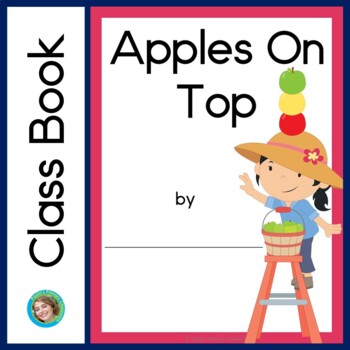
Another fun apple activity we've enjoyed many times over the years is making our Apples On Top classbook:
Apples On Top Most of the text for the book is already on the pages, the children add their name, and a numeral, draw themselves, and add apple stickers on top of their heads.  We read Ten Apples Up On Top, by Dr. Seuss to introduce this activity, and then bind the student pages together to create our own class book.
Learning about apples in preschool and kindergarten: fun activities, snacks, projects, graphs and more!
 One of the marvelous things about class books, is that the students have ownership of the books, and want to read and reread them.  Every time we do, we're reinforcing the repetitive text, making it easier for students to read it to themselves, to reread their names and numbers, and to count those apple stickers.  I LOVE how much mileage a simple activity like this can get!

Another high mileage activity I enjoy for our apples unit is our blind taste test.  (You can read more about it here).
Learning about apples in preschool and kindergarten: fun activities, snacks, projects, graphs and more!

Learning about apples in preschool and kindergarten: fun activities, snacks, projects, graphs and more!
Basically we graph which apples the children think they like best, taste 3 or 4 different ones, graph which one they actually like best after tasting, and compare the results.    Some years we write a class experience story about the process, and put the story and graphs in another class book.  We get science, math, writing a "how to", and reading from this one simple activity!

I also try to offer a sensory bin of some kind most weeks.  Unfortunately I don't have any good pictures of our apple sensory play, but you can see some ideas on my pumpkins and apples pinterest board.

I absolutely recommend you collect empty spice containers to add to your sensory play - cinnamon and cloves for apple play - because they add another sense to those you're engaging.  It seems silly (to an adult), but the children I've taught have loved smelling the spice containers, as well as pretending to season things with them.

For super easy sorting activities this week, try putting out red, yellow and green pompons (apples) and red, yellow and green containers for the children to sort them into.  You can make instant math centers with apple tree note pads (from a teacher supply store) with numbers written on them.  Students add the correct number of pompon "apples" to their trees.  You probably have several of your own favorite apple play ideas too!

I hope you and your kiddos get a chance to explore apples too - and that you'll leave a comment and let me know what your favorite apple activity is.  Thanks for stopping by!

P.S.  I didn't mention any apple themed children's books today, but you can read about 7 of my favorites here.


Saturday, August 8, 2015

Apple Books

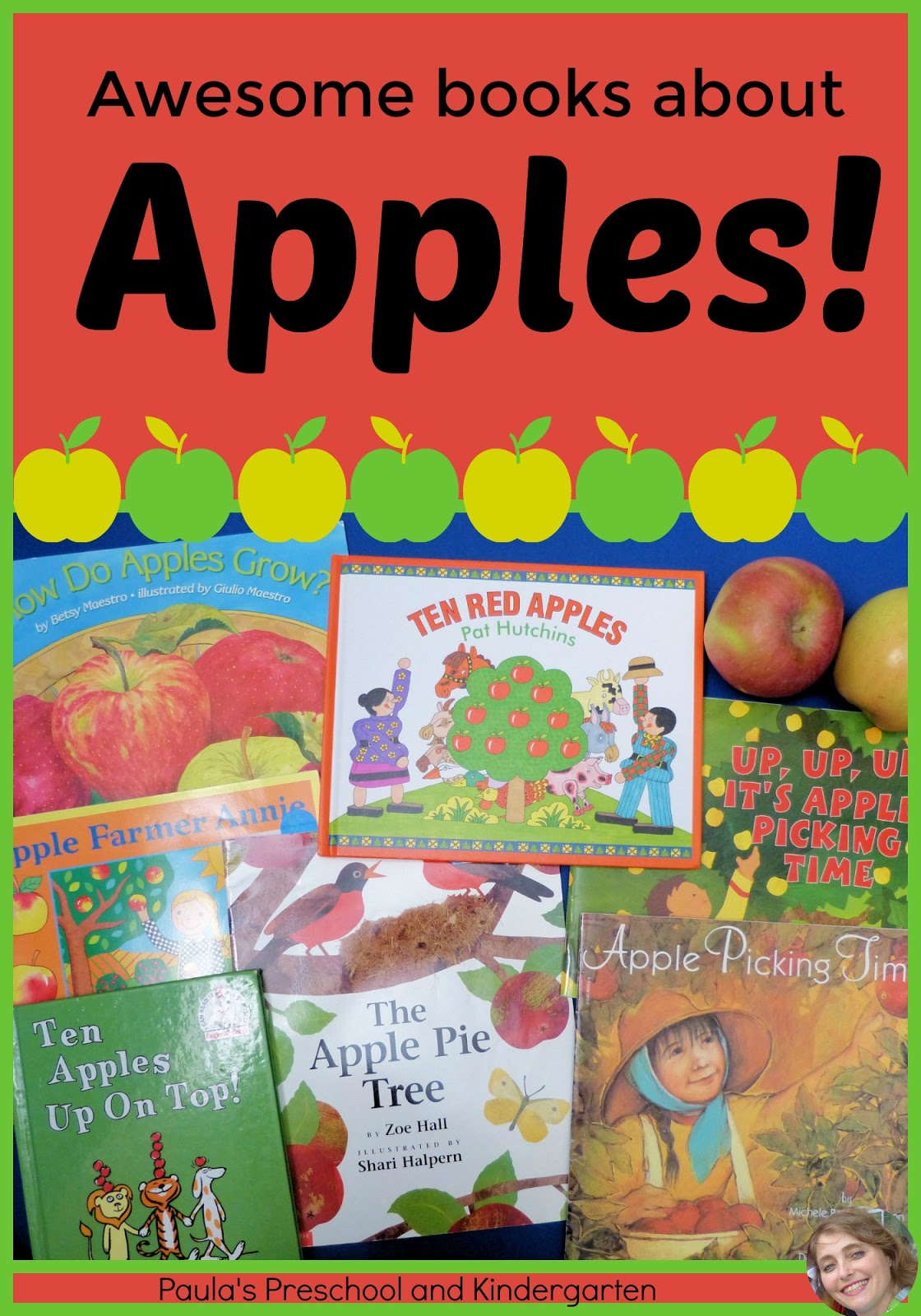
Awesome books about apples, from Paula's Preschool and Kindergarten

You know it's almost back to school time when your pinterest feed starts showing apples, lots and lots of apples!  Maybe it's because an apple for the teacher seems to represent school somehow, or that at the beginning of the year preschoolers are learning the beginning of the alphabet, and apples are a very real way to connect children with the short a sound.  It's getting towards fall, of course, so apple picking time really is coming up.  Whatever the reason, it seems to be apple time!
Awesome books about apples, from Paula's Preschool and Kindergarten

Today I want to review several apple themed books that I love.


Image result for the apple pie tree

The Apple Pie Tree by Zoe Hall, illustrated by Shari Halpern

Sheri Halpern's illustrations are incredible, from the apple blossoms on the front endpapers, to the bitten apples on the final endpapers.  Told from the point of view of a little girl, this book traces the life of an apple tree and the critters that live in it, from bare in winter, through blossoms, growth, and finally harvest of the apples.  On the final page of the book there is an explanation of how bees pollinate apple tree, and a recipe for apple pie.

This book does a wonderful job of including seasons, nature and science in a story that will engage youngsters.  If you can possibly visit an apple tree - or other fruit tree - throughout the year, this book will help guide you and your children in seeing the seasons of a fruit tree.  I hope you can follow up by baking a pie!


Image result for up up up it's apple picking time
Up, Up, Up! It's Apple-Picking Time by Jody Fickes Shapiro, illustrated by Kitty Harvill

Once again told from the point of view of a child, this book chronicles harvest time, and the work of picking and selling the apples the narrator's grandparents grow.  The end papers show more than 20 kinds of apples - a fun starting point to talk about all the different varieties that are available.

The apple picking in this book is very much a family venture, with 3 generations coming together over a weekend to pick and then sell their apples.  They eat and drink a variety of apple products during that time, which could easily prompt a discussion of all the ways we use apples, but my biggest take away from this book is the loving family atmosphere.  Bonus points for including a microwave apple recipe!


Image result for apple picking time
Apple Picking Time by Michele Benoit Slawson, illustrated by Deborah Kogan Ray

This book tells the story of a town coming together to pick apples, again talking about the heavy but satisfying work of fruit picking, this time as a community.  The narrator has grown since the last picking season, and is proud to fill a bin full of apples by herself for the first time.  Young children will relate to this girl, and the feeling of accomplishment that comes with each "first".  The muted fall tones of the illustrations are beautiful, matching the text.


 Image result for apple farmer annie
Apple Farmer Annie by Monica Wellington

Apple Farmer Annie is a one woman operation, unlike the other books I've mentioned so far.  Annie not only grows a large apple orchard, she also makes it into cider, applesauce, muffins, cakes and pies to sell.  This book is a great starting point to talk about apple products and farmers' markets, and would be lovely to inspire preschool pretend play.  Three apple recipes are included, inviting readers to join Annie in making and enjoying tasty applesauce, muffins and cake.


Image result for ten red apples
Ten Red Apples by Pat Hutchins

Ideal for the 3 - 6 year old crowd, Ten Red Apples counts down the apples on a tree, as various farm animals come by and each them.  Each page has a large numeral with the appropriate number of apples by it, as well as apples on the tree, and a refrain that children will quickly learn and join in on.  The disappointment of finding zero apples on the tree for the farmer's wife, is solved when he leads her to another tree full of apples.  A fun countdown book, this one was a fall favorite with my preschoolers.


Image result for ten apples up on top
Ten Apples Up On Top! by Dr. Seuss, illustrated by Roy McKie

I remember this one from my own childhood, as many of you probably do too, and it remains popular today.  Students love the one-up-man-ship of the three characters as they try to out balance each other, and Dr. Seuss' simple text and rhyming structure appeal as much today as ever.  I read this book for the fun of it, but there is definitely some counting fun to be had along the way.  There are many many ways to follow up this story, and you can find some of them on my Pumpkins and Apples Pinterest board.


Image result for how do apples grow
How Do Apples Grow? by Betsy Maestro, illustrated by Giulio Maestro

If you are looking to teach the science of apple growth, look no further than this book.  Gorgeous illustrations are coupled with an easy to read text that explains everything from leaf buds in winter, to ripe apples in the fall.  Illustrations include cut away views of a flower, and the progression from flower to tiny apple, along with orchard views, seamlessly blending facts into the story.  This book is too long for most preschool & kindergarten aged kiddos to sit through, but the information in the book is invaluable.  If you have access to an apple tree, you could definitely use this book for reference as you observe seasonal changes in the tree.

Next time I'll show you some of the fun apple activities I've enjoyed doing with my kiddos!