Welcome to Paula's Primary Classroom! This blog is where I share ideas for teaching and learning with families, friends and other early childhood educators. Please don't use the photos or text of this blog without permission, but please do use any ideas you find useful. Thank you for stopping by!
Showing posts with label Venn Diagrams. Show all posts

Monday, October 23, 2017

More easy steps for amazing STEAM learning

Recently I began a blog post series about STEAM learning (STEAM stands for Science, Technology, Engineering, Art and Math) by looking at some ways to practice observing and recording data - 2 of the most basic science skills.  Today I want to continue with sorting, classifying, and labeling.
More easy steps for amazing STEAM learning, from Paula's Preschool and Kindergarten

My students have always loved sorting / classifying.  Whether it's sorting building blocks by color, finding all the big buttons in my button box, or separating the mini erasers by shape, sorting seems to be a basic part of coming to understand their world.  Why not encourage it with fun materials, and add labels to those categories?!
https://www.teacherspayteachers.com/Product/Dinosaur-Math-Graphing-Sorting-and-Venn-Diagram-Math-Centers-1505643

https://www.teacherspayteachers.com/Product/Seasons-Sorting-2025351

https://www.teacherspayteachers.com/Product/Leaves-in-Fall-STEAM-investigations-2748942

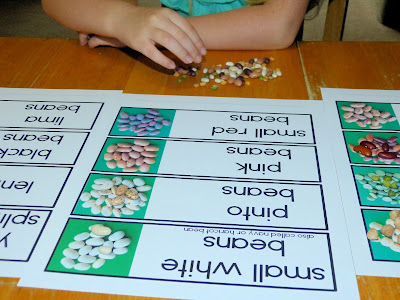
https://www.teacherspayteachers.com/Product/Beans-STEAM-Investigations-2979664

It's easy to take sorting a step further with Venn Diagrams - which make us consider more than one sort-able attribute at a time. Do you see the red t-rex in this picture?  It isn't green, and doesn't walk on 4 legs, so the child asked me where it should go.  I helped him think it through - can it go in the green circle?  No.  Can it go in the 4 legs circle?  No. Is there a place on your sorting mat that isn't for green and isn't for 4 legs?  Children can do some amazing thinking!
https://www.teacherspayteachers.com/Product/Dinosaur-Math-Graphing-Sorting-and-Venn-Diagram-Math-Centers-1505643

Once children have begun categorizing things - not just sorting them, but also identifying how they've sorted them, it's a natural progression to count those things, and to compare what has more or less.  Graphs make it easy to compare several categories. (More on graphs next time!)
https://www.teacherspayteachers.com/Product/Apple-STEAM-investigations-3320766

https://www.teacherspayteachers.com/Product/Dinosaur-Math-Graphing-Sorting-and-Venn-Diagram-Math-Centers-1505643

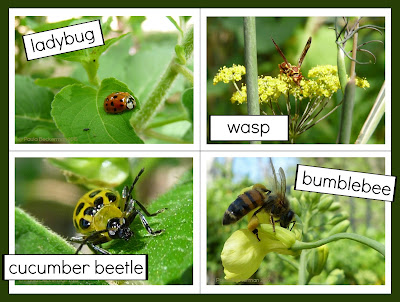
Children can also begin to label things they observe, from a single word for each item...
https://www.teacherspayteachers.com/Product/Insect-Photo-Sentence-Picture-Match-Reading-and-Science-Center-1646977
... to details as they develop vocabulary.
https://www.teacherspayteachers.com/Product/Spider-STEAM-investigations-3380944

Don't you love teaching STEAM skills?!


Saturday, October 22, 2016

Teaching Math on a Budget

Teaching Math on a budget, by Paula's Preschool and Kindergarten
 Okay, right off the bat, I know we're pretty much all on a budget - who isn't?!  If you are teaching young children, chances are good that you supply a lot of the materials you use in your classroom, and it can really add up!  Today I thought I'd share a few ideas that I've used to make my own teaching resources for little or no money!

Large graphs for children to work on:
Teaching Math on a budget, by Paula's Preschool and Kindergarten
Materials required: a large piece of cardboard, approximately the size of poster board, a yard stick and a marker.  (You absolutely could buy poster board, or if you shop at a warehouse store, try asking if you can have some of the huge pieces of cardboard they use on pallets of cereal to separate the layers.)
Time to make it: 10 minutes tops
What to do: I measured and marked 1.5" intervals along each edge of the cardboard, then used the yardstick to draw lines between the marks.  I wrote numbers on one axis, and ta-da! One large graph.

Venn Diagrams:
Teaching Math on a budget, by Paula's Preschool and Kindergarten
 Materials required: a large piece of cardboard, a large bowl or plate to trace around and a marker.
Time to make it: less than 5 minutes
What to do: Turn your bowl or plate face down, off center on your cardboard.  Trace the rim with the marker.  Move the plate over to the other side of your cardboard, leaving a large area of overlap from the first circle.  Trace it again.

Sorting trays:
Teaching Math on a budget, by Paula's Preschool and Kindergarten
Materials required: a divided tray, I got this one from a dollar store.  I've also used trays from fruit/vegetable/cookie platters, and those are free - you just have to remember to either save them yourself, or to ask your families to donate them if they use them.
What to do: nothing more!
Prep time: This depends on how long you browse at the dollar store!  ;-)

What about manipulatives: the small parts the children are working with.  We all know that those plastic dinosaurs and bugs aren't cheap. What can you do?

Save those lids, corks, bread ties, etc.  I keep a container in a cupboard in my kitchen, and every time there's a bread tie or a cork, I toss it directly in there.  Lids from food containers I put in the cutlery holder of my dishwasher first, and save them when they're clean.  You may also find some awesome lids in the bathroom or laundry room, just save them instead of tossing them out.
Teaching Math on a budget, by Paula's Preschool and Kindergarten
 Look in your junk drawer.  Okay, maybe you're perfect, and you don't have a junk drawer, but I'm guessing that somewhere in your home there's a catch-all spot full of amazing little things.  Parts to that one toy your kids had a few years ago, party favors they never even played with, assorted blocks, plastic bits and bobs, rings, craft supplies, tokens from that game place you never go to anymore...  Just be sure to consider the children who will be using these manipulatives, do you need to think about possible choking hazards?  Sharp edges?  Be selective about what will work for your students.
Teaching Math on a budget, by Paula's Preschool and Kindergarten
 You may also have (or know someone who has) a tin of buttons, or beads, or maybe an avid crafter with a lot of left over odds and ends.  Maybe there's a box in the garage with odd nuts and bolts, or old keys, or... go look!  Once you start thinking about and noticing things that are often considered throw aways, you'll find resources all over the place!

So how can you store all this stuff?  Plastic storage containers can be quite expensive, especially if you have a whole bunch of these collections going on!  Check your pantry and your recycling bin!  This is the container I keep in my kitchen to store those lids and corks - it originally had cashews in it, but when the food was eaten, the container got a new life, storing manipulatives.  Many foods come in resealable and reusable containers, everything from lunch meats to rice, fresh salad greens to soup.  If there's something in a useful container that your family uses regularly, you can save them and even end up with a matching set!
Teaching Math on a budget, by Paula's Preschool and Kindergarten
 Still not sure you can find a nice variety of things for your kiddos to sort?  Go outside!  Here are some leaves that are in my yard right now.  I see different colors, sizes and shapes.  How else are they the same?  How else are they different?
Teaching Math on a budget, by Paula's Preschool and Kindergarten
 Okay, so maybe you don't have time to go outside and collect leaves and things for your children to use.  Not to worry, put the kids to work!  Here I've used a strawberry punnet as a collecting box for acorns.  You can see we found some in different sizes, shapes and colors.  There are acorns with holes, broken ones, whole acorns, acorns with and without caps, some that are still connected to each other, and some that aren't... there are so many ways we could sort, graph or put these on a Venn Diagram!
Teaching Math on a budget, by Paula's Preschool and Kindergarten
I hope you can use some of these ideas in your classroom!  If you have another tip for teaching math on a budget, I'd love to hear it!


Friday, November 21, 2014

Thanksgiving or Christmas?

I could have titled this post "Out of the mouths of babes" again, because I'm going to start with a kid quote from one of my own children.

It was Christmas day, and the family was all gathered.  Presents were long since opened, and delicious smells were coming from the kitchen.  My barely 4 year old son asked me, "What are we eating for Christmas?"  I started listing the dishes, "Turkey, stuffing, green beans, potatoes... all the things we ate at Thanksgiving."  "Not leftovers AGAIN!" he moaned.

I think sometimes our youngest children have trouble remembering which holiday is which, and what symbols represent each one.  Pumpkins are a bit ambiguous, good for both Halloween and Thanksgiving, and a roast turkey dinner gets served up more than once at this time of year also.  Families gather for many holidays - so what exactly are the differences?

I've created a new activity for preschool and kindergarten kiddos, aimed at helping them figure all this out, and here it is :

Here's the finished Venn Diagram, with symbols sorted out by holiday.  I hope this helps the kiddos figure it all out! 
 

Want to add a literature component to this activity?  Try reading  Over and Over by Charlotte Zolotow.  It's a beautiful book about a young child experiencing the celebrations of a year, trying to sort them all out, just as my son did way back when.

What ever holidays you celebrate, I hope they are filled with family, love and joy!
                                                                                                                           - Paula