Welcome to Paula's Primary Classroom! This blog is where I share ideas for teaching and learning with families, friends and other early childhood educators. Please don't use the photos or text of this blog without permission, but please do use any ideas you find useful. Thank you for stopping by!
Showing posts with label patterns. Show all posts

Sunday, January 3, 2021

8 Outstanding Options for Over-the-top O Activities

What's so outstanding about letter Oo?  The variety of options for learning activities!  From oceans to outside time, baking oatmeal muffins to sorting ovals to lovely hand print art, there's so much to do!

Let's start with oceans and octopi... octopuses...the octopus.  You probably have some favorite ocean themed books - and of course so do I!

If you're wanting to learn octopus facts, I love Gentle Giant Octopus by Karen Wallace, and so do my students.  Just for fun?  Octopus's Garden, by Ringo Starr.  Bonus points, it includes a sing-a-long CD, so you and your littles can learn (or relearn) the song.  While you're at it, check out the gorgeous illustrations in Inky's Amazing Escape by Sy Montgomery and Over in the Ocean by Mariann Berkes.  

I haven't get read Manfish A Story of Jacques Cousteau by Jennifer Berne, but a study of the ocean is incomplete without learning about him, and again, the illustrations look awesome!

Many years ago I made an ocean tent to go over a card table - super easy to do - and my students have had a lot of use out of it!  I found a couple of panels of ocean fabric that measured the same size as my card table, and added some plain blue fabric for the other 2 sides.  I put a cord through the top hem, and tied it onto the card table.  It takes about 2 minutes to put up or take down, and folds quite small for storage. (I was inspired by tents from https://www.etsy.com/shop/missprettypretty ).  Just add ocean stuffed animals or other toys for some fantastic pretend play!

 Your littles might also enjoy working on patterns with ocean animals - here's a fun way to do that:

and early readers will enjoy this FREE reading center - click here to download it!


If you're in the mood to do some cooking with your little ones, AND you want them to eat healthy foods, try the oatmeal muffin recipe I wrote about here. Look at all the delicious ingredients: 

Remember to let your little ones help you cook - they're spending quality time with you, learning life skills, and if they help you cook something, they're more likely to try eating it.  Want more?  They're also developing fine motor skills, counting scoops, measuring ingredients and learning vocabulary - they are learning.

If you've been reading my blog for long, you know I also love to do hand print art with my kiddos, and letter O is no exception!  Here are 3 fun ideas: otter, owl and ostrich!  


The ostrich came from CreativityTakesFlight.com, the otter was uploaded to Pinterst without credit, and I'm not sure about the owl either.  As always, you can find more hand print and foot print art ideas on this Pinterest board:

Don't forget to add outside time to your letter Oo activities!  This is so open ended, you're sure to have some favorite outdoor ideas - or brainstorm with your children and try something new!


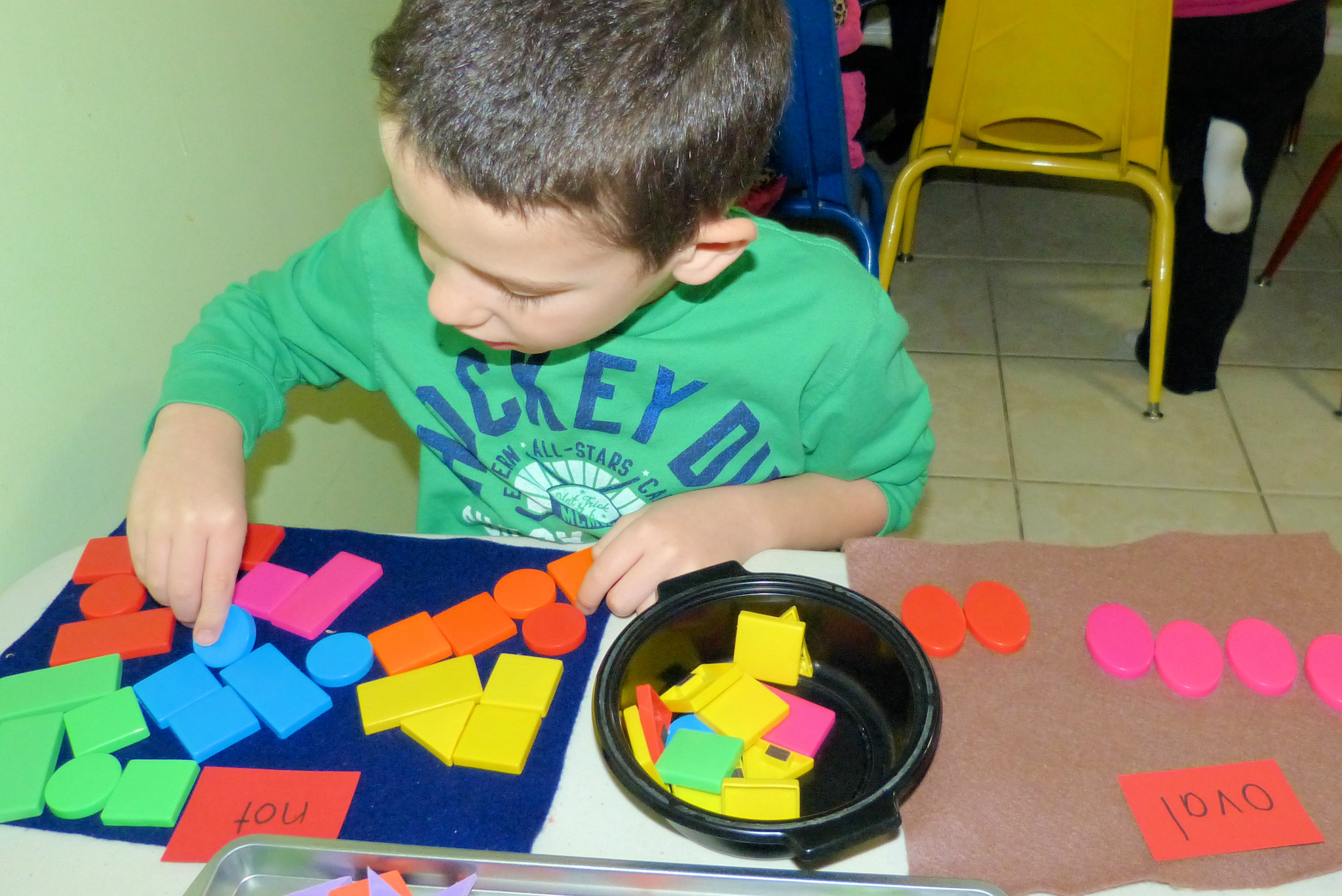
It's always a good time to revisit shapes and other math concepts; we broke out some magnetic shapes that include ovals.  As you can see they're fun for sorting, or making patterns, or simply look for ovals and other shapes in your environment. 

Finally, here are two great picture book characters for the letter O: the giant squid from I'm The Biggest Thing in the Ocean (by Kevin Sherry) and Olivia (from the series by Ian Falconer).  I came up with both of these crafts, which encourage lots of fine motor skills (cutting, gluing, even painting).  I hope you and your little ones enjoy them!
 

Click here for a quick tutorial on how to make the squid from  I'm the Biggest Thing in the Ocean, or get everything ready made for labeling, graphing, measurement AND this activity in my TeachersPayTeachers store.

Here are the shapes your child will need to cut out and assemble to create Olivia...

... we think she's pretty adorable!  

Have an over the top outstanding week of O activities, and come back next week for penguins, polar bears and positively perfect ideas for letter Pp!  See you then, Paula


Sunday, December 6, 2020

Letter S is Stunning in the Spotlight

 It's stunning, it's super, it's spectacular, it's...

...the letter Ss!  Timed just right for December and Santa, S is a smash hit every year!

It's all too obvious, but S for Santa really is a favorite.  With plenty of Christmas and Santa crafts and activities available, it's easy to find some that appeal to you and your students.  Many people schedule a visit with or to the jolly old elf, and we're no exception, but that's not your only option!

My big event to start our letter Ss week is to have the children dress up and pretend to be Santa.  I didn't go buy an expensive Santa costume - you can put one together pretty easily with just a little creativity!  For my costume I found a larger kids shirt and elastic waist pants at a resale store.  I sewed on some white fleece around the arms, bottom of the shirt and pant legs, added my own snow boots and black belt, a cheap Santa hat.... but what to do about a beard?  I found a piece of white fake fur, and just tucked it into the hat!  Ta-da!  Lots of little Santas!  Each child had a turn to put on the costume for a photo, which we put in our alphabet photo albums.  While we were taking turns putting on the costume we sang holiday songs - you could also add ringing bells in time with the music to keep little hands happily occupied while waiting for a turn.

We also make hand print Santas, which we print onto our large letter S craft.  You'll need red, white, and skin toned paint.  If you look at the Santa print in the picture above, you can see the center of the palm is Santas face, the fingers and around the edge of the hand is white for hair, and the thumb and face of the hand is his red hat.  It's easy, fun, and painting little hands is a lovely sensory experience and an opportunity to talk about the cool, slippery paint, the tickly sensation, and to introduce great vocabulary words about the experience!

You know I like to offer the children options for their hand prints - for one thing, not everyone celebrates Christmas and Santa, and another reason is that children so seldom have a say in things that having a choice helps them feel powerful - and more likely to cooperate when I can't give them choices.  

One of the other options is to paint snails - and this one isn't so easy to look at and understand, so I'll explain.  The brown part of our snails is made by painting the curved outer edge of our hands, from the tip of the pinky finger down to the fleshy part by our wrists.  We use a second color to paint the same area but with our hands fisted, and that sort of circular fist print makes the snail's shell.  When it's dry the children can use markers to add the swirl in the shell and stems for wiggle eyes.  (If you haven't taken a close look at a snail with your child, this is an excellent time to do so, so they know what they're trying to draw!)

Our other hand print option is to make a swan.  For this one we created the background first - blue for a pond, green for the plants surrounding it.  I like to offer the children tissue paper to add details - it's very inexpensive (I save it after gift giving occasions), and is fun and easy to tear.  Tearing is a great fine motor workout, so we're developing little fingers with a recycled material while encouraging artistic expression and learning our letters.... is that a win-win-win-win? Why yes it is!  Once our background is complete we make a white hand print for the swan's body and neck, then the children add a little more neck and a head.  As always, we add final details when the paint is dry.

To continue the Christmas theme learning, I created a Christmas patterning center.  With 4 AB, 4 ABC and 4 AAB / ABB patterns to continue, there's something just right for each child.  I seldom use worksheets with preschool children, but for those who do, and for slightly older children, I included 15 differentiated cut and paste activities. It's a fun way to bring some math to our seasonal learning!


If you do letter Ss in December, or at least during the winter, you may have another easily available, free, fun material on hand - SNOW!

Of course you're going to spend time outside in it, but there are also going to be inside times you want to make engaging, and painting on snow is a HUGE hit!  We simply filled pie pans with snow, then let the children use droppers to add water color paints to their tray of snow.  It's awesome to see how the color quickly leaches down through the snow, leaving a lightly colored area where the paint was.  This is a fun time to practice mixing colors - because your children are going to do it anyway!  If you offer primary colors (red, blue, yellow) someone will notice the combinations that result in secondary colors (purple, orange, green).  If not, you can act surprised to find green snow when you didn't offer green paint, and ask the child(ren) how they made it.  They'll figure it out and proudly tell you all about it!

Be prepared for this activity to last much longer than you think it will.  Also be prepared for large puddles of paint water - have old towels on hand ready for the inevitable cleanup.  The first time I offered this activity it lasted 2 hours, and older siblings who were arriving with parents at pick-up time joined in and stayed to play.  Thank goodness there's plenty more snow outside and you can easily refresh their snow over and over again!

If your little ones are super excited about snow, and want to know more, check out this snowy learning packet!

The non-fiction booklet explains how snow forms - at a level little ones can understand.  It's fun to graph their favorite snowy activities, and to measure with snowflakes.  Our favorite is probably using pattern blocks to create symmetrical snow like creations.  These are all easy ways to tie in science and math learning along with our letter study!

I haven't talked about our lowercase S at all yet!  S looks like a snake to me, so I like to read a book about a snake (my go-to is Keith Baker's Hide and Snake), then we make our own snakes.  The snake in the book we read has lovely patterns on it, so it's a natural step for the children to make patterns on their snakes too!  We do this with colorful foam shapes - and I have an important tip to make this go smoothly: have the child choose 2 or 3 shapes ahead of time, and find multiples pieces of each.  If they want small yellow triangles and big pink circles, they should find at least 5-8 of each BEFORE the glue comes out.  Put all the other shapes away out of sight.  It's so very hard to make a pattern when there are a kazillion brightly colored pretty shapes in front of you - who can choose?!  Trust me on this one, I did this craft with groups of children for about 15 years... and have learned from the children.  :-)  Once you have just the needed pieces in front of you, get out the glue, and help your little one say the pattern outloud, pausing expectantly at the end so they'll fill in the next shape: "Red, blue, red, blue, red...?"

As I said before, not everyone celebrates Christmas, and even if all of your students do, it's important to include other cultures and ways of doing things, because in our great big world there are many right ways of doing things!  December is the season for Bodhi Day, Hannukah, Kwanza, Omisoka (New Year's Eve), Boxing Day, winter soltice, Yalda and more!  Both Bodhi Day (December 8) and Hannukah (sunset December 10 - 18) will be celebrated this coming week.

To my friends who are celebrating - Happy Hannukah, and blessed Bodhi Day. 

Much love,

Paula


Tuesday, February 27, 2018

Insanely easy math fun that will make your children beg to learn!


 As I walked by the Target Dollar Spot this week, I spotted this little treasure!  200 mini erasers for $3 - and it's packaged in a divided container! 

This is a perfect math activity for our little ones to enjoy this spring.  Think of all the math they can learn as they play:  counting, sorting, graphing, patterning, 1-1 correspondence... there are so many possibilities.
I came up with a few more too - how could you use these for a Venn Diagram?  It's easy enough to make your own blank diagram - simply trace around a large bowl twice, overlapping the two circles as you do.  Can your child sort eggs/things with blue/eggs with blue?  How about bunnies/pink things/pink bunnies?

It would be easy to graph these too: have your child take a handful, and sort them.  Then line them up, and compare the rows of erasers.  What are there the most of?  The fewest?  How many more bunnies than carrots?

Have a slightly older child?  Can they add 3 bunnies and 6 eggs?  Two carrots with blue edges, and 4 carrots with yellow edges?  Can they use the erasers to answer a word problem: If I had 7 eggs, but gave 3 away, how many eggs would be left?

If your child has mastered addition and subtraction, try having them work on early multiplication skills by making a grid with the erasers.  How many is 3 rows of 5?  Can they show 12 erasers in rows and columns?  Can they do it another way?

I'm looking forward to sharing my new eraser collection with the kiddos!  How would you use it?!

Sunday, July 23, 2017

Are Sharks Scary or Cool? Download this free graph!

 Shark week, math, measurement, graphing, reading, resources, non-fiction
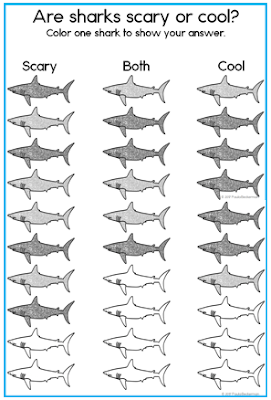
It's shark week - does that excite you, or freak you out a little?  Maybe some of both?  I was thinking about how our students might feel about sharks this week, so I put together a graph to find out.  (Click on the picture for my first freebie, then read on for another!) It's pretty simple, something you could use quickly at the beginning of a shark or ocean unit.  Of course, you could follow up by teaching your students about them, and then revisit the graph.  How many students do you suppose might feel differently after learning about sharks?
https://drive.google.com/file/d/0B3VE7_wMwNcfcWdSbmxBUXJXMWM/view?usp=sharing
Sharks really are scary - to me at least.  They're also incredibly cool and amazing - okay, I guess I have to repeat, to me at least.

Perhaps that's why I've been busy learning about sharks, and making fun resources to use when learning about them.  One of the things that stuck with me is the variety of sizes sharks can be, from dwarf lantern sharks that only grow to 9" long (not scary!) up to whale sharks at 45' long (also not scary, they eat plankton).  Of course, the great white, with all it's teeth, and growing to over 20' long is somewhat more intimidating! Sequencing them by size really gives a whole new understanding of shark sizes.
https://www.teacherspayteachers.com/Product/Shark-Math-for-First-Grade-measurement-graphing-addition-subtraction-2565521
Of course, we need to practice actually measuring things ourselves (not real sharks, thank you!).  This activity uses fish lengths as a non-standard unit of measure.
https://www.teacherspayteachers.com/Product/Shark-Math-for-First-Grade-measurement-graphing-addition-subtraction-2565521
For slightly older students, I wrote a non-fiction reproducible reader about sharks.  To make differentiating easy, there are two versions of the text.
https://www.teacherspayteachers.com/Product/Sharks-Guided-Reading-Books-3247361
For my younger kiddos, I made this patterning center.  I clipped the pattern strips onto ribbon, and the kiddos clip on additional pictures to either match...
https://www.teacherspayteachers.com/Product/Shark-Patterns-Math-Center-with-AB-ABC-AAB-ABB-Patterns-2569049

...or extend the patterns.
https://www.teacherspayteachers.com/Product/Shark-Patterns-Math-Center-with-AB-ABC-AAB-ABB-Patterns-2569049
We follow up with cut and paste versions.
https://www.teacherspayteachers.com/Product/Shark-Patterns-Math-Center-with-AB-ABC-AAB-ABB-Patterns-2569049

Finally, I want to share another freebie with you!  This is a very simple reading center, which I like to put in a pocket chart or on a table.  I hope you'll download it, and I'd so appreciate you leaving feedback after you do!
https://www.teacherspayteachers.com/Product/Sharks-Reading-Fun-Reading-Center-2607044

 I hope you have an exciting - but not too exciting - shark week!


Saturday, October 22, 2016

Teaching Math on a Budget

Teaching Math on a budget, by Paula's Preschool and Kindergarten
 Okay, right off the bat, I know we're pretty much all on a budget - who isn't?!  If you are teaching young children, chances are good that you supply a lot of the materials you use in your classroom, and it can really add up!  Today I thought I'd share a few ideas that I've used to make my own teaching resources for little or no money!

Large graphs for children to work on:
Teaching Math on a budget, by Paula's Preschool and Kindergarten
Materials required: a large piece of cardboard, approximately the size of poster board, a yard stick and a marker.  (You absolutely could buy poster board, or if you shop at a warehouse store, try asking if you can have some of the huge pieces of cardboard they use on pallets of cereal to separate the layers.)
Time to make it: 10 minutes tops
What to do: I measured and marked 1.5" intervals along each edge of the cardboard, then used the yardstick to draw lines between the marks.  I wrote numbers on one axis, and ta-da! One large graph.

Venn Diagrams:
Teaching Math on a budget, by Paula's Preschool and Kindergarten
 Materials required: a large piece of cardboard, a large bowl or plate to trace around and a marker.
Time to make it: less than 5 minutes
What to do: Turn your bowl or plate face down, off center on your cardboard.  Trace the rim with the marker.  Move the plate over to the other side of your cardboard, leaving a large area of overlap from the first circle.  Trace it again.

Sorting trays:
Teaching Math on a budget, by Paula's Preschool and Kindergarten
Materials required: a divided tray, I got this one from a dollar store.  I've also used trays from fruit/vegetable/cookie platters, and those are free - you just have to remember to either save them yourself, or to ask your families to donate them if they use them.
What to do: nothing more!
Prep time: This depends on how long you browse at the dollar store!  ;-)

What about manipulatives: the small parts the children are working with.  We all know that those plastic dinosaurs and bugs aren't cheap. What can you do?

Save those lids, corks, bread ties, etc.  I keep a container in a cupboard in my kitchen, and every time there's a bread tie or a cork, I toss it directly in there.  Lids from food containers I put in the cutlery holder of my dishwasher first, and save them when they're clean.  You may also find some awesome lids in the bathroom or laundry room, just save them instead of tossing them out.
Teaching Math on a budget, by Paula's Preschool and Kindergarten
 Look in your junk drawer.  Okay, maybe you're perfect, and you don't have a junk drawer, but I'm guessing that somewhere in your home there's a catch-all spot full of amazing little things.  Parts to that one toy your kids had a few years ago, party favors they never even played with, assorted blocks, plastic bits and bobs, rings, craft supplies, tokens from that game place you never go to anymore...  Just be sure to consider the children who will be using these manipulatives, do you need to think about possible choking hazards?  Sharp edges?  Be selective about what will work for your students.
Teaching Math on a budget, by Paula's Preschool and Kindergarten
 You may also have (or know someone who has) a tin of buttons, or beads, or maybe an avid crafter with a lot of left over odds and ends.  Maybe there's a box in the garage with odd nuts and bolts, or old keys, or... go look!  Once you start thinking about and noticing things that are often considered throw aways, you'll find resources all over the place!

So how can you store all this stuff?  Plastic storage containers can be quite expensive, especially if you have a whole bunch of these collections going on!  Check your pantry and your recycling bin!  This is the container I keep in my kitchen to store those lids and corks - it originally had cashews in it, but when the food was eaten, the container got a new life, storing manipulatives.  Many foods come in resealable and reusable containers, everything from lunch meats to rice, fresh salad greens to soup.  If there's something in a useful container that your family uses regularly, you can save them and even end up with a matching set!
Teaching Math on a budget, by Paula's Preschool and Kindergarten
 Still not sure you can find a nice variety of things for your kiddos to sort?  Go outside!  Here are some leaves that are in my yard right now.  I see different colors, sizes and shapes.  How else are they the same?  How else are they different?
Teaching Math on a budget, by Paula's Preschool and Kindergarten
 Okay, so maybe you don't have time to go outside and collect leaves and things for your children to use.  Not to worry, put the kids to work!  Here I've used a strawberry punnet as a collecting box for acorns.  You can see we found some in different sizes, shapes and colors.  There are acorns with holes, broken ones, whole acorns, acorns with and without caps, some that are still connected to each other, and some that aren't... there are so many ways we could sort, graph or put these on a Venn Diagram!
Teaching Math on a budget, by Paula's Preschool and Kindergarten
I hope you can use some of these ideas in your classroom!  If you have another tip for teaching math on a budget, I'd love to hear it!


Sunday, May 22, 2016

Dinosaur activities and books - roaring good fun!

Dinosaur activities and books - fun science, math, and of course literacy.  I love the Jurassic sand idea!
We love dinosaurs!  There's so much to love: they're big (mostly), make awesome noises (especially when voiced by small children), stomp through the prehistoric forests, chase each other, and generally get away with behavior that isn't often encouraged in children.  Who doesn't sometimes want to live vicariously as a dinosaur?!

For story time this week we read 3 lovely dinosaur fiction books: Harry and the Bucketful of Dinosaurs, Bones, Bones, Dinosaur Bones, and Saturday Night at the Dinosaur Stomp.  I talked about how much I love Saturday Night at the Dinosaur Stomp in my last blog post, and it is, in fact, the reason we focused on dinosaurs this week - I really wanted to read it again!  Then big question was what we could do along with the books.

If you Pinterest (I believe that really should be a verb, because I do it all the time), you know there are a gazillion fantastic and fun activities to go along with any subject.  Here's a link to my dinosaurs board for those of you who also use Pinterest as a verb. 

We sorted dinosaurs by color.  I made some very simple sorting mats by cutting brightly colored copy paper into quarters, and then mounting 4 of the resulting rectangles on white construction paper.  We had a supply of red, blue, green and yellow dinosaurs in one of our resource kits, so a simple sorting activity was born.
Dinosaur activities and books - fun science, math, and of course literacy.  I love the Jurassic sand idea!
 I say simple, because yes, it is simple.  Simple to prepare, and simple for the children to use, but still very satisfying for young learners!
Dinosaur activities and books - fun science, math, and of course literacy.  I love the Jurassic sand idea!

 I brought in a couple of fossils for the children to explore (carefully).  This child was fascinated with the small vug of crystals in my amonite.
Dinosaur activities and books - fun science, math, and of course literacy.  I love the Jurassic sand idea!

There was dough for the children to make imprints in, much like fossils, but without the millions of years of waiting. (Nobody has time for that!)
Dinosaur activities and books - fun science, math, and of course literacy.  I love the Jurassic sand idea!
Of course, what I have in mind as I put the activities together, and the possibilities the children see, are not always the same thing.  Dinosaur skeletons dancing in the dough?  Why not, after Saturday Night at the Dinosaur Stomp?!
Dinosaur activities and books - fun science, math, and of course literacy.  I love the Jurassic sand idea!

Here's another possibility I never considered.  Tyrannosaurus Rex balancing on his tail and doing the splits.  Bet you never thought of that either!
Dinosaur activities and books - fun science, math, and of course literacy.  I love the Jurassic sand idea!

Here's another early math concept we worked on this week: patterning.  I made AB, ABC, AAB and ABB dinosaur patterns, and the children (and parents) read the patterns, then extended them. 
Dinosaur activities and books - fun science, math, and of course literacy.  I love the Jurassic sand idea!

Our final activity was digging for dinosaur in the Jurassic sand.  There were usually 6 - 8 children gathered around this sensory bin, pretending, digging, or just running the sand through their fingers.  Little do they know they're working on their finger muscle strength, preparing their hands for all the jobs they will do!
Dinosaur activities and books - fun science, math, and of course literacy.  I love the Jurassic sand idea!

As the children left, we asked them to put one stamp on today's graph: Which book did you like best today?
Dinosaur activities and books - fun science, math, and of course literacy.  I love the Jurassic sand idea!
They loved Bones, Bones, Dinosaur Bones best of all.  After all, who doesn't like dinosaurs?!