Welcome to Paula's Primary Classroom! This blog is where I share ideas for teaching and learning with families, friends and other early childhood educators. Please don't use the photos or text of this blog without permission, but please do use any ideas you find useful. Thank you for stopping by!
Showing posts with label play. Show all posts

Monday, June 22, 2015

Dare to Dream

What do you remember about your earliest years of school?  Stop for a moment, close your eyes, and think, what do you remember?

I remember walking home from school with my friend Susan, and the jam sandwiches her Nana made us every day.  I still love jam sandwiches!  I remember Douglas A. singing along with the Winnie the Pooh song at school.  I remember the blocks, dress ups, boxes of junk for creating with, and lots of recess time.  I remember Mrs. Potts, my first and second grade teacher, reading The Very Hungry Caterpillar, and the pants and hat she wore.  I remember we had lots of windows, and a big carpet on the floor, and I remember the school library, and the books we took home to read.
All the things I remember about my early learning years are fun things.  School was a fun place to go, full of marvelous, child appropriate things to do and see.  We learned our letters and sounds by singing fun songs (my favorite was Rrrrrrrats are rrrrrrrunning, rrrr, rrr, rrr, because we were encouraged to roll the r, and it was fun!).  I learned to read with the Spot books by Eric Hill, and it was just a natural part of what we did.  I don't remember any flashcards or worksheets, although I do remember we had some mimeographs once in a while, and they smelled funny!  I loved everything about school, and knew even at 5 years old that I wanted to be a teacher.  (That was going to be my day job, until I could be a famous singer like Sally Boyden from the Johnny Young Talent Time show!)

When I graduated college I got my dream job, teaching first grade!
 What could be better?  I had ducks and fish and butterflies in my classroom (I do NOT recommend ducks by the way!), and we read and read, and I think we all had fun while we learned.  Sure, there were spelling tests, and timed math tests every week, and end of year tests, and May was always a whirlwind of end of year activities and deadlines and requirements, but I loved it.  Yes, over the six years I taught in the public school system we did add more requirements every year.  A few more forms, "the test" style questions for first graders - to prepare them for third grade testing, and yes, we did start using scripted math and language arts curriculum, but I could supplement them with my own ideas and activities.  It was still good, but, there was an edge to things, something that didn't feel right to me.
                                     
When my youngest was born, a couple of my teacher friends suggested I should stay home and teach my kids and theirs, and when I thought about it, I said yes.  The money and benefits didn't come close to comparing to a professional salary, but the value of being at home with my children, and of making their early childhood years amazing was well worth it. 
Friends told me stories of the continuing changes in the school system, and I was glad to be out.
I think the best thing about being at home with the children, was that I realized I could teach at home, and do it however I wanted.  I got to examine my core values and beliefs, and then live them.  We took long walks to the playground every day, collected dandelion flowers and stomped in puddles.

                                   Paula's Preschool and Kindergarten: Playing barefoot in puddles as part of our lead up to International Mud Day, basically getting comfortable with the idea of getting messy.
We watched the big trucks work on the road (from a safe distance), and started taking a lot of field trips.  We visited the museum and the zoo, the stock shows and the library, city parks and anywhere else that had child friendly venues where we could have real, hands on learning. 

My children learned to read, not with flashcards or worksheets, but with my friend Spot the dog, Eric Carle books, and marvelous books on tape, like The Dragons Are Singing Tonight by Jack Prelutsky.  I learned a tremendous amount about how children learn, and developed my program around that.  I'm pretty opinionated about early childhood, because I've spent the last 16 years deeply and passionately involved in it.

All of this is my backstory for this week's TpT seller's challenge:
                                      
When I saw this blog topic this morning, I thought, what?  Yes, I do dream big, but to say that I'd like to make a living doing TpT full time seems a bit... well... ordinary.

I'm very lucky right now to be able to TpT full time, and I really hope that I can build my business to the point that I feel justified with this as my only job, and that I can make a meaningful financial contribution to my family.  I'm living the dream, working toward that goal!

The thing is, not everyone is living the dream.  Many, many excellent and outstanding teachers are still working in our public school systems, doing the best that they can for their students, within the constraints that have continued to grow, sometimes to the point of choking out the fun.  My educator friends tell me they can no longer do many of the things that we know are best for children's learning: cook with them, do craft projects, read poetry, be kids!

My dream, what all my 22 years as an educator have prepared me for, is to make it easier for teachers and students to learn in playful, joyful, age appropriate ways.  I know time is short, and I'm so very sorry, I know the constraints are tight.  Finding fun learning activities that also meet the various standards, whether that's Common Core or state standards, is getting harder.  The joy of learning and of teaching is all too often being sucked right out of our schools, in the name of rigor and testing.  I hear of early childhood classroom where you can't find a toy kitchen, dress up bin, or sand and water table, but worksheets and flashcards are at hand.  I hear of elementary schools with little or no recess time, limited physical education and music time, and I wonder how our kiddos manage!

I've been so very blessed to spend the last 16 years playing on swings, digging in the garden, reading books aloud, and doing jigsaw puzzles with children, who have learned a love of nature, understanding of plant and animal life cycles, mathematical and logical skills, and to love reading and how to get along with each other.  Now I want to share that joy with as many teachers and children as possible, to help teachers put joy and playfulness back into their classrooms, without compromising learning goals or breaking the bank.  I want my teaching materials to help make teaching and learning a little easier, and a little more fun. I want to make a difference!


Thank you so much to Third in Hollywood, Teach Create Motivate, Sparkling in Second Grade, and Peppy Zesty Teacherista for hosting the TpT sellers challenge, and posing this thoughtful prompt!

Thursday, October 23, 2014

It's beginning to look a lot like... Halloween!

It has taken me a little longer than usual, but I have started our Halloween themed learning fun.
Awesome Halloween math and sensory learning ideas - see how this play based learning works!
Look carefully at the pictures - at first glance it looks like we're doing nothing but playing, but we've worked on sorting, matching, fine motor development, seriation and more.  See if you can spot the learning!
Awesome Halloween math and sensory learning ideas - see how this play based learning works!
 Our Halloween sensory bin has lots of small plastic goodies in it: rats, spiders, witches' fingers, rings, finger puppets, etc., plus some "test tubes," a pumpkin box, small trick or treat can, and a purple people eater.  Everyone needs a purple people eater!  The children like to pick through and collect items - note the rat collection at the bottom of the picture.  The rats are having a rat race - her words, not mine!  They sort, collect, negotiate for the desired pieces, and get a sensory play time all at once.  This was by far the most popular toy at school today, and was in constant use whenever I made it available.
Awesome Halloween math and sensory learning ideas - see how this play based learning works!
 I find it very interesting that the children all want containers to put things into, and love to see them working on their fine motor skills and pinch grip - very important muscle development that is a precursor to writing.  We need strong finger muscles to hold a pencil.
Awesome Halloween math and sensory learning ideas - see how this play based learning works!
 Our fall themed sensory bin was another very popular item today.  This child found 4 different sizes of scarecrow, and ordered them from biggest to smallest.  (That's ordering or seriating, an important math skill.)
Awesome Halloween math and sensory learning ideas - see how this play based learning works!
 These children sorted pumpkins and leaves into the dishes - including the various gourds that don't look like jack-o-lantern pumpkins - demonstrating that they did indeed learn about gourds on our field trip to Green's a couple of weeks ago.  No standardized test necessary, they're showing what they know!
Awesome Halloween math and sensory learning ideas - see how this play based learning works!
 Our jack-o-lantern felt board is mostly for fun - but also involves matching, shape recognition, and another fine motor work out.
Awesome Halloween math and sensory learning ideas - see how this play based learning works!
 Our math centers for this week are various mats I created to work with Halloween foam shapes - available all over the place at this time of year.  The colorful Halloween themed shapes engage the children - they saw them on the shelf while we were eating lunch, and asked what they were.  When I told them they were for math games, the kiddos actually cheered!  Yes, our math lessons are so exciting, that children cheer for them!
Awesome Halloween math and sensory learning ideas - see how this play based learning works!
 We sorted by size, shape, and color, and also matched and extended patterns.
Awesome Halloween math and sensory learning ideas - see how this play based learning works!

Awesome Halloween math and sensory learning ideas - see how this play based learning works!

Never underestimate the power of play - or the learning involved!

Awesome Halloween math and sensory learning ideas - see how this play based learning works!

Friday, August 22, 2014

More mathematical thinking with math games and manipulatives


Developing mathematical thinking through playful experiences
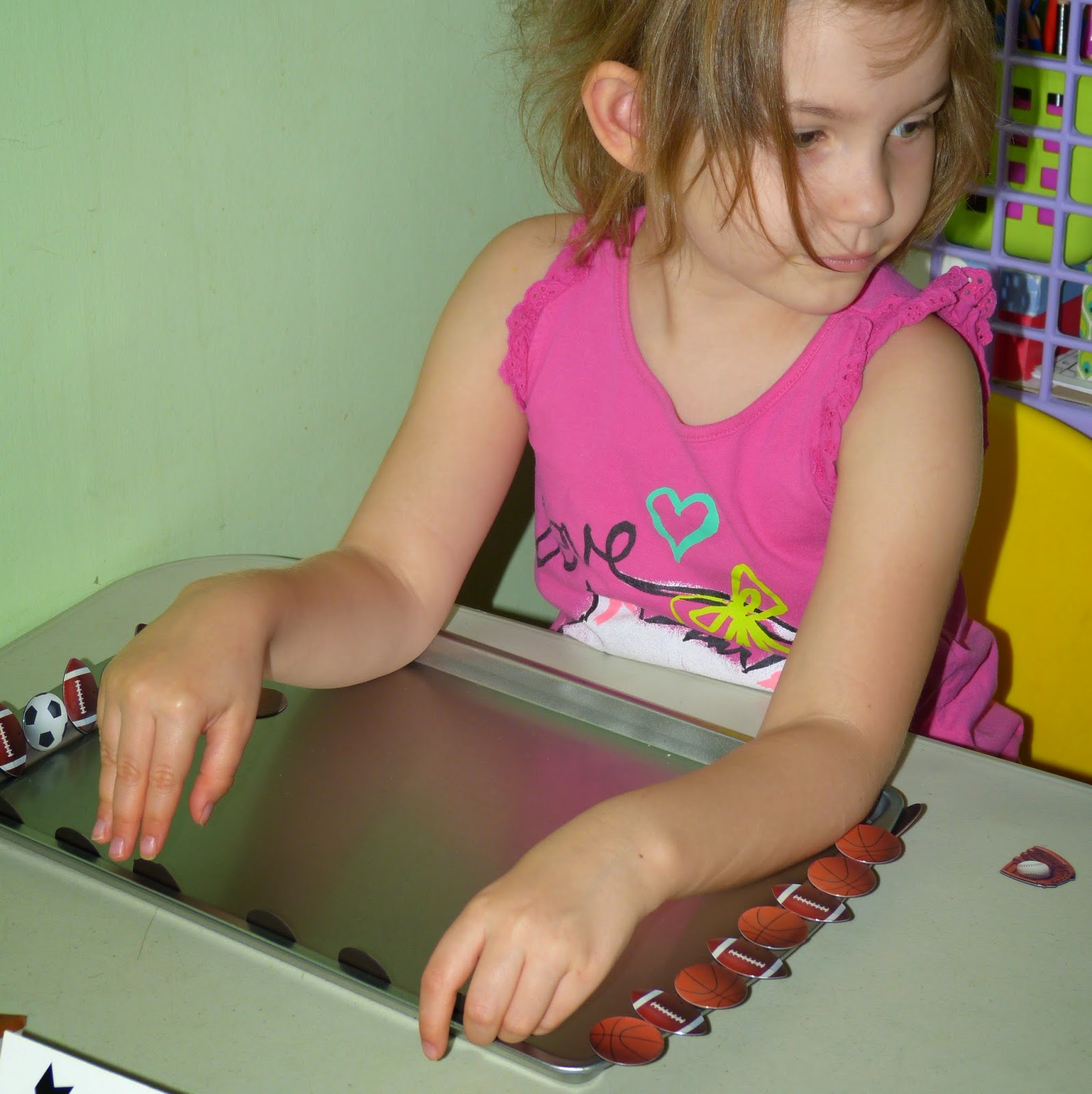
I like to do math games and manipulatives after lunch each day with the kiddos.  It's a great time for it - everyone finishes eating at different times, so after they bus their table and use the bathroom, they get to choose which of the available activities they want to use.  I have a variety, so each day is a little different, but there are always open ended materials that lend themselves to sorting, patterning, graphing and measuring.  It's interesting to watch how the children use the materials - as you can see, this child is observing another child's play!  Children learn from each other, as well as from the materials... oh yes, and the teachers.
Developing mathematical thinking through playful experiences
 The sports magnets shown here are almost always made into patterns around the edge of the pan - I don't know why, but apparently that is where they belong.

Pattern blocks are used in a variety of ways.  Sometimes the children will copy and extend patterns that I made...
Developing mathematical thinking through playful experiences
 ...other times they sort, stack, or pretend with them.
Developing mathematical thinking through playful experiences

 "This domino has zero spots on it," I was informed.  He's correct - and without needing to do any "standardized testing," I know he has that concept firmly in place.
Developing mathematical thinking through playful experiences

Cuissenaire blocks are another favorite.  I remember using these in Mrs. Potts' class in first grade..a long time ago!   I remember thinking of them as a "2 block" or a "7 block" - they come in 10 different lengths and colors, so orange blocks are as long as 10 white ones... but none of my preschool children has ever verbalized this without being guided to the concept.  Yet most children figure out to use them as stairs, showing an intuitive understanding of the different lengths.  When this child ran out of white "ones" blocks, she started using other colors to make her stairs - and later went back and replaced the stacks of white blocks to use all of the colors and lengths.  She's showing that she understands longer and shorter - and again, no test is necessary.
Developing mathematical thinking through playful experiences

 It's interesting to watch how children use materials that are intended for older children (or even adults).  They find ways to use things, and discover much about the materials in the process.  This puzzle can be solved many different ways, with all the blocks fitting neatly into the square frame - if you are persistent in solving it!  While they have yet to solve the puzzle in the way you or I might, the children have worked at matching angles and seeing how individual pieces can fit together.  I've also seen them create symmetrical creations, and when they use this they are always very engaged in whatever it is they are learning.
Developing mathematical thinking through playful experiences

Even very simple materials, like these sorting bears, can provide insights into what children are thinking and learning as they play.  These girls sorted their bears by size and style, and lined them up (to go where?)
Developing mathematical thinking through playful experiences
 Later one of the girls created a graph with them. I asked what had the most (blue) and the least (brown and black, because there are zero.)
Developing mathematical thinking through playful experiences
 Another child had all his bears lined up ready to go to Walmart.  (Back to school shopping?  Day after Thanksgiving sales?  That's a lot of bears lined up!)
Developing mathematical thinking through playful experiences

 These dinosaurs were gathering in "families".
Developing mathematical thinking through playful experiences

I thought it was interesting that this kiddo not only sorted the dinosaurs by color - but then made a pattern with the different kinds of pink dinosaurs.
Developing mathematical thinking through playful experiences

"These two are the same," this child informed me.  I asked her how, and she told me they're the same kind of dinosaur. 
Developing mathematical thinking through playful experiences

This child also told me that his dinosaurs were "the same," but his explanation was that they are both orange.
Developing mathematical thinking through playful experiences

These dinosaurs are also "the same."  When I asked, she was able to tell me that they are the same AND different - you can't tell from the photos, but there are actually two sets of dinosaurs mixed together, made of different kinds of plastic.  These are both yellow brachiosauruses, but they're slightly different colors, and one kind of plastic is more rigid than the other.
Developing mathematical thinking through playful experiences


 Oh yes, we are playing, but we are also learning a lot as we do.  In the words of the most wonderful Mr. Rodgers:
        "Play is often talked about as if it were a relief from serious learning.  But for children play is serious learning.  Play is really the work of childhood."

We are working hard!

Saturday, July 12, 2014

Let the children play!

I love to teach.  I love watching children grasp new concepts, and seeing them get excited about it.  It's so cool when those little light bulbs go off over their heads, and their eyes sparkle because they get it - whatever "it" is.  I think I'm pretty creative, and good at finding fun ways to make those moments happen.  My students know the joy of learning.

So why do we spend so much of our time playing?  Couldn't I spend a little more time teaching my 3 and 4 year olds how to read?  How to add and subtract?  How to write?  I could, and while I think those things are important, and I want to encourage the children to develop those skills, I also think there is a lot more to being a child.

Children need to have a say in what they do.  If you think about it, there is very little they are in charge of.  Adults usually decide what food children will eat, and when it is offered, what clothes they'll wear, when it's time for bed/cleanup/to go somewhere, etc. etc. etc.  Smart adults, people who get kids, know that when we allow children to have power over some decisions in their lives, they're happier, and better able to accept the times when adults really do have to have the final say.

Play provides children with the opportunity to lead, to choose what they want to do, and who to do it with.  They work on social skills as well as physical skills, and are most definitely learning!  In this week's blog, I'd like to offer some ideas and photographs about our outside play time.

Of course we need swings and slides and climbing things, and balls to kick or throw!


At this time of year we also need to find ways to stay cool while we play, so we have a lot of water play.  I watched these two children as they patiently collected the drips of water from my mister, and then threw it in the air.  Obviously they needed more water play, so I got out some tubes and containers, and added a couple of inches of water to the water table.

 Much inventing followed!  The children tried putting various parts together, and pouring water through the tubes.  Notice all the cooperative play going on, as well as the experimenting with how the loose parts can work.  These kiddos are being scientists - they're making hypothesis about how things will work, trying them out, and then modifying their creations based on what they discover.


 I added pvc pipes to the water play one day, when I realized the tubes would connect with some empty bottles I had.  (Yup, I'm a scientist too!)  The opening to pour water in is in the center upright - and the boys on the right put an upturned bottle on it (blocking it thoroughly), added an upturned funnel (why be conventional?!), then carefully poured water into the bottom of the funnel.  Obviously no water went into the tube, but they were fascinated with it spilling out, and kept this up for a long time.
 The other three children in the meantime were really wanting some water to get into the bottles I used to support the contraption.  Even with the center point open, water was not going sideways along the pipe and descending into the bottle.  Problem?  No!  They carefully poured water around the pipe and into the bottle. 
 There were five kiddos, at very different ages and stages, sharing the materials and negotiating how to make things happen - and that's some serious cooperation!

Of course, there is also a lot of cooperation involved in playing with the parachute!  The children have to spread out around the perimeter, and we all have to do our actions together to make it rise, fall, and for us to scoot under.
 Making "popcorn" with bouncy balls is the most fun!

We also love to play the musical instruments outside.  This is partly because too much loud noise makes me crazy (and if you've ever heard a group of preschoolers "playing music", you know why this is a problem), so I prefer to have this outside where the sound can dissipate easily.
 Sometimes we play cooperatively with instruments...
 ... sometimes we play alone.

Art activities are easily taken outside!  There's no need to worry about spilled paint or water when we're outside, and it provides a calm outlet for the children who are ready for some quiet time.


Block play also translates to the outdoors easily.  Can't afford fancy unit blocks?  Me neither.  These blocks are scraps of wood that I've rescued here and there, and store in a milk crate beneath the playground.  The odd shapes and sizes provide a building challenge - not a bad thing! - and lend themselves to all kinds of pretending.


 My son is interested in woodworking, and experimented with free form cutting recently - resulting in some very interesting shapes, which can be put back together like a crazy puzzle. (Think spacial reasoning skills.)

Are any of your kiddos "block heads"?  Mine are!  This is a favorite game.  We've also focused a lot on shapes this week, and the children noticed that these were like the cube heads we saw in an animated block video earlier in the week. 
 These boxes also make excellent "hot tubs"!  This group of boys loves to play the hot tub game, but it wasn't until this week that I understood what they're doing.  These guys are usually very active, so it always surprises me to see them chilling out in their hot tubs.  On Friday morning, as I watched and photographed, one boy sat in the box and complained to the others that he was stuck.  The other boys explained to him that he needed to put his elbows back, and push his hands down hard towards the back of the box, to lift himself out!  They aren't chilling and relaxing - they've found a way to strengthen their arm muscles.
 This was a new way to play... I think they're experimenting with stretching, pushing their bodies to the limit.

Sometimes the children need places to be alone, or with just one friend, places for quiet reflection....
 ...Sometimes they need lots of action and many friends to be with.

Our outside play time is special, and full to the brim with learning!  Is this time well spent?  I believe it is!