Welcome to Paula's Primary Classroom! This blog is where I share ideas for teaching and learning with families, friends and other early childhood educators. Please don't use the photos or text of this blog without permission, but please do use any ideas you find useful. Thank you for stopping by!

Wednesday, April 15, 2015

Ice Cream!

I'm not sure what got me thinking about ice cream today - really, does there need to be a reason?  Almost everyone likes ice cream, and when we like things, we're more inclined to learn about them.  Today I'm going to share some of the ways I've harnessed a love of ice cream to get kiddos learning.
My favorite easy ice cream recipe, and how I use making ice cream to teach young children. Delicious fun!

Disclaimer: Looking at pictures of ice cream may cause you to crave and or eat it.  I cannot be held responsible for my own ice cream eating, let alone yours! 

Every  summer we make ice cream with the children.  We read a recipe, gather ingredients, follow directions, and measure ingredients. (Keep reading for my favorite recipe!)
My favorite easy ice cream recipe, and how I use making ice cream to teach young children. Delicious fun!

 By the time the ice cream maker is done, the children are well and truly ready to taste it!  In the meantime, we graph which flavor we think we like the best, or if we think we will like a particular flavor.

My favorite easy ice cream recipe, and how I use making ice cream to teach young children. Delicious fun!
This is a great time to compare numbers: greater than, less than or equal.  Real life learning!

My favorite easy ice cream recipe, and how I use making ice cream to teach young children. Delicious fun!

My favorite easy ice cream recipe, and how I use making ice cream to teach young children. Delicious fun!

My favorite easy ice cream recipe, and how I use making ice cream to teach young children. Delicious fun!

My favorite easy ice cream recipe, and how I use making ice cream to teach young children. Delicious fun!
 Sometimes we eat it in cones, sometimes in a bowl.  We usually read one of our favorite ice cream books at story time or while we're eating too.
My favorite easy ice cream recipe, and how I use making ice cream to teach young children. Delicious fun!

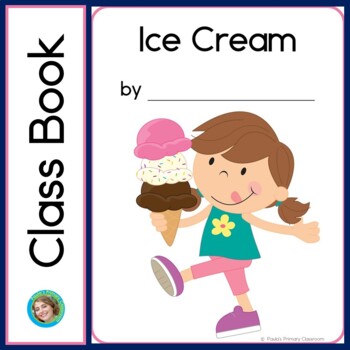
 Some years we've made a book about our ice cream experiences.  I've made a simple class book about it, which is available at  TeachersPayTeachers if you are interested.  
Ice Cream


Another fun way to extend the learning for young children is to have them cook up a batch of dough and pretend.  I grabbed bowls, cups, spoons, etc. from my toy kitchen, added dough and kiddos, and we made all kinds of delicious concoctions.  As they played and pretended, the children cooperated, worked their finger muscles (important for writing skills), spoke and listened to each other about what they were doing, and more.  Child's play is how kiddos learn, and as you can see, they were all very engaged with what they were doing.
My favorite easy ice cream recipe, and how I use making ice cream to teach young children. Delicious fun!
 When we work on our letter Ii, ice cream is a sure way to help them connect the long i sound with a concrete object. I especially like pictures of ice cream with a cherry on top - I tell the children it's like the dot on top of the letter i, which helps them remember too.

My favorite easy ice cream recipe, and how I use making ice cream to teach young children. Delicious fun!

Another fun way to get "hands on" is with ice cream puffy paint.  I found the idea on pinterest, from http://www.gettingmessywithmsjessi.com/search/label/ice%20cream.  It's just a mixture of shaving cream, white glue, and tempera paint.  The kiddos mix it up, then paint the ice cream on top of their cone.  When it dries, it is still textured, and feels beautifully soft and silky.  (We painted it with our hands too, for more sensory fun!)
My favorite easy ice cream recipe, and how I use making ice cream to teach young children. Delicious fun!

My favorite easy ice cream recipe, and how I use making ice cream to teach young children. Delicious fun!

Some years I like to do a taste test with the children, giving them several flavors to try.  Of course, we graph which we think we will like best, and then which one they actually prefer.  The children are often surprised to discover a new favorite!

My favorite easy ice cream recipe, and how I use making ice cream to teach young children. Delicious fun!

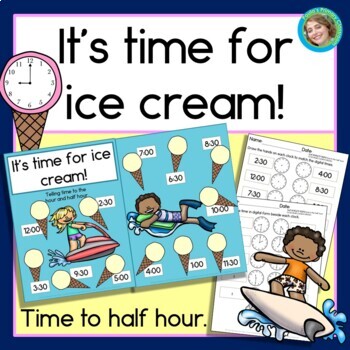
There are so many ways to engage our students in learning, and I have to admit, I'm not above using ice cream or other food to reach them.  Here's another ice cream themed game I've made, for students who are ready to learn to tell time.
Super fun folder games for telling time - with an ice cream and ocean theme!  My kiddos will LOVE this!


There are lots more brilliant ideas about engaging students with food, I've gathered some of them on my Food and Nutrition Pinterest board - I hope you'll check it out!

As promised, here's my favorite recipe!  It was hand written on the back of an envelope by one of my daycare mommies years ago, so I can't tell you who wrote it, but I can absolutely tell you we love it!

In your ice cream machine, put 2 or 3 cans of sweetened condensed milk, 1 or 2 cans of evaporated milk, 1 teaspoon of vanilla flavoring, fruit or chocolate chips as you prefer, and then top off to the fill line with milk.  Churn until done, then EAT!

I'd love to hear how you engage your students too.  In the meantime, I'm off to find some ice cream!

Friday, March 20, 2015

Calaveras Big Tree State Park, California

Until now, all my blog posts here have focused on teaching young children, on materials and ideas that have worked in my own classrooms, and that I hope may be useful to others.  Today I'm going to step outside of that zone, but with purpose.  I hope you'll come along with me.

Last week, during spring break, my family took a trip to Calaveras Big Tree State Park in California.


I've seen pictures of giant sequoias before, you probably have too.  Pictures showing groups of people all holding hands to reach around the base of a tree, pictures of cars driving through holes carved into their trunks, pictures of people dwarved by them.  I knew I wanted to see them, my family has wanted to see them for a while, so we jumped at the opportunity to go.  What I didn't know, was that all those pictures mean next to nothing until you stand at the base of a BIG tree.

We walked through the North Grove, a 1.5 mile path amongst 2000 year old sequoias.  There are both shorter and longer paths, camp sites, and much more to do at the park, and if you are interested you can click the link at the top of this page to the official web page for the park.

Early in our walk we came upon this tree stump, which was used as a dance floor way back when. 
 You get a much better perspective when you see a person near a section of the tree!  These trees were so large that there weren't saws long enough to cut through them, so they used plumbing augers to drill many many holes into the trunk instead.

During this early part of the walk I really was just taking in the sheer size of the trees, which, regardless of seeing pictures, I hadn't really understood.

These trees, Mother and Son, appear to have been pressed against each other, the parts of their trunks facing each other mirroring each other's shape.
Here's the view from between them.
 
It is amazing to me to think of these trees being 2000 years old;  they aren't the oldest trees on earth, or even the tallest, but they are certainly the biggest.  According to the website,
 "The largest redwood in Calaveras Big Trees State Park is the Louis Agassiz tree. It is located in the South Grove. This tree is "only" 250 feet tall, but it is over 25 feet in diameter six feet above the ground! The largest tree in the North Grove is probably the Empire State Tree, which is 18 feet in diameter six feet above the ground." 
 The largest Sierra Redwoods have a diameter of 30 feet, and measure 93 feet around!

If you are a teacher, try measuring out 93 feet of string, tying it into a loop, and laying it out on the ground.  How many children can you get in that space?  Oh, my, goodness!  Can you measure and lay out a string 300 feet long to represent the height of one of these trees?  Wow!

My family laughed at me, but I laid on the ground to take a picture looking up at these marvels of nature.  I got dusty, but the view was well worth it!

There is  a  hollow, fallen tree that you can walk through.  I'm 5'2" and could easily stand up, my 6' tall son had to stoop in some places.  This is the view up through a crack in the tree.  Look how thick the remaining wood is.

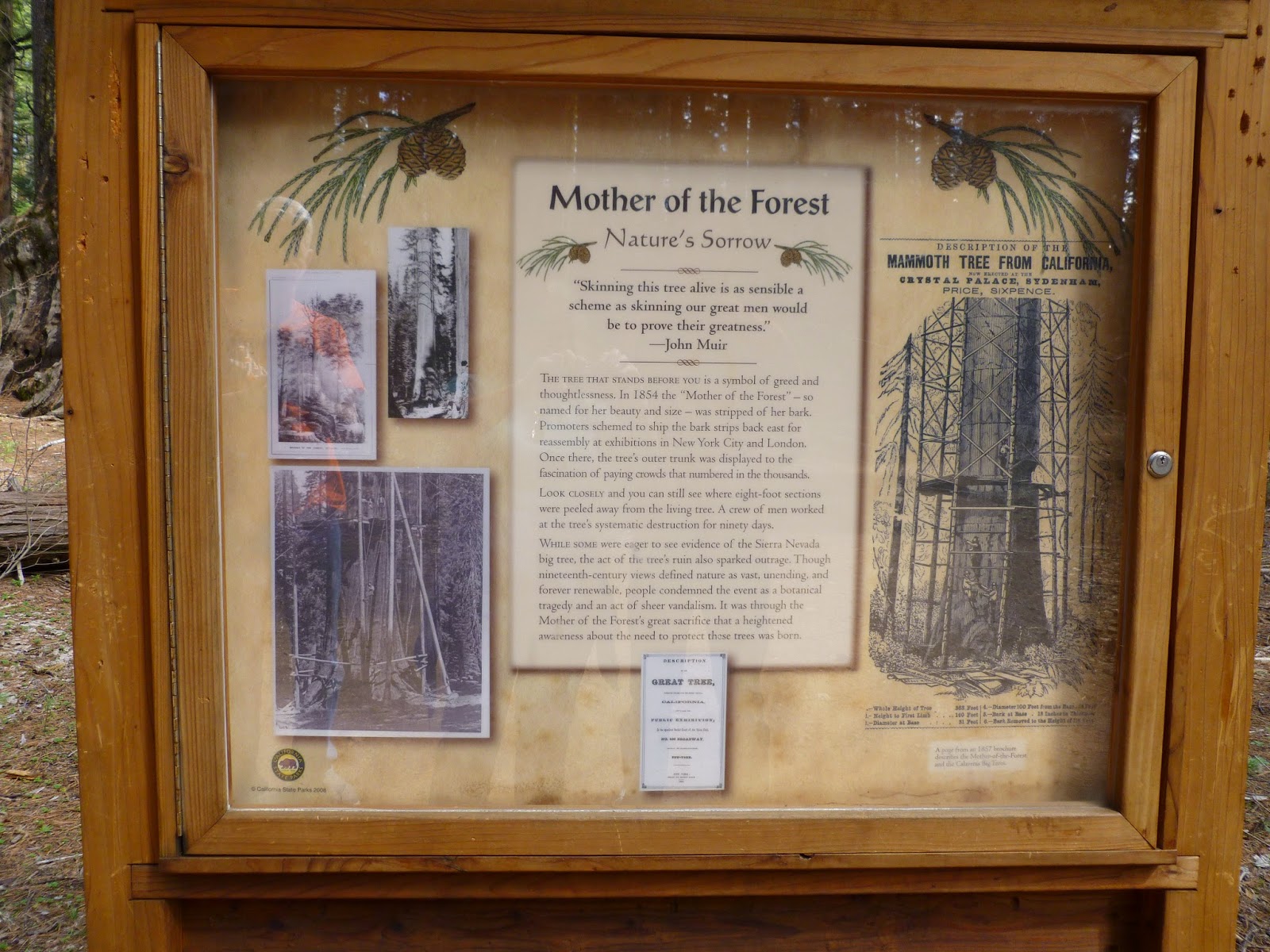
Just past half way along the trail we came upon The Mother of the Forest. 
She is dead, killed by human greed.
The price of viewing her reassembled bark was sixpence.  I keep finding myself making judgements about these circumstances, and then skirting around the very difficult environmental questions of our own times, and my own role in using resources.

 Does she remind you of Edvard Munch's "The Scream"? 

 Near her is another testament to human folly.  I have to admit, seeing pictures like the one below, I've briefly wondered if cutting the hole through it harmed the tree, but I've always let it go, to be amazed by the very clear size of the trees shown in pictures like this. 

 The answer is yes, cutting through trees like this does indeed harm them.  It's 140 years since this tree was  hollowed out, and there is only one small surviving branch. 

 Here's the remaining life in the tree, the little leafy part at the top left in this picture.
 Again, I wondered about my own role in all of this, as I stood at the base of this dying tree, taking pictures in the same place people have been taking pictures for 140 years, a photo opportunity that is killing the tree.  I understand why this is a national park, why people fought political battles to save the remaining trees, and why we still visit Mother of the Forest, and  The Pioneer Cabin Tree.  They are reminders to stop and think about our own roles in the world, a call to arms - or at least to composting, recycling and using resources more wisely.

What does this experience mean for me as a teacher and as a parent?  I have to admit, after a week thinking about it, I'm still not sure.  I don't know my own role in this, not clearly, and so how can I lead children to find theirs?  When it comes to reading and writing and math and how caterpillars grown and change into butterflies, all those "normal" things we teach our children, I know where I stand.  I'm comfortable dancing my part in the give and take of learning and teaching. It is a dance, a back and forth, leading and following, finding the way together.

And there the answer lies.   I'm sharing my experience with you, continuing the dance, learning and and teaching. 

We'll find the way together. 

Tuesday, March 3, 2015

Ever so much learning with class books

How do you learn best?  Do you like to hear information, or do you prefer to see it?  Do you need to be involved in doing something to really learn and remember?  Do you learn best when you are totally involved?

“Tell me and I forget, teach me and I may remember, involve me and I learn.”


I think most of us are familiar with this quote from Benjamin Franklin.  It has stood the test of time, and still rings true today.  So how do we involve children, so that they really do learn?

One of the ways I like to do this is to make class books.  There are so many possibilities!  Over the years I've helped my classes write class experience stories, telling about a field trip or a cooking activity, bringing an element of literacy to follow up other kinds of learning.  We've made books of graphs, class books that are innovations on popular children's literature, big books, little books, whole class books and books by individuals.  We've made them with sturdy cardboard covers, flimsy paper books, and books we published in a "real" bound book.

For the last several years I've helped each child make two books of their very own: a hand print alphabet book, and an abc activities book.  Children sit and read them frequently, looking back at their illustrations, commenting on their writing, reading their names, and remembering letters and sounds we worked on to make each page.  I love that the children look back at their work so often, reviewing their learning because they want to.  I plan to publish examples and directions, as well as printables, for those of you who also teach little people - follow my TeachersPayTeachers store to get updates when these and other new materials become available.

Children love to see themselves, their writing and their pictures.  That's what makes class books such fantastic learning tool - they love to look back and revisit their learning.  In our Baa Baa colorful sheep book, we have lots of repetitive text (which helps support early reading), a familiar nursery rhyme (they know the words, so pretend reading and other early reading strategies are supported), and pictures that help the children figure out the unknown parts (using picture clues is an important early reading strategy too!)  Do you see where the children added their own name in the middle of the song?  We practiced writing our names as we made the book, and when they revisit the book they read the names of their class mates.  Want to try this one out?  I have a freebie you can download.

Innovations on familiar stories also support children's early reading - with repetitive text, familiar stories, opportunities to write and read our names, and picture clues.  Add in the irresistible draw of seeing their own work in the books, and you have a recipe for reading and writing success.  Those of you who know me, or are regular readers (thank you!) know that I like to include hands on learning, math skills, cooking, and field trips whenever I can.  Below you can see the letter C shaped cookies that the children made from scratch, and plastic sorting cookie shapes we practiced math skills with, along with a class book we made. 

Those field trips and cooking activities are great learning tools all by themselves, but it is easy to add an element of writing and reading, with class experience stories.  The pictures below tell the story of making applesauce, so why not have the children dictate as a class how it was done, then publish it?


After we finish an activity, I sit with the children and ask them to tell me what we did.  Because they are so young, they usually tell what they liked the best first, or what was most memorable.  I write their thoughts down on a chart, modelling the writing process.  When we've got all the important ideas down on paper, we look at the chart together, and decide what order their sentences should be in.  When the children go outside to play, I'll type up their words, add photos taken during the activity, and print it off.  My favorite simple way to bind children's class books is to print on regular paper and slip the pages into a bradded folder, gluing on a cover to finish it off.  These books have been sturdy enough to survive a couple of years of classroom use, and if you buy lots of bradded folders during back to school sales, you pay only a few cents for them.  The return on that investment is hours of children reading, an absolute bargain!

Below is an even easier, cheaper version, made by simply stapling pages of children's writing together.  The 3 children who made this book chose it for story time several times too, because we let them read it to their friends, another powerful motivator and teaching tool!


You can also use songs to put together class books.  When we were learning the letter J, we also learned Jugo de Naranja in Spanish, singing along with it on youtube.com.  I transcribed the words to make a book so that the children could choose to review it during storytime (who doesn't love a book that also involves singing along?!).  As you can see, we added a small drink of orange juice to the mix to keep everyone fully engaged, and we practiced the book, song, and Spanish language learning at least once a week, because students chose it for story time.  Happy memories are worth revisiting, and adding a literacy element was simple and effective.

Class books aren't only for learning literacy skills either, you can practice all kinds of math skills with your class books.  Here's the beginning of a spring/farm themed counting book we made.  Again, I made a simple cover to glue to a bradded folder, and inserted the children's pages.  This book includes names, numerals, counting, and an art project, all in one simple to create book.  Did we reread it? You bet!


You can also make books of graphs or other math skills that your class practices. When we read the very popular Pigeon books by Mo Willems, I added a math element to our learning with some Pigeon themed graphs.  I put the completed graphs in a bradded folder, and the children read and reread that too, finding their names on the graphs and practicing graphing skills as they did so.

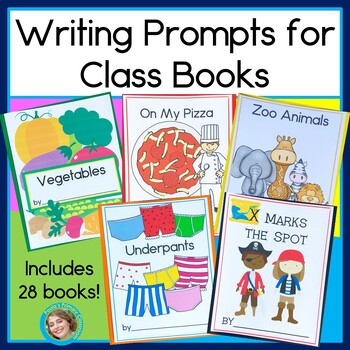
For those of you who want to include more class books in your school day, but just don't have time to make them, I have put together a collection of 28 class books, ready to print and go: click on the picture below to check it out.  For even more ideas, check out Class books.
Class Books for Every Letter of the Alphabet, Using every PP word

 This set has books that work well for each letter of the alphabet, and between them use every preprimer word, so you cover reading and writing skills all year long, with very little preparation.  The books are all available individually too, so you can pick and choose what's right for you, or get the whole set at a huge discount.

Making class books is a tried and true method of involving students in their learning, and like Benjamin Franklin's quote, it has stood the test of time.  I hope you found some new ideas about how to incorporate class books into your school year, and I'd love to hear new ideas too, so please share your ideas in the comments!

Happy teaching and learning!
Paula

Wednesday, February 11, 2015

Learning about insects

I don't know about where you live, but here in Texas, spring is just around the corner.  In the last 10 days our first daffodil has bloomed, and the trees are covered in leaf buds.  They aren't opening yet, but there is definitely a promise of spring in the garden.

Spring is best enjoyed outdoors, and it's a great time to learn about all the little critters that share our world with us. 

While some children are lucky enough to experience nature in a big way every day - I'm thinking farm or country life, or frequent nature walks - not everyone is. One kind of animal almost every child gets to see up close and personal is insects.  All those amazing things that creep, crawl, and all too often "bug" us!

I can't tell you how many times I've taken children to the zoo, only to have them all oo-ing and ah-ing over a beetle or a roly poly.  Sound familiar?  There's a couple of things that make all those little critters so appealing: they're tiny, and kids seem to love tiny things, they move, and that's pretty cool, and there are so many of them that you can almost always find one to check out!

Sometimes it's best not to touch.  I never could identify this particular caterpillar (if you know what it is, I'd love you to leave a comment!), but I try to have the children leave hairy, spiky caterpillars alone. 
I try to teach my kiddos to be safe, without being scared.  Bees are scary to a lot of children, whether because they've been stung, heard about stings, or because their family members are afraid.  Instead of teaching the children to fear them, I like to talk about how to be safe around them.  I teach the children that bees are attracted to bright colors - like flowers.  If our clothes are brightly colored, a bee may want to investigate us, even land on us.  But as soon as they realize we aren't sugary sweet like a flower, they'll fly off.

It's amazing to see the relief on children's faces when they realize that bees aren't out to get them!  We also talk about how a bee's stinger is part of her body, and that she dies if she stings something.  If we aren't a threat - batting at her or bothering her, then she most likely won't bother us either.

 If you have a garden area, even a small one, you probably get lots of insect visitors that you can observe.  Try giving children a pencil and a notepad and encouraging them to draw what they see. 

 Check out the aphids on our cabbage plants!  (Yes, it really is cabbage.  I let them go to flower, and then we watch the insects come, and we also like to nibble on the tasty cabbage flowers ourselves - although not if they're covered in aphids!)

It's no surprise to find ladybugs crawling on the cabbage, and we often find ladybug pupa too!

 We also learn about insects a lot of other places.  With books, of course, but also on field trips.  We saw "Critter Man" at one of our local libraries over the summer, and he had some SERIOUS insects to show us!
 This looks like a bee, but it isn't.  On a trip to the Botanic Gardens one of the children pointed out the "big bee" by the flowers.  I was able to snap a few shots, and upon closer inspection realized it was a moth.  Cool!

I've blogged before about seeing the butterfly exhibit at the Fort Worth Botanic Gardens, but I'll mention it again anyway.  If there is an opportunity for you to walk through a live butterfly exhibit, I hope you will - unless your children are scared of them.  Last year I took 3 different groups of children to the exhibit, and the first 2 groups LOVED it.  There were 2 kiddos in the last group who didn't like bugs getting too close to them, and it didn't matter that they were harmless and beautiful.  I should have prepared those kiddos better for our trip, or let them skip it.  20 years of teaching, and yes, there is definitely still more for me to learn!

 Can you see the butterfly on the left using its proboscis to suck up sweet juice from the fruit?  How cool is that?!


If you don't have a garden area, and you can't get to an exhibit, you might consider raising butterflies.  I've had a lot of luck with painted lady butterflies, which I've ordered from Insect Lore before.  There are other companies too, that's just the one I've used.  The first time I raised butterflies I had them in a cardboard box enclosure with plastic side windows.  Please, please, don't use that!  It wasn't big enough for the butterflies to fly in, so they'd launch from one side, crash into the windows, and unable to hold onto the slick plastic, slip to the floor.  They were able to climb up the corners, between plastic  sheets.  Sad!  After that I made a wire frame that fit inside a large plastic bin, and added a fine mesh cover.
 Our butterflies only stayed in it a few days before we released them, and it was a much better arrangement!

I've bragged about Bella's book club at the Botanical Research Institute of Texas before too.  Check out the fun insect learning activities we enjoyed at one of their story times.  If you are in or near Fort Worth, I highly recommend joining them!

Of course there are times when you need to take the learning inside, and if you are a teacher, there are times you need paper and pencil activities too.  


 If you are interested in insect themed arts and crafts, please check out my Insect board on Pinterest,

there are so many people with so many amazing ideas!

I've put many of my best insect photographs into a fun sentence-picture matching activity.  (It is $3.50 to buy from my TeachersPayTeachers store).
A complete literacy and/or science center, Insect Photo Sentence Picture Match comes with 12 close up photographs of common insects, and sentences to match. With a focus on commonly used nouns, preprimer and primer words, these simple factual sentences will teach your students about insects including butterfly, dragonfly, katydid, ladybug, praying mantis, wasp, beetles, ants and bumblebees.
I used a lot of preprimer and primer words, and designed the activity for student success.  I tried it out with a former student, and as you can see from the look on her face, she was ecstatic  to discover she could really read all the sentences.  If you're working on early reading, or you have a junior entomologist on your hands, I hope you'll check it out!

If you'd like to see all my insect themed resources, just click here!

Have an awesome spring!